
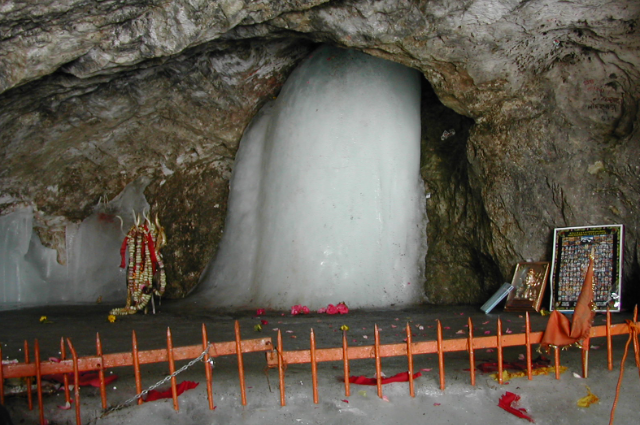
Amarnath Cave, known as Baba Barfani, drew the attention of all by almost disappearing in just five days into 57 days of yatra. News reporters, devotees and environmentalists are highly concerned about the early melting of the ice at the sacred Amarnath cave, a memorial shrine in the south Kashmir Himalayas. It is located 3900 metres above sea level, and due to this, ice naturally forms. Amarnath Cave is one of India's most revered Hindu pilgrimage destinations. According to Hindu tradition, Lord Shiva revealed the secret of immortality to Goddess Parvati inside this cave. Various factors are responsible for this change.
First of all, the growing number of pilgrimage weight the change, as the infrastructure has developed to accommodate the devotees. Resulting this, roads have been widened and the community kitchens, known as langers, have moved closer to the shrine.
Reportedly, by July 5, more than 20000 pilgrims offered prayers out of 32000 devotees, and visited the shrine on the second day.
Massive illegal sand and boulder mining occurs along the Lidder river, which flows next to the pilgrimage route. The limestone quarries here generate massive dust plumes that winds carry up to the higher Himalayan glaciers, darkening the Amarnath ice.
Furthermore, two months before the ice melt, police seized over a dozen vehicles that were involved in illegal mining in Ganderbal and Anantnag. This indicates that heavy extraction was active right up until the pilgrimage began; thus, the cool area turned into the summer heatwave. This activity spiked between 2020 and 2026, directly destroying the cooling microclimate needed to sustain the ice Shivling.
The Kashmir valley suffered abnormally high summer temperatures right before the pilgrimage began. Many experts argue that the ice Shivling is due to the Himalayan region warming up faster than other mountains. The pattern of snowfall is significantly influenced by the change in climate. Amarnath cave is sensitive to small changes in temperature and humidity. Warmer conditions can cause it to shrink much earlier.
Activists are sounding the alarm over the critical condition of the region's monumental shrines. People’s Democratic Party (PDF) leader Iltija Mufti blamed deforestation, illegal mining, poor waste management and falling water levels. People are finally raising awareness about the terrible condition these shrines are in.
“Climate change from mindlessly axing trees, illegal mining, waste mismanagement and dangerous depletion of water levels are major factors. Unfortunately, the environment has become a casualty in Kashmir’s politics," Iltija added. “For our mountains, rivers and glaciers to survive, we need a long-term sustainable environmental and tourism policy — much like Bhutan. Otherwise, Kashmir will cease to exist,” she said.
The authority has declared that the human-induced factors heavily impacted the heat generation, including artificial lighting, CCTV cameras, communication equipment, and other electronic installations; thermal radiation from continuous human presence; changes in temperature and humidity caused by platforms, flooring and railings, and alteration of natural airflow due to barricades, security infrastructure and temporary structures.
“The excavation, drilling, concreting, rock cutting, heavy machinery and vibration-generating activities could potentially disturb the fragile ecological balance around the cave shrine and therefore require immediate scientific evaluation,” it stated.
Push from the community is growing widely to get funds and protect these monuments. Rajan Gupta, President of the Shri Amarnath Barfani langars organisation (SABLO), confirmed that the association has submitted a formal memorandum to the Shri Amarnathji shrine board (SASB). The association's distress over the environmental factors accelerating the meltdown, noting that the "majority of pilgrims will now be deprived of the sacred darshans."
Authorities are called to immediately investigate the carrying capacity of the cave, suggesting that if climate shifts and continue unaddressed, the early melting of the deity's physical form will permanently alter the nature and timeline of the annual pilgrimage.
Pilgrims keep climbing anyway. “Baba has vanished, yet faith remains,” said Divyanshu Khanna, another devotee. “The divine presence of Baba can still be felt in every particle of that sacred place.”
Inside the cave, a pair of white pigeons attracts many pilgrims, despite the freezing temperature; they survive. Legend says that when Lord Shiva was telling Goddess Parvati the secret of eternal life, he thought they were completely alone, but these two birds overheard the story and became immortal. For everyday travellers, seeing two small birds alive. It makes the ancient stories feel enchanting, giving the pilgrims a sudden sense of peace.
The Amarnath ice Lingam is more than just a piece of ice. It is the heart of faith for millions of people worldwide. SABLO has urged the government to step in with scientific and environmental solutions. This will help make sure the pilgrimage stays safe, organised, and friendly to nature.
We must all work together to protect this sacred mountain cave. By travelling responsibly, protecting nature, and teaching others, we can keep the air cold enough for the ice Shivling to form every year. This will ensure that future generations can also experience this special symbol of faith.
References: