
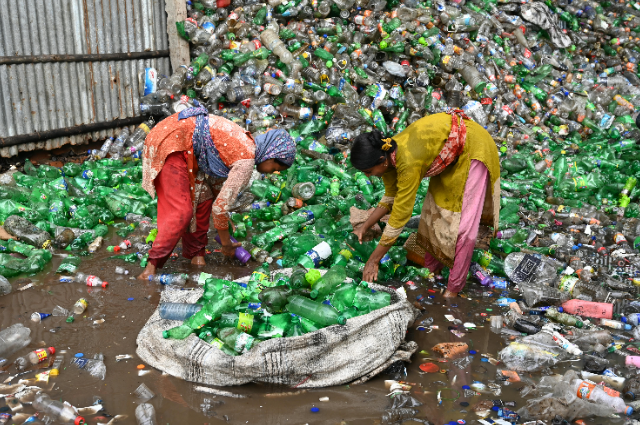
A cow stands by the edge of a village road, chewing slowly, not on grass, but on a crumpled plastic packet that once held shampoo. Nearby, a thin trail of smoke rises from a backyard where household waste is being burned, consisting of wrappers, sachets, and fragments of packaging that will never fully disappear. This is not an isolated scene. It is the new, normalised reality across thousands of villages in the Global South, where plastic has quietly embedded itself into the rhythms of rural life.
For generations, villages functioned as self-sustaining ecosystems. Consumption was local, materials were biodegradable, and waste was not an environmental threat but part of a regenerative cycle. Leaves wrapped food, clay stored water, and worn-out items returned to the soil as nutrients. Sustainability was not a conscious choice, it was structurally embedded in everyday life. Today, that system has been fundamentally disrupted…
The expansion of global supply chains and the aggressive penetration of fast-moving consumer goods (FMCG) companies have replaced this circular economy with a linear, plastic-dependent model of consumption. Products once bought in bulk are now sold in single-use sachets, designed for affordability but engineered for disposability. What appears to be a story of convenience and inclusion is, in reality, a story of systemic imbalance. Rural communities that were never designed to process synthetic waste have been turned into the final dumping grounds of a global packaging economy.
The plastic crisis in villages is often framed as a problem of poor waste management or lack of awareness. This interpretation is not only simplistic, it is misleading. The issue is structural. It lies in the collision between advanced industrial packaging and fragile rural infrastructure, between corporate profitability and ecological sustainability. What we are witnessing is not just pollution, but the slow erosion of a system that once embodied balance between human life and the natural world….
The Sachet Economy: When Affordability Becomes a Trap..
In a small village in West Bengal, a daily-wage worker stops at a roadside kirana shop and buys a ₹1 shampoo sachet before heading home. A similar scene unfolds thousands of miles away in a barangay in the Philippines, where a mother purchases a single-use packet of coffee from a sari-sari store because a full jar is beyond her daily budget. These transactions appear insignificantly small purchases made for convenience but they represent the front line of a much larger transformation in rural consumption.
This shift is the result of a deliberate strategy by global FMCG corporations to penetrate low-income markets through what is known as the sachet economy. By breaking products into tiny, affordable units, companies made branded goods accessible to populations with limited cash flow. However, this accessibility is misleading. On a per-unit basis, sachets are often more expensive, effectively placing a hidden financial burden on poorer consumers while simultaneously flooding rural areas with single-use plastic.
The real cost of this system lies in its material design. Most sachets are made of multi-layered plastic, combining different materials to preserve product quality in harsh climates. This makes them nearly impossible to recycle. Unlike traditional packaging, which could return to the soil, these packets accumulate in fields, drains, and waterways. What enters the village as a symbol of inclusion ultimately remains as permanent waste, turning everyday consumption into a long-term ecological burden.
Packaging Without Systems: The Rural Infrastructure Gap
On the outskirts of a village in Maharashtra, plastic wrappers gather along the edges of a dried canal, carried there by wind and rain. There are no dustbins, no collection trucks, and no recycling units, only an open stretch of land where waste quietly accumulates. A similar pattern can be seen in parts of sub-Saharan Africa, where rural households dispose of plastic in nearby fields or waterways simply because there is no formal system to handle it. The waste does not disappear; it only relocates.
This reflects a fundamental structural mismatch. Modern packaging is engineered using advanced materials designed for durability and resistance to heat, moisture, and time. Rural infrastructure, however, has not evolved alongside it. Waste management systems remain heavily urban-centric, leaving villages outside formal collection and recycling networks. Even when waste is generated in smaller quantities per household, the cumulative volume across millions of rural residents becomes unmanageable without institutional support.
In this context, the problem is often misrepresented as one of awareness or behavior. In reality, it is a failure of design at the systemic level. Villagers are consuming products that arrive with no exit pathway. Without infrastructure to collect, segregate, or process plastic, disposal becomes an individual burden with no viable solution. The result is a landscape where waste is not managed, but merely displaced into soil, water, and the everyday environment of rural life.
Burning Survival: When Disposal Becomes Toxic
At dusk in a village on the outskirts of Delhi, a small pile of household waste is set on fire behind a row of homes. The flames are weak, but the smoke is thick carrying the smell of burning plastic, food scraps, and synthetic wrappers. Children play nearby, occasionally coughing as the smoke drifts through the air. In rural parts of Kenya, similar scenes unfold daily, where open burning is not a choice but a routine necessity in the absence of waste collection systems.
This practice emerges from compulsion, not carelessness. With no formal disposal mechanisms in place, burning becomes the quickest and only accessible method to reduce accumulating waste. However, plastic does not burn cleanly. When exposed to fire, especially at low temperatures typical of open burning, it releases toxic chemicals such as dioxins, furans, and carbon monoxide. These substances are known to persist in the environment, settling on crops, contaminating water sources, and entering the food chain.
The consequences extend far beyond the immediate act. What appears to be a localized solution transforms into a widespread health hazard. Continuous exposure to these emissions contributes to respiratory problems, long-term illnesses, and environmental degradation that is difficult to reverse. In trying to eliminate visible waste, villages are inadvertently creating an invisible layer of toxicity, one that lingers in the air, the soil, and the bodies of those who live there.
Eating Plastic: Livestock as the First Casualties
On the streets of a village in Rajasthan, a cow rummages through a pile of mixed waste, pulling out food scraps wrapped in thin plastic. Unable to separate the edible from the inedible, it swallows both. Thousands of kilometers away in rural Bangladesh, veterinarians report similar cases, cattle brought in weak and undernourished, only for surgery to reveal kilograms of plastic lodged inside their stomachs. What looks like casual grazing is, in reality, a slow and fatal process.
Plastic, once ingested, does not break down inside the animal’s body. It accumulates in the rumen, forming dense, compact masses that interfere with digestion. Over time, this creates a false sense of fullness, reducing appetite and leading to chronic malnutrition. The animal gradually weakens, producing less milk, losing weight, and eventually dying not from disease, but from the inability to process what it has consumed.
For rural households, this is both an ecological and economic crisis. Livestock are central to village economies, providing daily income, agricultural support, and organic fertilizer. Their decline directly affects food security and financial stability. In this way, plastic waste does not remain an environmental issue alone, it translates into tangible losses for families who depend on these animals for survival.
Poisoned Land: Microplastics and the Slow Death of Soil
In a farming village in Punjab, a wheat farmer runs his hand through the soil before sowing the next crop. Mixed with the earth are tiny, almost invisible fragments remnants of plastic wrappers, fertilizer bags, and discarded packaging that have broken down over time. In parts of rural China, similar findings have alarmed researchers, where agricultural fields show rising concentrations of microplastics embedded deep within the soil. What cannot be easily seen is steadily becoming part of the land itself.
As plastic waste fragments under sunlight, heat, and physical pressure, it transforms into microplastics, particles small enough to integrate into soil systems. These particles alter the soil’s natural structure, reducing its porosity and its ability to retain water. They interfere with microbial activity, disrupt nutrient cycles, and affect the efficiency with which plants absorb essential elements like nitrogen. Over time, this leads to declining soil fertility and reduced agricultural productivity.
For farmers who depend entirely on the land, the implications are severe. Even a modest drop in yield can threaten household survival. Unlike visible waste, microplastics cannot simply be removed; they persist and accumulate, creating long-term damage that is difficult to reverse. The soil, once a source of renewal, is gradually turning into a repository of synthetic residue, undermining the very foundation of rural livelihoods.
Externalizing the Cost: Who Really Pays for Plastic?
In a village in Tamil Nadu, a sanitation worker sorts through heaps of mixed waste with bare hands, separating what little can be reused from what must be discarded. Most of what remains, thin wrappers, sachets, and multilayered packaging has no resale value and no recycling pathway. Meanwhile, in rural areas of the Philippines, community volunteers organize periodic clean-up drives, collecting sacks of plastic waste that ultimately end up in landfills or are burned. The products were consumed locally, but their lifecycle ends in systems that were never designed to handle them.
This imbalance reflects a broader economic dynamic: the externalization of cost. Corporations design packaging to minimize production and distribution expenses, often using materials that are lightweight, durable, and cheap but difficult or impossible to recycle. The responsibility for managing this waste is not retained by producers; instead, it is transferred downstream to local communities and under-resourced governments. The environmental and health costs are effectively shifted onto those with the least capacity to bear them.
As a result, rural populations are left managing the afterlife of products they did not design and cannot sustainably dispose of. What appears to be an efficient global supply chain is, in reality, incomplete, ending not at a recycling facility, but in open fields, waterways, and informal dumping grounds. The true price of plastic is not reflected at the point of purchase; it is paid over time through environmental degradation, economic loss, and public health risks borne by the most vulnerable…
Reclaiming Balance: Pathways Back to a Sustainable Village System..
In Ambikapur, a small city in Chhattisgarh, waste is no longer something that disappears into the background. Households segregate it, collection is systematic, and women’s self-help groups manage decentralized processing centers that convert waste into usable resources. Similarly, in parts of rural Indonesia and the Philippines, refill stations are re-emerging small shops where consumers can once again purchase essentials without single-use packaging. These are not isolated experiments; they are working models of how rural systems can adapt without abandoning sustainability.
The path forward lies in redesigning the system rather than placing the burden solely on individuals. At the policy level, stronger enforcement of Extended Producer Responsibility can compel companies to take back or recycle the packaging they introduce into the market. Corporations must move beyond token clean-up initiatives and invest in packaging innovation shifting toward recyclable or truly biodegradable materials, while also building reverse logistics systems that bring waste back from rural areas to processing centers.
Equally important is the revival of localized practices that once defined rural sustainability. Refill systems, community-led waste management, and the use of biodegradable materials can reduce dependence on single-use plastics. When combined with awareness and institutional support, these approaches can restore a balance between consumption and ecology. The goal is not to return to the past, but to integrate its logic into present systems ensuring that rural development does not come at the cost of environmental collapse.
Critical Analysis…
What emerges from this analysis is not a story of rural failure, but of systemic imposition. The plastic crisis in villages is rooted in a development model that prioritizes market expansion over ecological compatibility. Global supply chains have introduced materials that are technologically advanced but contextually inappropriate, creating a structural mismatch between production and disposal. The sachet economy, often framed as inclusive, operates by shifting both financial and environmental burdens onto those with the least capacity to manage them. What is presented as consumer choice is, in reality, a constrained decision shaped by affordability, access, and aggressive market penetration.
At the same time, the response to this crisis reveals a persistent gap in accountability. Policy frameworks remain urban-focused, corporate responsibility is weakly enforced, and rural systems are left to absorb the consequences through informal and often harmful practices. This reflects a broader pattern where environmental costs are externalized and rendered invisible in economic calculations. Any meaningful solution must therefore go beyond awareness campaigns and individual behavior, and instead confront the structural incentives that allow such a system to persist. Without that shift, interventions will remain fragmented, and the burden will continue to fall on communities that neither created the problem nor have the means to resolve it.
A cow still stands by the edge of a village road, but the scene no longer feels incidental. The plastic in its mouth is not an accident of carelessness but the residue of a system that delivers consumption without responsibility. The smoke rising from burning waste is not just a local act of disposal but the visible endpoint of a global chain that begins far beyond the village. What was once a self-sustaining cycle has been interrupted, replaced by a flow of materials that enter easily but never truly leave. The rhythms of rural life now carry an unfamiliar burden, where survival adapts to waste that does not belong.
If the village once reflected balance, it now reveals imbalance with equal clarity. The problem is not that villages have changed on their own, but that they have been made to absorb a model that ignores their limits. Restoring that balance will require more than managing waste at the edges; it demands rethinking how it is created at the source. Until that shift happens, the image remains unchanged, a quiet reminder that the smallest packet can carry the weight of a much larger failure, and that the places least responsible are still the ones paying the highest price…
References:
- https://www.carbonbright.co
- Food plastic packaging blog https://blog.sathguru.com
- Food plastic packaging as well https://www.mdpi.com
- FMCG PACKAGING https://www.aquapakpolymers.com
- Sachet economy https://www.evergreenlabs.org
- Micro plastic effects explained https://pmc.ncbi.nlm.nih.gov
- https://ijoear.com
- https://wikifarmer.com
- https://pmc.ncbi.nlm.nih.gov
- https://interreg-baltic.eu
- How india can achieve zero waste https://ic-ce.com
- The Ambikapur model blog
https://cgi.princeton.edu