
The greatest con of any social system is convincing its people that it's a divine order.
The very first essence of it traces back to the Brahmanical manifesto of Manusmriti, often called history’s most androcentric legal text. It was phenomenally crafted by a cunning cadre of hierophants consisting of Brahmin priests and legal scholars, passing off man-made law as cosmic decree. It has explicitly mandated that women must be under the continuous guardianship of male relatives throughout their lives, ensuring the preservation of the cradle-to-grave surveillance that stripped away their autonomy and freedom.
With hyper-modernisation, this dogmatism was supposed to be relegated to the pages of history only. Rather, the victims of the system, the women themselves, joined the crowd, passively participating in the perpetuation of patriarchy, accepting it as something normal.
Revisiting the opening quote, this is precisely why the con succeeds,s as everyone around us is compelled to achieve salvation through obeying the holy script.
However, India’s diversity doesn't let a unified orthodoxy be uniformly up-kept. In the forests of Chhattisgarh and the hills of Meghalaya, communities have long existed that challenged this uniform structure. Subject to scathing controversies, these two exceptional Indian tribes are the headliners with peculiar traditions that are yet to be described, traditions that complicated the idea of “mainstream” conventions.
The Muria and their socio-cultural institution of Ghotul
Occupying the Bastar region of Chhattisgarh, their “unique” take on identifying personal autonomy, gradual growth and educational enrichment is implemented through the social institution of Ghotul. Ghotul is a community-run space for unmarried adolescent and youth groups of mixed sexes. Rather than being an isolated institution, Ghotul is a centralised village-locality where houses are made of mud, bamboo and thatched roofs. As we have Dharma backed up by our religious deity Brahma, this very institution was held sacred as foundational roots trace back to deity Lingo Pen.
A group of pre-teens of 6-10 years old would run the institution free from external interference and parental control. The boys (Chelkas) are led by a chosen leader positioned as Sirdar, while the girls (Motiyaris) are led by a chosen leader positioned as Balosa. These leaders thereby assign duties and maintain the curriculum of the cohabitation and are collectively chosen through the active participation of both genders, which further denotes its democratic feature.
Ghotul therefore highlights the eminent way of life by providing “choices” to the young minds of choosing their own partners through selection and cohabitation. Interaction between the sexes is not treated as something that must be concealed or suppressed. Instead, it occurs within a framework of accepted norms overseen by the youth community and, indirectly, by the wider village. This has fascinated anthropologists for decades due to its distinctive character of initiating sexual autonomy as one of them; precisely, Verrier Elwin phrased this commune as “Youth Republic”. In his descriptive study of THE MURIA AND THEIR GHOTULS, he has emphasised the two varied systems of the Ghotul system.
As in the Jodidar System, the encouragement of enduring and exclusive courtships is appreciated while infidelity is penalised by the youth council. The monogamous attitude reflects their progressive vision. Similarly, the opposite was observed in Bolda Kiyana, where swapping companions was mandated. One cannot become exclusive with their desired partner as such notion was seen as individualistic and possessive, which contradicts the group’s philosophy of “residing in harmony”. It fractures feelings of jealousy through poly-fidelity rotation. The Murias generally practice cousin marriage, tying the knot late, dowry exempt union and have a remarkably low divorce rate.
Beyond the sensationalisation of dowry-exempt sex, it's worth putting forth that besides such modern practices, it upheld the value orientation and acts as a “school of life”. It teaches cooperation, mutual responsibility, emotional self-control, respect for communal obligations, and the values required for participation in village society. The behaviour of each participant is regulated through social control in the guise of customary rules, duties and accountability, so much so that they are disciplined even out of parental control. As an extension of modernity, another notable feature is their Anti-materialistic economy, where ostentation of personal wealth is prevented. Alongside, people having extra materials are redistributed evenly between all as monopoly of power and wealth cease to exist.
Having such features, the Muria Tribal Community and Ghotul Institution have become a modern utopia for Gen Zs. Yet, it must not be fully romanticised or dismissed as a relic of the past. While it offered youth an unusual degree of social interactions, communal harmony and sufficient freedom in the selection of partners, partially collective interests outweighed personal preferences either way or other. Evidence of absolute gender equality is contested, as role expectations like expecting cleaning and tender work from females and farm workwere associatedd with males. Premarital sexual unions were eyed with inappropriate behaviour by Victorian moral values. Besides, its sustainability is attacked by modernisation of formal schooling, urban migration, wage labour, religious conversion and state interventions.
Khasi Tribe - Not quite a Matriarchy
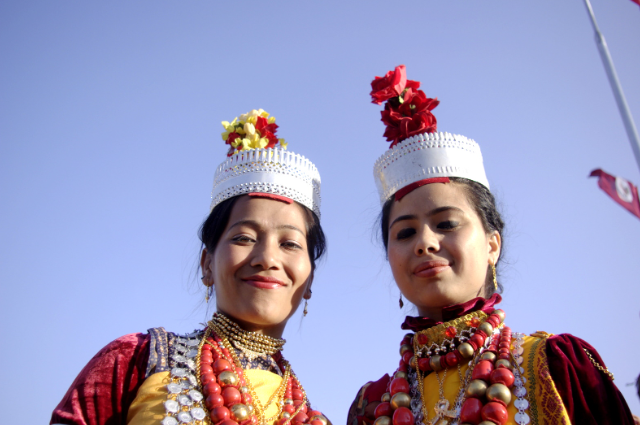
Nestled in the mist-covered hills of Meghalaya, lives one of the last surviving matrilineal systems in the world, named the Khasi Tribe. Linguistically and culturally distinct, they trace their mythological origins back to the Ki Hynniew Trep, translating to the seven hits. By the title of "Not Quite Of A Matriarchy,” it is established that the Khasi Tribe evolves upon Matrilineal conduct, where lineage, inheritance, and family identity pass through the female line while political authority and customary governance have traditionally remained concentrated in the hands of men.
Stepping aside from conventional customs of Namakaran, children born and brought up in the Khasi Community, carry their identity by taking their mother’s clan surname (Kur). Maternity continuity also forms the foundation of tribal kinship and social recognition of oneself.
The most significant character of the clan is pursued by Ka Khadduh, the youngest daughter. As custodian of ancestral property, she is meant to inherit the family's estate and assumes responsibility for preserving it for future usage. Her ownership is not absolute, with a caveat of certain conditional duties such as caring for ageing parents or elderly people of the household, maintaining ancestral traditions, and providing support to distressed siblings. Hence, she acts as a trustee rather than a sole proprietor. Another prominent feature is that traditionally, a Khasi husband leaves his natal home and resides with his wife's family, a practice known as matrilocal residence. The reverse pattern of this is observed in parts of South Asia where women relocate to their husband’s household after marriage. Besides the active participation of women of the Khasi Tribe, men are seemingly responsible for exercising considerable influence over clan affairs. For instance, U Kñi, known as Maternal Uncle bridges the gap between gender parity by performing the role of chief-mediator decision-maker in spiritual matters, clan affairs and legal disputes.
This very unique counterweight between female inheritance and male governance establishes the Khasi kinship framework as one of the most distinctive social structures globally.
For the Khasi, culture goes far deeper than just who inherits the family name;e, it is tied directly to the land they live on. Their original, ancestral faith, Niam Khasi, is built entirely on a deep respect for the natural world and a supreme creator. One can observe this clearly in their sacred forest groves, called Law Kyntang. These pockets of jungle have survived for centuries as incredible examples of local conservation, kept safe by strict tribal taboos that ban anyone from cutting trees or exploiting their resources. Even with the arrival of British missionaries and conversion of most of the populace to Christianity, they didn't forgo their old ways. The Khasi simply adapted, blending their new faith with their ancient matrilineal laws to keep their cultural identity sustained amid disparities.
Though portrayed as an ideal commune by new-age anthropologists and influencers, the Khasi Tribe has certain limitations to its practices. Women enjoy inheritance of lineage and property but have always retained neither political authority nor governance mandates, as those positions were firmly vested in male counterparts. Debates regarding objections of male demographic of the Khasi community introduce the deep-rooted matrilineal hypocrisy of not granting them sufficient ancestral property, an ambiguous father figure position with less rights and obligations, as well counting on insan ufficient recognition.
Perhaps the most striking aspect of both the Muria and Khasi communities is not that they achieved some perfect form of equality, but that they arrived at certain social arrangements long before modern India began debating them through legislation and constitutional discourse. While women across much of India had to wait for successive legal reforms, culminating in the Hindu Succession (Amendment) Act, 2005, to secure equal inheritance rights in ancestral property, Khasi society had already embedded female inheritance into its social structure centuries ago. Keeping in mind how this does not translate into complete female authority, nor is it free from criticism. Yet it remains difficult to ignore the irony that a right requiring statutory recognition in mainstream society existed as a customary norm in parts of Meghalaya.
A similar contradiction emerges in the Muria communities Ghotul practices. Contemporary Indian society continues to view live-in relationships' premarital intimacy with considerable suspicion, often treating them as symptoms of moral stigma despite increasing legal recognition. Yet among the Muria, unrestricted interaction between young men and women is looked upon as a part of social life. The Ghotul was not a modern dating culture disguised in tribal form, but challenged the assumption that strict segregation was the only traditional model available. This often mocks the culture of not yet pronouncedly adapting the choice of selection of partners in love marriage. Taken together, the Muria and Khasi reveal something far more significant than a simple story of women's empowerment, which is that they expose the myth that Indian society has always spoken in one voice on questions of family, inheritance, consent, and gender.
Ultimately, a question arises before us - So the taboos of contemporary Indian societies have long existed in civilisations that we label as “jungli”?
References:
- Brahmanical patriarchy explained - https://share.google/Tsz64yUuhNMkh4xEw
- Research paper https://share.google/NHaMAgfUmQ6mQO0Sx
- “Ghotul is in a village locality with houses made of mud, bamboo and thatched roofs”
- Anthropologists remarked on it as republican youth.
- Cult hero deity named “lingo pen”
- Hidden Treasures of India
- https://share.google/E7E5LugtH7IVOFC7q
- eHRAF World Cultures https://share.google/ikqsHLDGL8NfwY9v3
- IJCRT https://share.google/UNHVFZ9AYBsEJw53r
- Magik India https://share.google/pDhTcLny8JnPa25Qe
- Comprehensive research papers I've used.
- https://share.google/WM0l8uRQPDdOKC93A
- https://share.google/Hr6GwGE4owTt5NjIb
- BBC newsletter https://share.google/AykkvSfQcu2TRQD2L
- https://share.google/CS1o7d4Gh9VkDGeb9
- https://www.ijfmr.com/papers/2024/5/28765.pdf
- 9-Sweethe Khasiueen-JSAR.pdf https://share.google/a0UQXxq0FSusIOJCu
- https://share.google/9dOPC28hCbTox7K1q
- https://share.google/8KLOUHMSTyavr92I3