
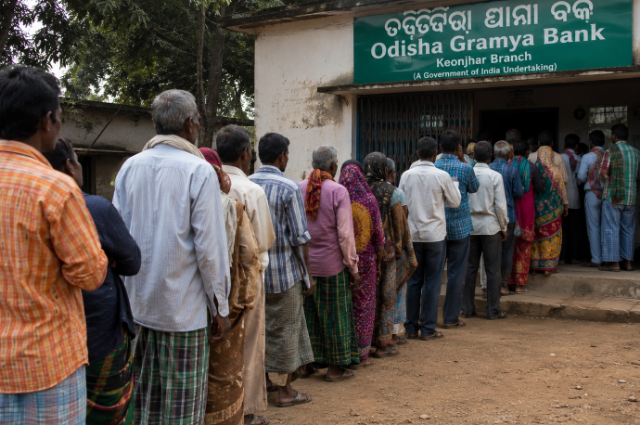
By the time the bank shutters rattled open that morning in a remote corner of Odisha’s Keonjhar district, a man was already waiting outside with mud on his hands, exhaustion etched into his face, and a quiet determination that unsettled anyone who looked too closely. Slung beside him was a bundle, tightly wrapped in cloth, carried with a care that didn’t match the murmurs beginning to rise around him.
He had made this trip before. Walked the same road, stood in the same queue, and asked for the same ₹19,400 that his sister had saved, rupee by rupee, before she died. And each time, he had been turned away, not with cruelty, not even with anger, but with something far more dangerous: instructions he did not understand.
“Bring the account holder.”
That morning, he did not argue. He did not plead. When the cloth slipped, and the truth revealed itself in fragments of bone, the crowd recoiled, the bank staff froze, and the distance between a rural villager and a formal system, usually invisible, became impossible to ignore.
This was not an act of shock. It was the final, literal answer of a man who had run out of ways to be understood.
The People Behind the Incident and What Led to It…
Jeetu Munda, a 50-year-old tribal man from a remote village in Keonjhar district of Odisha, lived a life shaped by isolation, limited access to formal systems, and an inability to read or navigate bureaucratic processes. His world was small, defined by daily survival rather than paperwork or procedures. His elder sister, Kalra Munda, had returned to her parental home after enduring deep personal loss, having lost both her husband and her only son. In the absence of an immediate family, she lived quietly and developed a habit of saving small amounts of money in a bank account at a nearby rural branch, building a modest sum of ₹19,400 over time. After her death on January 26, 2026, Jeetu became the natural claimant to her savings, not through formal nomination but through familial reality. When he approached the bank to withdraw the money, he was met with requirements that were standard within the system but unfamiliar to him.
Bank officials asked for a death certificate or official proof to process the claim, but this instruction did not translate meaningfully to someone who had never dealt with documentation. According to Jeetu’s account, he was told to bring the account holder, a phrase that he interpreted literally rather than procedurally. He returned multiple times, each visit ending in rejection without resolution, each attempt reinforcing his confusion and frustration. What appeared routine to the institution became an insurmountable barrier for him, and with no one to bridge that gap or explain the process in a way he could understand, the situation escalated from a simple transaction into a deeply tragic misunderstanding.
The Breaking Point…
After several failed visits, the process stopped being about money and turned into something heavier and more urgent for Jeetu. Each rejection reinforced the idea that he was missing a single requirement, something simple but essential that the bank would not move forward without. In his understanding, the instruction to bring the account holder was not symbolic or procedural. It was direct. Without literacy, without guidance, and without anyone to interpret the system for him, he reached a point where logic was replaced by literal action. The distance between what the bank meant and what he understood collapsed completely.
Driven by that belief, Jeetu went back to his village, exhumed his sister’s remains, and carried them to the bank. When he arrived, there was no confrontation at first, only a quiet insistence that he had done what was asked of him. As the cloth loosened and the reality became visible, shock spread among those present. What followed was immediate escalation, with panic, confusion, and eventually police intervention. For everyone else, it was an unthinkable act. For him, it was the final step in a process he believed he was required to complete…
The Bank’s Version.
The bank presented a sharply different account of the incident, framing it as a case of disruption rather than misunderstanding. According to officials from the Odisha Grameen Bank branch, Jeetu Munda arrived intoxicated and began creating a disturbance outside the premises. They stated that he placed the exhumed remains near the entrance and demanded immediate release of the funds, causing panic among customers and staff. The situation, they said, left them with no option but to call the police to restore order and ensure safety.
Bank authorities also denied ever instructing him to physically bring the account holder, maintaining that standard procedure had been clearly communicated. They emphasised that in cases where the account holder has died, claimants are required to submit a death certificate and relevant legal heir documentation before any withdrawal can be processed. From their perspective, the incident was not a failure of procedure but a breakdown in awareness and understanding, one that escalated beyond their control once the situation turned volatile.
State Intervention and Immediate Resolution.
The incident quickly moved beyond a local disturbance and drew the attention of higher authorities once its details became widely known. The Chief Minister of Odisha intervened directly, prompting swift action from the district administration in Keonjhar district. Officials reached Jeetu Munda’s village the same day, recognising that what had unfolded was not an isolated act but a reflection of a deeper administrative gap.
The local Tahsildar coordinated with the bank and other departments to fast-track the required documentation that had earlier acted as a barrier. The death certificate and legal heir certificate were issued on the spot, removing the procedural obstacles that had stalled the process. With formalities completed, the bank released the full amount of ₹19,402, including interest, to Jeetu the very next day, demonstrating how quickly the system could respond once it was actively engaged.
Compensation and Relief.
In the immediate aftermath, efforts were made to provide not just administrative resolution but also some degree of material support to the family. After the required documents were issued and verified, Jeetu Munda received the full amount from his sister’s account, totalling ₹19,402, including accrued interest. What had taken multiple failed attempts and an extreme act to surface was resolved within a single day once authorities intervened, highlighting the stark contrast between procedural delay and administrative urgency.
Beyond the bank settlement, the Indian Red Cross Society extended financial assistance of ₹20,000 to support funeral-related expenses. This gesture acknowledged the distressing circumstances under which the incident unfolded, though it also underscored a deeper reality that such support arrived only after the situation had escalated beyond control…
Systemic Failure and the Real Issue…
What unfolded in this case cannot be reduced to an isolated misunderstanding or an individual lapse in judgment. It exposes a structural failure at the intersection of rural banking, administrative outreach, and social inequality. For institutions, procedures like submitting a death certificate or legal heir proof are routine safeguards. For someone like Jeetu Munda, these requirements exist in a completely different reality, one where documentation is neither easily accessible nor clearly explained. The system assumes a baseline level of literacy and awareness that simply does not exist in many remote tribal regions, creating an invisible barrier that excludes the very people it is meant to serve.
Equally critical is the failure of communication. Even if the bank did not literally ask him to bring the account holder, the fact that such an interpretation was possible points to a breakdown in how information was conveyed. There was no effort to translate the procedure into understanding, no intermediary to bridge the gap, and no proactive support despite repeated visits. This is not about bending rules but about recognising context. When institutions operate without sensitivity to ground realities, compliance turns into confusion, and confusion, in extreme cases like this, leads to actions that seem irrational only from the outside…
What unfolded in this case goes beyond an isolated misunderstanding and points to a deeper structural failure within rural banking and administrative systems. Procedures such as submitting a death certificate or legal heir documentation are standard safeguards, but they assume a level of literacy and institutional familiarity that does not exist for many people living in remote tribal regions. For Jeetu Munda, these were not simple formalities but inaccessible requirements, never translated into terms he could understand. The communication gap played a decisive role. Even if no one explicitly instructed him to bring the account holder, the fact that he interpreted it that way reveals how poorly procedures were explained. There was no meaningful guidance, no local support system, and no attempt to bridge the divide despite his repeated visits. What appears to be compliance within the system became confusion outside it.
The incident also reflects a wider pattern of exclusion that continues to shape rural India, where access to banking and administrative services exists in theory but remains uneven in practice. Tribal communities, in particular, often remain on the margins of institutional outreach, navigating systems that were not designed with their realities in mind. The speed with which authorities resolved the issue after intervention shows that the system is capable of efficiency, but only when attention is forced upon it. This raises uncomfortable questions about accountability and responsibility. If resolution was always possible, why did it require such an extreme act to trigger it? The story ultimately exposes the gap between policy and lived experience, where the absence of proactive governance turns routine processes into barriers and leaves vulnerable individuals to navigate systems they were never equipped to understand…
By the end of it, the money was released, the documents were issued, and the system, at least on paper, had done its job. The same process that had seemed unreachable to Jeetu Munda was completed within hours once attention shifted and authority intervened. On record, the case was resolved. But resolution, in this instance, feels incomplete, almost procedural in itself, because it arrived only after the damage had already been done.
That morning outside the bank does not fade as an isolated image. It lingers as a mirror to the very gap it exposed. A man followed instructions as he understood them and carried that understanding to its most literal and devastating conclusion. The bundle he brought was not just proof of death. It was proof of distance, between policy and people, between systems and those expected to navigate them without guidance. In the end, nothing about his actions was sudden. They were built, step by step, from every unanswered question, every failed attempt, every instruction that was never truly explained. And that is what makes it unsettling. Not what he did, but how it became inevitable.
REFERENCES..
Case details :
- The Guardian Post http://www.theguardian.com
- New York Post. https://nypost.com
- news.com.au https://www.news.com.au
- Times of India