
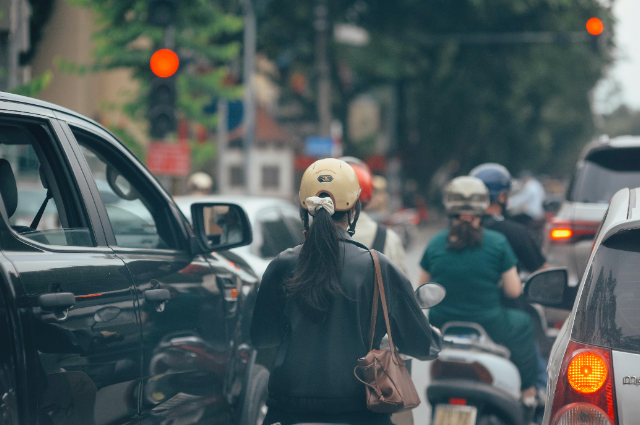
Mumbai is a city that survives on motion, restless, relentless, and unforgiving of delay. Every minute carries weight, either a commuter calculating time against wages, a parent racing the final school bell or an ambulance threading through traffic with urgency that cannot afford interruption. Beneath its chaos lies an unspoken contract that movement, however strained, will not come to a complete halt. On April 22, 2026, in Worli, that contract fractured. A protest led by the Bharatiya Janata Party occupied the city’s arterial roads, transforming them from channels of movement into sites of political assertion. What unfolded was not merely a traffic jam, but a moment of confrontation between private necessity and public power. As vehicles stood still and frustration mounted, the imbalance became visible: the ease with which authority can claim space, and the helplessness of those compelled to yield it. The episode forces a deeper reflection, not just on the legitimacy of protest, but on its execution within dense urban life. When the right to assemble translates into the power to obstruct, the cost is not evenly distributed. It is borne quietly by those with no stake in the demonstration, yet no choice but to endure its consequences. In that sense, Worli was not an isolated disruption, but a revealing snapshot of how power, space, and everyday life intersect in a modern city…
A Rally-Protest and A city standstill…
The events in Worli on April 22, 2026, did not emerge in isolation. They were the result of a planned political mobilisation that sought visibility as much as it sought validation. The protest, organised by the Bharatiya Janata Party, was positioned around the issue of women’s reservation, a subject that has remained politically potent despite legislative progress. Framed as an assertion of commitment toward greater representation, the rally drew thousands of participants, a significant number of them women from across Maharashtra, lending both scale and symbolic weight to the demonstration.
The march began at Jambori Maidan and proceeded toward the Worli Dome, cutting through one of Mumbai’s most densely trafficked corridors. At the forefront was Maharashtra minister Girish Mahajan, whose presence underscored the political importance of the event. The route was neither incidental nor neutral; it passed through arterial roads that sustain the city’s daily rhythm, ensuring that the demonstration would not remain confined to a peripheral space but would instead intersect directly with the city's life.
Yet it was the timing that transformed scale into strain. Scheduled during peak evening hours, when the city is at its most compressed and unforgiving, the rally entered into a fragile ecosystem already operating at capacity. Movement slowed, then stalled, as the sheer density of the gathering overtook the available space. What had been organised as a demonstration of political intent began to take on another character altogether, one defined less by its stated purpose and more by its immediate impact. In attempting to occupy visibility, the protest also occupied mobility, and in doing so, it revealed how easily the language of representation can blur into the experience of disruption when translated onto the streets of a city that cannot afford to pause.
The Disruption That Ignites Public Fury…
As the march advanced along its designated route, the consequences of its scale and timing became increasingly difficult to contain. Roads that typically function as continuous channels of movement were gradually overtaken, first slowing the flow of traffic and then bringing it to a near standstill. Vehicles stretched across lanes in long, unmoving lines, their occupants left to measure time not in minutes but in missed obligations. For many, the delay was not a minor inconvenience but a disruption with immediate personal stakes, affecting work schedules, school pickups, and essential travel.
The congestion did not remain confined to the immediate vicinity of the rally. It spread outward, spilling into adjoining roads and creating a ripple effect that extended far beyond Worli. In a city where traffic systems operate on delicate coordination, even a single obstruction can trigger widespread paralysis. Here, the density of the gathering amplified that effect, turning a localised protest into a broader urban slowdown.
Amid this, the presence of Girish Mahajan added another layer to the unfolding situation. As he engaged with the media along the route, the movement of the rally intermittently paused, tightening the bottleneck and further restricting whatever limited mobility remained. What was intended as political communication began to compound the physical immobility experienced on the ground. The roads, in that moment, ceased to belong to the many who relied on them and became the stage for the few who occupied them.
The Moment That Shifted the Narrative…
It was in the midst of this immobilised landscape that the incident acquired its defining image. Among those stranded was a local woman, reportedly on her way to pick up her child, whose urgency stood in quiet contrast to the scale of the demonstration around her. After a prolonged wait, she stepped out of her vehicle and moved toward the gathering, confronting Maharashtra minister Girish Mahajan directly. Her words were not rehearsed or rhetorical; they were immediate, pointed, and rooted in the frustration of being rendered immobile. Questioning the use of a public road for a political rally and asking the minister to clear the way, she articulated what many around her were experiencing but had not voiced. The exchange, brief yet charged, was captured on camera and circulated widely, quickly transcending its setting. In that moment, a protest organised in the name of women’s representation came to be defined by a single woman’s interruption, one that reframed the event from a display of political intent to a confrontation over its consequences.
In this way, ordinary citizens found themselves drawn into the protest without consent or participation. They were neither its audience nor its supporters, yet they bore the weight of its execution. It is within this environment of mounting frustration that the defining moment of the incident unfolded.
Reactions and Political Fallout.
What might have remained a moment of roadside frustration quickly expanded into a wider public conversation once the video began circulating online. For many viewers, particularly among younger audiences, the woman’s response resonated not as an act of defiance but as an articulation of something familiar. Across social media platforms, her confrontation was framed as relatable, even overdue, capturing a sentiment that urban inconvenience is often normalised until it becomes unavoidable. The reaction was not merely supportive; it was participatory, with users projecting their own experiences of stalled commutes and unacknowledged disruptions onto the incident. In this sense, the episode moved beyond its immediate setting and became a shared reference point for everyday frustration in city life.
Politically, the moment was quickly absorbed into a broader narrative. Opposition leaders circulated the video, presenting it as evidence of the disconnect between governance and the governed, and questioning the necessity of occupying critical public roads for demonstrations. The critique extended beyond the incident itself to the larger approach of political mobilisation, suggesting that the exercise of power had come at the expense of public convenience. At the same time, the response from the ruling side, articulated by Girish Mahajan, reflected a more layered stance. While acknowledging the disruption and offering an apology for the inconvenience caused, he also took issue with the tone of the confrontation, pointing to what he described as inappropriate language and behaviour.
These parallel responses revealed the complexity of the situation. The same moment was interpreted as justified dissent by some and as excessive reaction by others, creating a split in perception that resisted easy resolution. The narrative, therefore, did not settle into a single viewpoint but remained contested, shaped as much by political alignment as by personal experience. Yet, beyond the immediate reactions, the episode raises deeper structural questions…
Broader Implications…
The Worli incident is not an anomaly but part of a recurring pattern visible across major Indian cities, where political rallies routinely translate into road blockades, followed by public outrage that dissipates without structural reform. The sequence has become predictable: mobilisation occupies space, disruption follows, frustration finds brief expression, and normalcy resumes without any meaningful recalibration of how such events are managed. This cycle reflects a deeper governance gap, one where the right to protest is accommodated in principle but inadequately planned for in practice. The absence of clearly enforced protocols, designated zones, or adaptive traffic strategies allows demonstrations to spill into critical urban arteries, effectively transferring the burden of political expression onto uninvolved citizens.
At its core, the issue raises a more fundamental question about the design and priorities of urban life. Are cities like Mumbai equipped to absorb large-scale political disruption without compromising their basic function of movement? Or does the current approach reveal an implicit hierarchy, where the assertion of organised power takes precedence over the everyday needs of the public? Until this tension is addressed through deliberate policy and planning, such incidents will continue to surface, not as isolated failures but as symptoms of a system that has yet to reconcile democratic expression with the realities of dense, time-sensitive urban environments…
Fault Lines of Democracy in Urban Space.
At the heart of the Worli episode lies a tension that is often acknowledged but rarely interrogated with seriousness: the coexistence of two equally legitimate democratic rights that begin to collide in practice. The right to protest is foundational to a functioning democracy; it enables visibility, dissent, and collective assertion. Yet, the right to movement, especially in a city calibrated around time-sensitive flows, is no less fundamental. The conflict does not arise from the existence of either right, but from the manner in which one is exercised at the cost of the other. In dense urban environments, where infrastructure operates at near saturation, even a temporary occupation of key roads produces disproportionate consequences.
What appears as a lawful demonstration on paper translates, on the ground, into an involuntary imposition on those who neither consent to nor participate in it. The problem, therefore, is not ideological but operational. It reflects a failure to reconcile democratic freedoms with the spatial and temporal constraints of modern cities.
This leads to a second, less visible but more revealing dimension: the use of public space as an instrument of power. Roads, in such instances, cease to be neutral civic utilities and become sites of political theatre, where visibility is achieved through occupation. The ability to command space, halt movement, and redirect attention is not evenly distributed; it belongs to organised entities with institutional backing. In contrast, the ordinary citizen occupies the same space without the capacity to negotiate or resist its appropriation. The imbalance is structural. One group asserts its presence by design, while the other is rendered passive by circumstance. What unfolded in Worli was not merely a disruption but a demonstration of how power manifests spatially, privileging those who can organise and mobilise over those who must simply endure.
Equally significant is the dissonance between the stated objective of the protest and its lived impact. A rally centred on women’s representation carries symbolic weight, positioning itself within a discourse of inclusion and empowerment. Yet, when such a demonstration disrupts the daily lives of women navigating the same urban space, it introduces an uncomfortable contradiction. The optics suggest advocacy, but the reality, for those affected, may feel exclusionary. This gap between intention and experience complicates the narrative, raising questions about whether the methods of political expression align with the principles they claim to uphold. In this sense, the incident is not just about inconvenience or confrontation, but about coherence. It asks whether the pursuit of representation can remain meaningful if it simultaneously disregards the lived realities of those it seeks to represent.
Mumbai endures because it moves, sustained by countless journeys that rely on continuity. When that movement is interrupted, even briefly, it exposes how fragile the balance over public space truly is. The events in Worli did not simply halt traffic; they revealed how easily organised power can override the quiet urgency of everyday life.
The issue, then, is not the legitimacy of protest, but its execution within a city that cannot afford to pause. Democratic expression gains strength when it is exercised with responsibility toward those who must coexist with it. Until that balance is consciously addressed, such disruptions will continue to reflect the same contradiction, where the right to be heard comes at the cost of those who have no choice but to endure it…
REFERENCES..
- The video talked about in the very article. https://share.google
Details of the event.
- The Hindu https://share.google
- The Times of India https://share.google
- Hindustan Times https://share.google
- Mid-day https://share.google
- https://www.mid-day.com
- Citizens, activists praise Worli lady who confronted roadblock by BJP rallyists https://timesofindia.indiatimes.com
- https://m.rediff.com.
. . .