
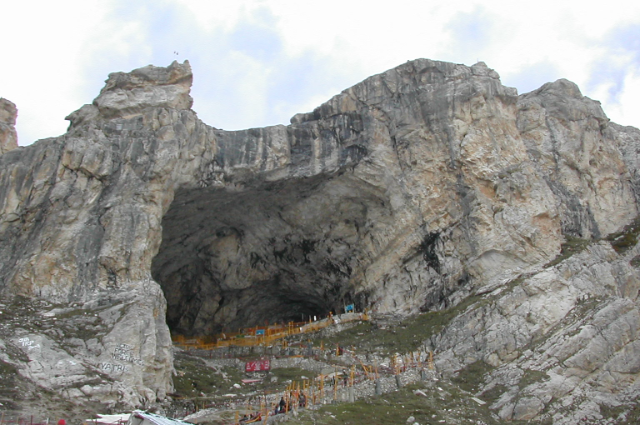
Each year, as the Himalayan valleys awaken to the chants of "Har Har Mahadev," lakhs of devotees begin a pilgrimage that has never been merely about reaching a destination. They walk through freezing winds, slippery mountain trails, thinning oxygen, and uncertain weather, carrying little more than devotion in their hearts. Their destination is the sacred Amarnath Cave, where nature itself creates one of Hinduism's most revered symbols—the naturally formed ice Shivling, lovingly known as Baba Barfani.
Yet there are years when pilgrims arrive to find the cave without the towering ice formation they had dreamt of for months. Rising temperatures, climatic shifts, and changing environmental conditions cause the Shivling to melt earlier than expected. Photographs spread across social media. Television debates begin. Some express grief, others anger, while many ask whether the disappearance of the Shivling diminishes the sanctity of the pilgrimage.
But perhaps the more meaningful question is not why the Shivling melted.
Perhaps the question is: Can faith melt with it?
The answer lies not in the cave, but in the footsteps of every pilgrim who climbs towards it.
The Amarnath Yatra has always demanded something that cannot be bought or borrowed. It asks for endurance before it offers darshan. The mountains test the body before the cave touches the soul. Every aching muscle, every breath drawn in the thin mountain air, every whispered prayer uttered along the path becomes part of the pilgrimage itself. The journey transforms ordinary people into seekers, reminding them that spirituality is rarely found on easy roads.
For many devotees, seeing Baba Barfani is the culmination of years of longing. Families save money for months. Elderly pilgrims prepare themselves physically and spiritually. Some make vows to visit after surviving illness or hardship. Others return year after year, not because the cave changes, but because they do.
When they finally stand before the sacred space, many break into tears—not because they are looking at ice, but because they are experiencing something words struggle to contain.
That experience does not vanish simply because the ice formation does.
Science explains that the Shivling forms naturally through the freezing of water droplets inside the cave. It also explains why warmer temperatures, increased human activity, changing snowfall patterns, and global climate shifts affect its size and duration. Science answers how. Faith asks why. The two are not enemies. One explains nature; the other gives meaning to human experience.
It is possible to acknowledge climate change without diminishing belief. In fact, recognising the fragility of the Himalayan ecosystem should deepen our sense of responsibility. Sacred places deserve not only reverence but protection. If devotees believe the cave is the abode of Shiva, then caring for the mountains, rivers, forests, and glaciers surrounding it becomes an act of worship in itself.
Lord Shiva has never been limited to one form.
He resides in the silence of the Himalayas, in the flowing Ganga, in the rhythm of the damru, in the ash spread across the body, in meditation, in destruction, and in creation. Hindu philosophy has long taught that the Divine is beyond form, even while expressing itself through countless forms. The ice Shivling is one such expression—beautiful, sacred, and deeply moving—but not the entirety of Shiva.
If divinity depended solely upon permanence, then every temple destroyed by time would have taken faith down with it. Every river changing its course would have erased its holiness. Every idol damaged by disaster would have ended worship forever.
History tells us otherwise.
Civilisations have fallen. Kingdoms have vanished. Temples have been rebuilt stone by stone. Yet prayers survived where monuments could not. Faith has always proved more enduring than the structures that house it.
Perhaps Baba Barfani teaches this lesson every year.
The Shivling forms.
It grows.
It is worshipped.
And eventually, it melts.
In that cycle lies a profound truth that echoes through Hindu philosophy: everything in the material world is temporary. Seasons change. Mountains erode. Rivers alter their paths. Human lives begin and end. Attachment belongs to what changes; spirituality belongs to what remains beyond change.
Maybe the melting of Baba Barfani is not the disappearance of a miracle.
Maybe it is the miracle's final teaching.
That the sacred cannot be imprisoned inside ice.
That Shiva is not absent because a natural formation has dissolved.
That faith does not depend upon what our eyes witness, but upon what our hearts continue to recognise.
The pilgrim who returns home after the Yatra carries something greater than a photograph of the Shivling. They carry patience learned on difficult roads, humility born from standing before the vastness of nature, gratitude for completing the journey, and a renewed relationship with the Divine.
No rising temperature can melt those memories.
No disappearing ice can erase those prayers.
No empty cave can empty a faithful heart.
Baba Barfani may disappear, but never from the soul of those who chant His name. The ice may melt into water, the water may become clouds, and the clouds may return as snow upon the Himalayas. Nature completes its cycle. Faith completes its own.
And perhaps that is why, even if one day the cave stands without the familiar white Shivling, the mountains will still echo with "Har Har Mahadev."
Because true devotion was never frozen in ice.
It has always lived in the hearts of those who keep walking toward Him.
SOURCES
- The Morning Voice https://share.google
- Ground Report https://share.google
- Nagarjuna Travels https://share.google
. . .