
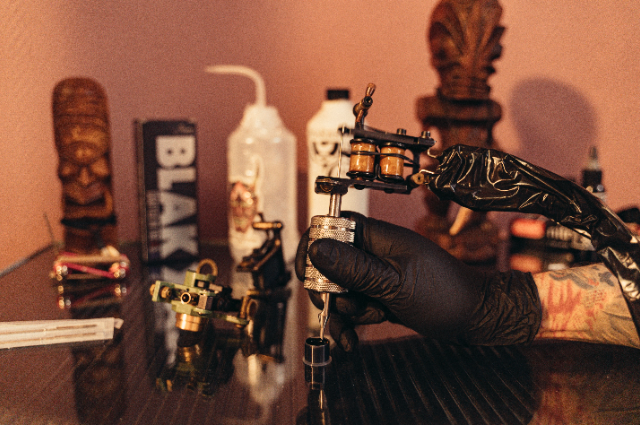
Some inventions fail because they're ahead of their time. Others fail because someone else finds a better use for them.
The modern tattoo machine exists because of one of those failures.
In 1876, Thomas Edison patented the electric pen. It wasn't designed for artists or tattooists. It was an office tool that used a rapidly moving needle to punch tiny holes in paper, allowing copies of documents to be made. Edison believed it would revolutionise paperwork.
It didn't.
The electric pen was noisy, difficult to use, and quickly became obsolete. Most people saw it as a failed invention.
Samuel O'Reilly didn't.
An Irish-American tattoo artist working in New York, O'Reilly recognised that the pen's rapid up-and-down motion could do something far more interesting than copy documents. Instead of punching holes in paper, it could drive ink beneath human skin.
He redesigned the machine for an entirely different purpose. He added an ink system, altered the grip so it could be held comfortably during long tattoo sessions, and adapted the mechanism to carry multiple tattoo needles. The changes looked simple, but they transformed a forgotten office gadget into a practical tool for tattooing.
In December 1891, O'Reilly patented the world's first electric tattoo machine.
The impact was immediate.
Before his invention, tattoos were created by hand. Every puncture had to be made manually, making large designs slow, inconsistent, and physically exhausting for both artist and client. An experienced tattooist could only make a handful of punctures each second.
O'Reilly's machine increased that speed dramatically, reaching around 50 punctures per second. Tattoos that once took days could now be completed much faster, with cleaner lines and more consistent results. The machine also made it easier for artists to experiment with larger, more detailed designs.
As electric tattooing spread, so did O'Reilly's reputation. His New York studio attracted sailors, soldiers, performers, and travellers from around the world. His machine became the blueprint for nearly every tattoo machine that followed.
The success also led to a dispute. Because O'Reilly's invention was based on the mechanism of Edison's electric pen, Edison challenged the patent. But the law recognised that O'Reilly had created a fundamentally different machine with a completely new purpose. His patent stood.
More than a century later, modern tattoo machines have changed in shape, materials, and technology, but they still work on the same basic principle O'Reilly patented in 1891.
A machine built to copy paperwork ended up becoming the tool that put permanent art on millions of people.
Not every great invention starts with a brilliant new idea.
Sometimes it starts with someone looking at a failed invention and asking, "What else could this do?”
SOURCES:
- https://pro.bhub.com.ua
- Ink Gallery Tattoo Studio https://share.google
- IEEE Spectrum https://share.google
. . .