
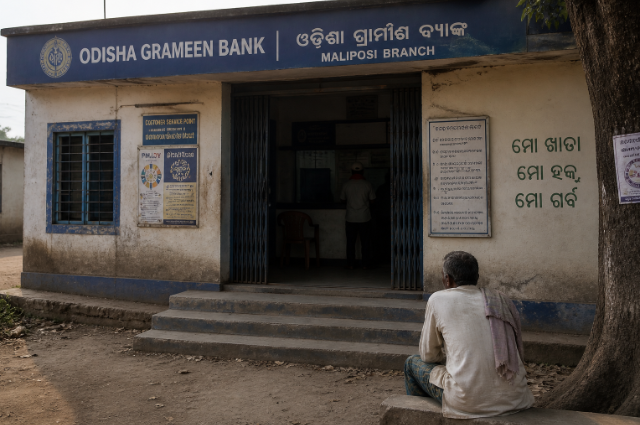
A man entered the bank without anger or protest. He entered with a bundle, one that no rulebook anticipates. Inside it were the skeletal remains of his sister. Not a death certificate, not an official form stamped and signed, but bones. Because somewhere between what the system said and what he understood, a man came to believe that this was the only proof that would be accepted.
This is not fiction or exaggeration. It is a real incident that forces us to confront an uncomfortable truth about India’s institutions they often fail the very people they claim to serve.
The Man Behind the Incident
Jeetu Munda, a 50 year old tribal resident of a remote village in Odisha’s Keonjhar district, was trying to withdraw money from his deceased sister’s bank account. His sister, Kalra Munda, had lived a life marked by hardship. After losing her husband and only son, she returned to her parental home and began saving small amounts in a rural bank.
When she passed away, she left behind a modest sum around ₹19,400. For many, this amount might appear insignificant. But for Jeetu, it meant survival. It was not just money; it was security in a fragile life.
Lost Between Words and Meaning
The tragedy did not begin with rules ,it began with misunderstanding. Bank officials, following procedure, asked Jeetu to provide proof of death and documents establishing his claim. But communication failed.
Whether due to language barriers, lack of clarity, or impatience, what he took away from repeated visits was simple: “bring the account holder.”
In an urban setting, such confusion might be corrected instantly. But in a remote village, where literacy is limited and institutional processes are unfamiliar, words carry different meanings. For Jeetu, this was not a metaphor. It was an instruction.And so, he followed it.
When Systems Don’t Speak the People’s Language
India often celebrates its achievements in financial inclusion. Millions of bank accounts have been opened under government schemes. Digital payments and biometric systems are expanding rapidly. On paper, the system looks accessible and modern.But inclusion is not just about numbers. It is about usability.
For first generation users, especially in rural and tribal areas, banking remains intimidating. Forms are complex, procedures are rigid, and explanations are often delivered in technical or unfamiliar language. There is little effort to adapt the system to the user’s reality.Jeetu’s case exposes this gap in the starkest way possible. He was included in the system, but he was not equipped to navigate it.
The Burden of Small Money
One of the most troubling aspects of this story is how easily the urgency of “small” amounts is dismissed. ₹19,400 may not seem significant within institutional frameworks, but for someone living on the margins, it can mean food, healthcare, or basic survival.
Systems are designed for uniformity, not empathy. They do not differentiate between large and small struggles. But people do. Lives do.
When institutions fail to recognize this, they unintentionally deepen inequality not through denial, but through indifference.
A System That Responds Only After Crisis
After the incident came to light, the response was immediate and efficient. Authorities intervened. Documents were issued quickly. The money was released without further delay. Additional financial support was also provided.
This swift action reveals something important the system is capable of working efficiently when it chooses to.But it also raises a difficult question: why did it take such an extreme act to trigger that efficiency?
This pattern is not unique. In many cases, systems remain slow and inaccessible until public attention forces action. By then, the damage of emotional, social, or personal has already been done.
Beyond Individual Blame
It would be easy to hold bank staff solely responsible. But this incident is not about one mistake or one institution. It reflects a broader systemic failure.
Where were the local administrative mechanisms that could have helped Jeetu earlier? Why was there no support system to guide someone unfamiliar with banking procedures? Why do processes rely so heavily on documentation without offering assistance to those who cannot access or understand it?Failures like this are not isolated. They are structural.
The True Cost: Dignity
The most profound loss in this story is not financial. It is dignity.Exhuming a loved one’s remains is not just an act of desperation; it is an emotional and cultural rupture. It reflects the collapse of trust between citizens and institutions.
No system should push a person to such extremes. No process should demand proof in a way that strips individuals of their humanity.When procedures become more important than people, the system stops serving its purpose.
What Must Change
If this incident is to have any meaning beyond shock, it must lead to reform. Not symbolic responses, but practical changes.
Banks and institutions must prioritize clear communication. Procedures should be explained in simple, local languages. Staff should be trained to recognize confusion and respond with patience, not dismissal.
For small claims, documentation requirements should be simplified. Local authorities should play a more active role in verification, reducing the burden on individuals.Most importantly, systems must become more human. Efficiency cannot come at the cost of empathy.
A Question That Remains
Jeetu Munda eventually received the money. The paperwork was completed. On record, the system worked.But the image remains of a man standing outside a bank, holding the remains of his sister, trying to prove something that should never have required proof in that form.
It forces us to ask a difficult question: what does progress mean if it leaves people behind in understanding?
“Bones Over Paperwork” is not just a striking phrase. It is a warning. A reminder that development measured only in statistics can hide deep fractures beneath the surface.
Until institutions learn to bridge the gap between rules and reality, stories like this will continue to emerge, not as rare tragedies, but as reflections of a system that still struggles to see its most vulnerable citizens.
References:
- Reserve Bank of India (RBI) – Customer Service in Banks Guidelines.
- RBI – Financial Inclusion Reports
- Government of India – Pradhan Mantri Jan Dhan Yojana (PMJDY)
- NABARD – Rural Banking and Financial Inclusion Reports
- News reports on Odisha Keonjhar incident (2026) – covered by major Indian media outlets