
Artificial Intelligence (AI) is one of the fastest-growing technologies in the world today. It is being used in many fields such as education, healthcare, business, banking, and entertainment. AI can write articles, answer questions, create images, and even help companies make decisions. Because of these abilities, many people believed that AI would quickly become very profitable and change the future of work.
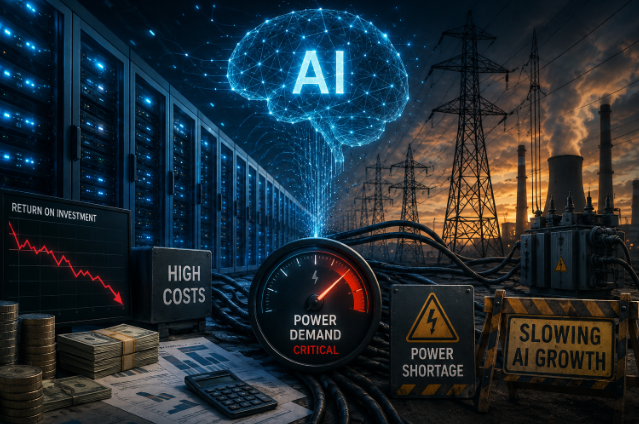
However, in 2026, people are starting to look at AI more carefully. Although the technology is improving every day, many companies are finding it difficult to earn enough money from it. There are several reasons for this, including low returns on investment, high operating costs, power shortages, and growing public concerns.
Difficulty in Getting Good Returns
Many companies have spent huge amounts of money on AI projects. They expected AI to improve productivity and increase profits. However, the results have not always been as good as expected.
Reports show that less than 1% of executives have received returns of 20% or more from AI investments. More than half of the organisations report only 1% to 5% returns. Around 60% of companies say they are getting little or no value from their AI projects.
Another problem is that many AI projects never become successful products. Nearly 30% of generative AI projects are stopped after the testing stage because companies cannot find a practical way to use them. This shows that while AI is impressive, turning it into profit is not easy.
AI Is Very Expensive
One major challenge is the high cost of AI. Building AI systems requires advanced computer chips, powerful servers, and large data centres. All these things cost a lot of money.
Technology companies are investing billions of dollars in AI infrastructure. However, the income generated from AI services is often not enough to cover these expenses. Some companies are spending more money on AI than they are earning from it.
Many AI services were first offered through fixed monthly subscriptions. But companies later realised that some users were using so many resources that they were actually causing losses. Because of this, many firms are now introducing usage-based pricing, where customers pay according to how much they use the service.
The Power Problem
One of the biggest issues slowing AI growth is electricity. Most people think AI only needs software and computers, but it also needs a huge amount of power.
Large AI data centres operate 24 hours a day and consume enormous amounts of electricity. As more people use AI, the power demand continues to increase. In some places, power grids are already under pressure and may not be able to support rapid expansion.
Building new power plants and improving electricity networks takes time and money. This means that even if companies want to expand their AI services quickly, they may not have enough power available.
Experts believe that energy supply could become one of the biggest factors deciding how fast AI can grow in the future.
Cooling and Infrastructure Challenges
AI servers generate a lot of heat while working. To prevent overheating, companies must use cooling systems. These cooling systems also require electricity and increase operating costs.
As AI becomes more powerful, the need for cooling and infrastructure also increases. Companies not only have to buy expensive equipment but also maintain it properly. This makes AI development slower and more costly.
Therefore, the challenge is not only creating better AI software but also building the physical infrastructure needed to support it.
Investors Want Real Results
For the past few years, investors have been excited about AI and invested large amounts of money in AI companies. They believed the technology would bring huge profits in the future.
Now, investor thinking is changing. Rising interest rates have made investors more careful. Instead of focusing only on future possibilities, they want companies to show actual profits and business success.
Many investors are asking important questions. Is AI generating enough revenue? Are companies recovering their investments? Can AI become profitable in the long term?
Because of these questions, businesses are under pressure to prove that AI is more than just a popular trend.
Growing Public Concerns
Another challenge for AI is public opinion. While many people enjoy using AI tools, others are worried about their effects on society.
A recent survey found that more than half of Americans believe AI may do more harm than good. Some people fear that AI could replace jobs, spread false information, or create privacy problems. Others worry about the ethical issues connected with AI.
These concerns may lead to stricter government regulations and slower adoption of AI technologies in the future.
Artificial Intelligence is still one of the most exciting technologies in the world, and its capabilities continue to improve. However, the business side of AI is facing several challenges. Companies are struggling to prove strong returns, operating costs are very high, power shortages are limiting growth, and investors are demanding better results.
At the same time, public concerns about AI are increasing. All these factors show that the future of AI depends not only on technology but also on profitability, infrastructure, and public trust. AI has great potential, but companies must show that it can create real value and not just excitement.
References:
- McKinsey & Company. (2025). The State of AI: Global Survey on AI Adoption and Value Creation.
- Deloitte Insights. (2025). Generative AI and Business Return on Investment Report.
- International Energy Agency (IEA). (2025).Energy and AI: Power Demand from Data Centres.
- Gartner Research. (2025). Challenges and Opportunities in Artificial Intelligence Implementation.
- Pew Research Centre. (2025). Public Attitudes Toward Artificial Intelligence and Its Impact on Society.