
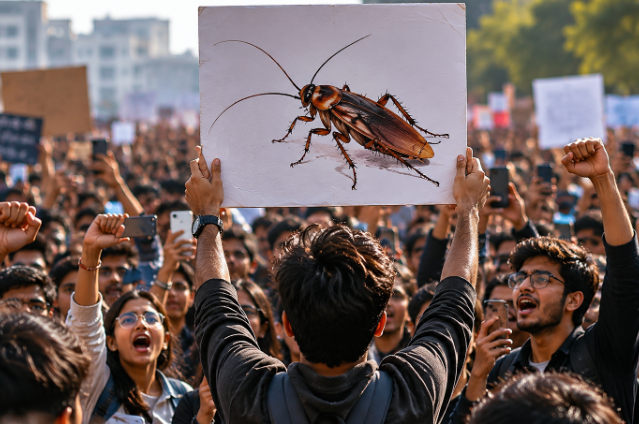
In the long, often bizarre history of political iconography, few creatures have transformed as radically as the cockroach. For decades, the insect was the ultimate slur—a biological shorthand for filth, infestation, and a lack of humanity. Yet, in May 2026, the cockroach crawled out of the gutter and onto the digital mainstage of Indian politics. The emergence of the Cockroach Janta Party (CJP) has forced a sudden re-evaluation of this resilient insect as a metaphor for the marginalised, the resilient, and the irrepressible.
The CJP did not begin with a convention or a grassroots door-knocking campaign. It began with a sentence from the highest judicial office in India. On May 15, 2026, during a Supreme Court hearing regarding fraudulent law degrees, Chief Justice Surya Kant reportedly remarked that some unemployed youngsters were like "cockroaches" and "parasites" who attack the system through social media and activism. While the Chief Justice later clarified that his remarks were aimed specifically at those using fake credentials, the damage was already done in the court of public opinion. Within twenty-four hours, Abhijeet Dipke, a thirty-year-old public relations student and former political volunteer, launched the CJP as a "platform for all the 'cockroaches' out there".
The speed of the party's ascent was staggering. Leveraging what strategists call "weaponised humour," the CJP's Instagram account amassed 20 million followers in under a week, surpassing the reach of the ruling Bharatiya Janata Party (BJP). The party’s tagline, "Voice of the Lazy & Unemployed," and its "Secular, Socialist, Democratic, and Lazy" preamble were a direct, absurdist inversion of the Indian Constitution. By reclaiming a derogatory label, the movement effectively stripped the insult of its power, turning it into a badge of honour for a generation of Gen Z Indians who felt unheard and economically precarious.
This tactical reappropriation of a slur is a sophisticated move, but it carries a heavy historical burden. To understand why the "cockroach" label was so inflammatory, one must look back to the darkest chapters of the 20th century. During the 1994 Rwandan genocide, Hutu hardliners used the term "Inyenzi"—the Kinyarwanda word for cockroach—to dehumanise the Tutsi population. Through the RTLM radio station and newspapers like Kangura, propagandists repeated the phrase "a cockroach cannot give birth to a butterfly" to justify mass slaughter. In that context, the cockroach symbolised an invasive filth that had to be "cleaned" or "liquidated". The CJP’s recent rise in India has been seen by some as a direct challenge to this history of pejorative political vocabulary, attempting to arrest the trend of dog-whistling by owning the epithet as a counter-political move.
Beyond the grim history of genocide, the cockroach has a long-standing pedigree in modernist and contemporary literature as a symbol of alienation. The most famous example is Franz Kafka’s 1915 novella The Metamorphosis, where Gregor Samsa wakes to find himself transformed into a "monstrous vermin" or cockroach. Kafka’s use of the insect was an exploration of how modern society—and the soul-crushing requirements of capitalist labour—reduces humans to mere cogs in a machine. Gregor’s transformation into an insect was his ultimate escape from the monotony of work, recovering his "right to be lazy".
In more recent years, authors have used the cockroach to satirise the perceived decay of political leadership. In 2019, Ian McEwan published The Cockroach, a novella that flips Kafka’s premise. In McEwan’s tale, a cockroach named Jim Sams wakes up inside the body of the British Prime Minister. He discovers that his entire cabinet has been similarly "possessed" by cockroaches, who then use their human forms to push through a nonsensical economic policy called "Reversalism"—a thinly veiled satire of the Brexit movement. McEwan’s cockroaches thrive in "poverty, filth, and squalor," and they aim to make the human population poorer to ensure their own survival. For McEwan, the cockroach symbolises a government that is fundamentally inhuman, acting in its own "collective spirit" against the best interests of the people.
The CJP sits at the intersection of these literary and historical traditions. While it uses the "lazy" tropes of Kafka’s alienation, it also addresses very real, modern grievances. The party’s five-point manifesto includes demands for judicial independence (no post-retirement Rajya Sabha seats for Chief Justices), strict accountability for deleted voter names under the UAPA, and a 55% reservation for women in Parliament. It targets "Godi media" and the corporate ownership of independent voices, asking "loudly, repeatedly, in writing, where the money went".
The response from the Indian state suggests that this "satire" is being treated with genuine alarm. On May 21, 2026, the Ministry of Electronics and Information Technology (MeitY) blocked the CJP’s official account on X (formerly Twitter), citing "national security concerns". The party’s central website was also taken down after it launched a petition demanding the resignation of the Education Minister following a leak of government exam papers. This digital crackdown only served to validate the party's mascot; as the founder noted, the cockroach is famously an insect that "shuns the light" and can survive even a nuclear winter.
Despite its viral success, the CJP faces a literal hurdle in the traditional political arena: the Election Commission of India (ECI). India’s election laws, specifically the 1968 Symbols Order, generally prohibit the use of "any bird or animal" for newly proposed party symbols. This restriction was implemented in the 1990s after animal rights activists complained that parties were parading live animals through the streets during campaigns. While older parties like the Bahujan Samaj Party (elephant) and the Forward Bloc (lion) have legacy exceptions, the CJP would likely find it nearly impossible to get an official "cockroach" symbol on a ballot. The ECI has yet to weigh in on whether a cockroach is technically an "animal" or merely an insect, but the party has already hedged its bets by suggesting a mobile phone as a possible alternative.
Critics of the movement dismiss it as "meme politics" or a manufactured PR campaign, noting founder Abhijeet Dipke’s past ties to the Aam Aadmi Party. Union Minister Sukanta Majumdar even alleged that the majority of the party’s followers were from Pakistan, a claim intended to delegitimise its domestic support. Yet, the movement has drawn endorsements from serious figures, including Congress MP Shashi Tharoor, environmentalist Sonam Wangchuk, and activist Anna Hazare. Tharoor called the CJP a "revelation" of youth frustration, arguing that humour is a healthy outlet for public dissatisfaction in a democracy.
Ultimately, the history of the cockroach as a political symbol is a history of survival. From the dehumanising broadcasts of Rwanda to the satirical Prime Minister of McEwan’s London, and finally to the viral "laziness" of 21st-century India, the insect has proven remarkably durable. The Cockroach Janta Party may never become a registered political entity with a seat in Parliament, but it has already succeeded in shifting the political discourse. It has proven that in an era of "doom scrolling" and hyper-productivity, the lowly cockroach—a creature that persists through every attempt to crush it—is a potent metaphor for a generation that refuses to be ignored.
RESOURCES
- https://www.cockroachjantaparty.buzz
- https://www.theguardian.com
- https://digitalcommons.conncoll.edu
- https://scroll.in
- https://www.hrw.org
- https://thinkindiaquarterly.org