
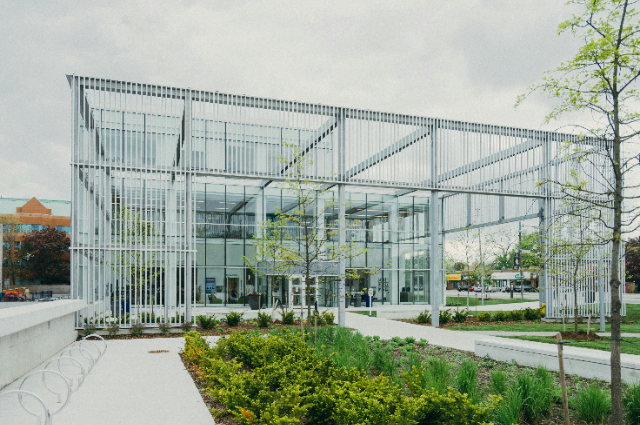
At 9:00 a.m. sharp, a thousand ID cards beeped in unison as the glass doors swung open and the elevators started moving quietly upwards. Rows of identical desks came to life with screens flickering on, while the gentle hum of air-conditioning blended with the soft tapping of keyboards and muted conversations in the distance. Someone walked over to the coffee machine to order a cappuccino, but it didn't r their name - not that it cared anyway. Outside the campus gates, the usual chaos of an Indian city unfolded with traffic crawling along at a snail's pace. Yet, inside the campus, everything seemed perfectly organized, controlled, and somehow disconnected from the real world. It was as if you could be anywhere - Pune, Bengaluru, or Hyderabad - and it wouldn't make a difference, which was exactly the intention behind the design. The sense of detachment was deliberate, a result of careful planning to create a space that felt more like a bubble, isolated from the hustle and bustle of the city outside.
India's IT parks are often thought of as symbols of the country's growing economy and modern ambitions, but they have a more complex side to them. If you look closely, you'll see that they are what anthropologists call "non-places" - spaces that are designed to be efficient, to get things done quickly, and to make people productive, rather than to create a sense of identity, memory, or belonging. These places are different from traditional ones, where people and history come together to give them meaning. Instead, IT parks are designed to be smooth and easy to navigate, without any obstacles or challenges, which makes them functional, but also kind of forgettable. For many young Indians who are starting their careers, chasing their goals, and figuring out adulthood, these parks are not just temporary workplaces, but the backdrop for some of the most important moments of their lives. They are where life happens, where people grow and change, and where memories are made, even if the spaces themselves don't seem to hold much memory or character.
Walking into an IT park for the first time often feels strangely familiar. The architecture follows a predictable pattern: reflective glass exteriors, biometric entry points, wide food courts with both global and local dishes, and carefully landscaped open areas that look nice but are rarely used. These design choices are intentional; they form a global model meant to allow anyone, regardless of background, to function easily within the space. In achieving this universality, however, these environments gradually detach from the cities they inhabit, losing the textures, languages, and unpredictability of their surroundings.
What emerges is a standardized setting that could be placed almost anywhere in the world without losing its identity.
When you're inside an IT park, it can feel like you're in a different world. Everything is organized and scheduled, with meetings and deadlines to keep track of. But as soon as you step outside, you're hit with the chaos of Indian city life - vendors competing for space, cars honking, and a kind of energy that can't be controlled. Going back and forth between these two worlds every day can be disorienting, making you feel like you don't quite fit into either one. You're caught between the calm, orderly world of the IT park and the messy, unpredictable world outside, and it's hard to reconcile the two. This can create a sense of detachment, like you're living in a "bubble" that's separate from the rest of the world. It's a subtle but persistent feeling, one that can make you feel like you're not fully a part of either world.
In a place like this, figuring out who you are can get really complicated. Usually, we get our sense of self from the people around us, our culture, and the things that stay the same over time. But in a setting where technology and work are everything, who you are often gets boiled down to what you do. You're known for your job title, people recognize you by what you're working on, and you're judged on what you produce. Even though you're interacting with people all the time, it's usually about getting something done, not about sharing your story. Even with open offices that are supposed to help people work together, they can actually make everyone behave in the same way. But despite all this, people still want to connect with each other. So, over time, they find ways to make their own little spaces within the bigger system. Like, taking a break to have tea together becomes a special thing, or a joke that's just between a few people can pop up in different projects, and meeting a deadline can become a memory that ties people together in ways that the building itself never planned. As people find these small ways to connect, they start to create their own sense of community and identity, even in a place that's mostly about work and technology. It's like they're taking back a little bit of who they are, and making it their own, even when everything around them is trying to make them fit into a certain mold. And that's what makes these small, meaningful spaces so important - they're a way for people to be themselves, even in a place that's not always designed for that.
At the heart of this journey is a driving force - ambition. It's what shapes the paths we take and the culture that surrounds us. For many young professionals, joining an IT park is about more than just a job. It's a ticket to better opportunities, financial freedom, and a chance to be part of a global community. But this promise comes with its own set of challenges. The pace can be relentless, with deadlines looming and weekends spent working. The lines between work and personal life get blurred, and the pressure to constantly learn and adapt can be overwhelming. In this environment, being productive becomes the top priority, leaving little room for reflection or downtime. As time goes on, it's easy to feel like you're making progress, but unsure what that progress really means or where it's taking you. The experience can be confusing, like being on a path without a clear direction.
There's more to the IT hubs than what we can see. Behind the scenes, there are people who work hard to keep everything running smoothly. These include security guards, cleaning staff, cafeteria workers, and transport providers. They are the backbone of the IT ecosystem, making sure everything works like clockwork. For them, the IT park is not just a place they visit sometimes, but a place where they go to work every day. It's a place where they find routine, stability, and a sense of belonging. They know the park like the back of their hand, and it's not just a boring, abstract space to them. This makes us question the idea that the IT park is a "non-place", a space without any real meaning. Instead, it shows that the meaning of a space comes from the people who use it and the experiences they have there. The IT park is not just a building or a location, but a place where people live, work, and interact with each other.
The global focus of IT parks adds to their complexity. These spaces are carefully designed to meet international standards of work and communication. While this encourages collaboration across borders, it also leads to the gradual loss of local distinctiveness. The architectural style becomes neutral, cultural markers fade, and the sense of place weakens. Employees find themselves in environments that, while physically situated in India, culturally align with a global corporate vibe, creating a kind of spatial confusion that is both empowering and disorienting.
As time passes, IT parks start to take on a life of their own. The people who work there begin to put their own stamp on the place, making it feel more like home. They celebrate festivals, decorate their desks, and form little groups based on shared hobbies or experiences. These small actions might seem insignificant, but they show how people are constantly trying to balance the formal structure of the park with their own personal touches. Slowly but surely, memories start to build up, friendships grow, and certain areas of the office become special to people. This emotional connection changes the way people experience the space, making it feel more warm and welcoming, even if it wasn't designed to be that way.
So, can a space that's not really meant to be a place where people connect ever actually become one? It's not about how the space is designed, but about how people can make it their own. Even if IT parks start out feeling impersonal and static, they eventually take on the stories and experiences of the people who work there. What really matters about these spaces isn't how they look or how they're laid out, but the lives of the people who use them - their hopes and dreams, the challenges they face, and the connections they make with each other.
India's IT parks show us something important about life today. We want things to be efficient and connected to the world, but this can make us lose touch with who we are and where we come from. Even in these places that are designed to be kind of generic and forgettable, people still find ways to make their mark and leave their imprint. It's in these small acts of defiance that we see the real nature of the IT park - it's not just a boring, empty space, but a complicated and changing place that's shaped by the people who use it, not just by its design.
RESOURCES
- Marc Augé – Non-Places: Introduction to an Anthropology of Supermodernity (concept overview) https://www.missionsstudies.com
- “Making Places: From Non-Place to User-Generated Space” (discussion on identity in non-places) https://www.thefreelibrary.com
- “Non-place, dispossession, and urban transformation in Delhi” (urban theory in thIndian context) https://www.sciencedirect.com
- “IT-Oriented Infrastructural Development in Pune” (impact of IT hubs on urban planning) https://www.cogitatiopress.com
- Placeness blog – Non-places and globalization explained https://www.placeness.com
- “Making Places From Non-Place to User-Generated Space Through a Diversity of Media” (research paper) https://www.researchgate.net