
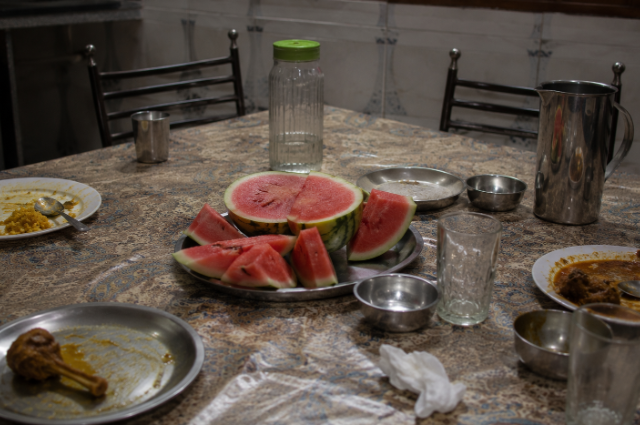
On a seemingly ordinary Saturday night in the Pydhonie neighbourhood of Mumbai, the Dokadia family sat down for what should have been a routine weekend meal. Abdullah Abdul Kadar, a 40-year-old mobile accessories trader, his 35-year-old wife Nasreen, and their two daughters—16-year-old Ayesha and 13-year-old Zainab—had hosted five relatives for a dinner of mutton pulao and biryani. The atmosphere was likely light and convivial; after the guests departed, the family decided to share a watermelon around 1:00 AM before turning in for the night. It was a mundane act of domestic life, yet it preceded a rapid, terrifying descent into a medical nightmare.
By 5:00 AM on Sunday, the quiet of the household was shattered as all four family members were struck by violent vomiting and diarrhoea. When they finally reached the care of Dr. Ziad Qureshi, he found them in a state of profound exhaustion and critical instability. Despite being rushed to Sir JJ Hospital for emergency intervention, the family’s condition spiralled beyond the reach of modern medicine. Thirteen-year-old Zainab was the first to succumb at 10:15 AM, followed by her mother and sister shortly after. Abdullah, the father, fought the longest, but he eventually passed away at 10:30 PM that same night. Within a single twelve-hour window, an entire family had been erased, leaving the city of Mumbai in a state of shock.
Initially, the finger of suspicion pointed directly at the watermelon. Public concern flared over the possibility of contaminated or chemically ripened fruit hitting the local markets. However, investigators quickly encountered a puzzling detail: the five relatives who had shared the biryani earlier that evening remained perfectly healthy. This realisation narrowed the focus to the fruit consumed only by the four victims, yet as forensic details began to trickle in, the "accidental food poisoning" theory began to crumble.
The autopsy reports delivered a chilling revelation that moved the needle from tragedy toward something far more sinister: the internal organs of the victims, including the heart, brain, and intestines, had turned a startling, unnatural shade of green. Medical experts immediately recognised that these findings—and the brutal speed of the family's decline—did not align with a typical case of food-borne illness. Then came the discovery of morphine in Abdullah's system, a potent painkiller that is strictly controlled and certainly not a natural component of fruit. Forensic science suggests that such findings require a deep dive into the decedent's medical history and scene investigation to differentiate between accident and foul play.
This case mirrors a dark chapter from history known as the 1858 Bradford sweets poisoning, where the dinner table also became a site of mass tragedy. In that instance, a confectioner in England, William Hardaker, accidentally sold peppermint lozenges that had been "adulterated" with five pounds of arsenic trioxide. The mistake occurred when a druggist’s assistant, William Goddard, retrieved the white powder from the wrong barrel in a dark attic, mistaking the poison for "daft," a cheap gypsum substitute used to bulk out expensive sugar. The result was the death of 21 people and the sickness of over 200 others. Like the Mumbai case, the Bradford tragedy initially saw victims misdiagnosed with cholera because the symptoms—vomiting and abdominal pain—were so similar.
While the Bradford case was ultimately ruled a tragic accident born of negligence, the Mumbai investigation is exploring the possibility of a more deliberate hand. Abdullah Dokadia was reportedly a witness in a significant criminal case involving a real estate developer, a detail that has led authorities to keep a potential murder angle open. The challenge for the Mumbai police is exacerbated by the fact that the specific vendor who sold the watermelon in the Null Bazar area has not been located. Without the source of the fruit or a clear explanation for the presence of morphine, the case remains a haunting puzzle.
Forensic experts note that interpreting postmortem drug concentrations is notoriously difficult. A phenomenon known as postmortem redistribution means that drug levels can shift after death, making it hard to calculate exactly how much of a substance was consumed. In cases of opioid toxicity, like those involving morphine, a complete autopsy and toxicological panel are essential because history and scene investigation alone can be "insensitive indicators" of what actually happened. For the Dokadia family, the presence of morphine and the green discolouration of their organs point toward a toxic exposure that the Maharashtra Food and Drug Administration is still struggling to officially categorise.
As the city waits for the final toxicology and histopathology reports, the case serves as a grim reminder of how vulnerable we are to the substances that enter our homes. Whether it is a nineteenth-century sweet maker trying to save a few pennies on sugar or a modern-day mystery involving a potentially spiked fruit, the intersection of food and poison remains a recurring nightmare in the annals of forensic science. The legacy of the Bradford poisoning was the eventual passage of the Pharmacy Act of 1868 and stricter food safety laws, born out of public "revulsion" and a demand for protection. One can only hope that the investigation into the Dokadia family's "watermelon deaths" eventually yields a similar measure of truth and systemic change.
For now, the Pydhonie case remains in a state of legal and scientific limbo. The police have urged caution regarding unconfirmed forensic leaks, stressing that the full analysis is still pending. Yet, the image of the green organs and the detection of a clinical narcotic in a father who was simply sharing a late-night snack with his daughters lingers in the public imagination. It is a story that began with a family gathering and ended in a sterile hospital ward, a stark illustration of how the most domestic of scenes can be transformed into a forensic mystery that defies easy answers.
Resources-
- Mumbai 'Watermelon Death' Case (LatestLY): https://www.latestly.com
- National Association of Medical Examiners Position Paper on Opioid Deaths: https://name.memberclicks.net
- American Academy of Forensic Sciences (AAFS) - In Vitro Formation of Acetylmorphine: https://www.aafs.org
- European Journal of General Medicine - Fatal Poppy Capsule Toxicity: https://www.ejgm.co.uk