
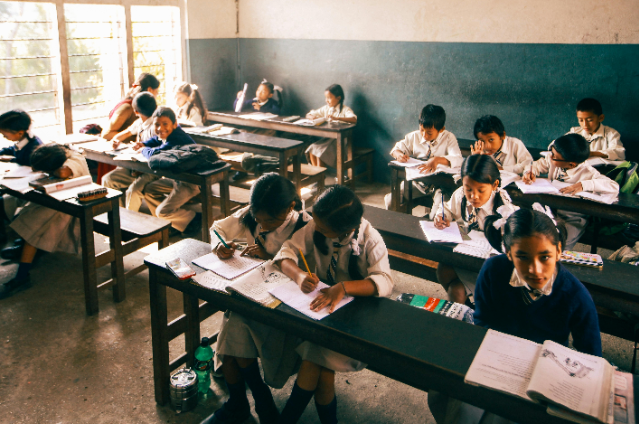
There is a striking, almost bitter irony currently playing out in Maharashtra’s education system. On the surface, the state government appears to be a fierce champion of its native tongue, having recently mandated that Marathi be taught in every school from Class 1 to 10, backed by the threat of heavy fines for those who don’t comply. Yet, while the state is busy issuing mandates, the very institutions that serve as the bedrock of the language—Marathi-medium schools—are being pushed toward a quiet, systemic extinction. This "Marathi Paradox" has reached a breaking point, forcing the Bombay High Court to step in as an unlikely shield against a policy that seems to celebrate the language in public while starving it in private.
The conflict reached a fever pitch when the state government issued two controversial Government Resolutions (GRs) in early April 2026. These resolutions effectively pulled the financial rug out from under hundreds of unaided primary and secondary schools, many of them Marathi-medium institutions serving rural and underprivileged communities. The state’s ultimatum was blunt: these schools had to apply either to become "self-financed" institutions or face the automatic cancellation of their recognition. For schools that cater to families with little to no money, "self-financing" is essentially a death sentence.
The Bombay High Court’s rebuke of this move was sharp and unambiguous. Justices Madhav J. Jamdar and Pravin S. Patil pointed out the glaring hypocrisy of a government that insists on the importance of Marathi while simultaneously crafting policies that would shutter over 750 Marathi-medium schools across the state. The court was particularly disturbed by the government’s failure to follow its own rules of natural justice; the state hadn't given these schools an individual hearing or even considered what would happen to the students and teachers left in the lurch. As the bench noted, the government seemed to have "totally ignored" whether nearby schools existed to absorb these children or if they could even continue their education in the same medium elsewhere. By quashing these resolutions for the petitioner schools, the court provided a vital, if perhaps temporary, lifeline.
However, the legal battle is only one symptom of a much larger, decade-long decline. Data from the Praja Foundation and the government’s own UDISE Plus system paint a sobering picture of Mumbai’s shifting educational landscape. In the last ten years, the number of municipal schools in Mumbai has shrunk from 1,263 to 1,118, with Marathi-medium schools bearing the brunt of this retreat. Enrollment in these Marathi institutions has plummeted by 34%, with 114 schools closing their doors permanently since 2014.
The reasons for this "slow-motion" collapse are complex and deeply human. There is, undeniably, a massive shift in parental preference toward English-medium education. Even in low-income families, parents see English as the essential currency for social mobility and global opportunity. This has led to a lopsided growth where English-medium municipal schools are the only segment showing any real vitality, with enrollment surging by 54% even as vernacular mediums wither.
But it isn’t just a matter of choice; activists and teachers argue it is a matter of neglect. Deepak Pawar, the founder of Marathi Abhyas Kendra, has been a vocal critic of what he calls the "systematic shutdown" of vernacular education. He points out that while the Brihanmumbai Municipal Corporation (BMC) pours resources into high-profile CBSE and ICSE schools, the Marathi and Urdu-medium schools are often left in crumbling, unsafe buildings or moved into inadequate slum redevelopment (SRA) structures. When a building is declared dilapidated—as happened to five schools in the 2025-26 academic year alone—the students are often scattered to other locations, leading to a high rate of dropouts as families lose the convenience of a neighbourhood school.
Furthermore, the quality of instruction in these vernacular schools is being hollowed out from the inside. There has been a freeze on the recruitment of permanent Marathi-medium teachers in BMC schools since 1997. To fill the gaps, the city relies on "clock-hour" teachers who are paid a pittance per class, a practice that Rajendra Mohite of the Brihanmumbai Shikshak Sabha argues makes it impossible to maintain high educational standards. In some cases, the shortage is so severe that three or four different classes are forced to share a single room, further eroding the trust parents have in the system.
This neglect feels particularly pointed when contrasted with the state’s aggressive "pro-Marathi" legislative agenda. The 2020 Act that made Marathi compulsory for all schools, regardless of their board affiliation, was intended to preserve the language’s status. But as activists like Deepak Pawar have noted, the mandate lacks clarity—is it a first, second, or third language?—and often results in schools treating it as a 50-mark "grading" subject rather than a core academic pillar. A language cannot survive on mandates alone if the very schools where it is the primary medium of thought and instruction are being closed or merged into oblivion.
The human cost of this paradox was on full display in recent protests outside the BMC headquarters. Teachers and students gathered to submit a memorandum, demanding an end to the "redevelopment" excuses that often lead to school closures. For families like that of Trupti Nikalje, whose daughter studies in a BMC school, these institutions are the only path out of poverty. "We don't have money for private schools," her daughter Preksha noted, "but we have ambitions". When a municipal school closes, those ambitions are often the first things to be buried under the rubble.
The Bombay High Court's intervention serves as a reminder that the "absence of arbitrary power is the first essential of the rule of law". By demanding that the state actually listen to the schools it intends to shut down, the judiciary has forced a pause in a process that seemed headed toward a foregone conclusion. But a judicial shield is not a long-term language policy.
If the state is serious about the Marathi language, it cannot continue to treat its vernacular schools as liabilities to be managed or assets to be liquidated for redevelopment. Activists are now calling for a "White Paper" on language policy—a transparent, honest accounting of why enrollment is falling and what can be done to fix the infrastructure and teacher shortages. The "semi-English" model, where science and math are taught in English while other subjects remain in the mother tongue, offers a potential middle ground that respects parental aspiration while preserving linguistic roots. But such initiatives require decentralised planning and a genuine commitment to quality that has, thus far, been missing.
The Marathi Paradox is a cautionary tale of what happens when cultural pride is used as a political badge but ignored as a public service. Until the state aligns its financial resolutions with its linguistic proclamations, the future of vernacular education will remain in the hands of the courts and the protestors on the street, fighting to keep a language alive in the very classrooms where it was born.
Resources:
- https://www.newsbytesapp.com
- https://timesofindia.indiatimes.com
- https://www.outlookindia.com
- https://mumbaimirror.indiatimes.com
- https://www.freepressjournal.in
- https://www.lawfultalks.net
- https://www.hindustantimes.com