
In today’s world, identities shift and change. Yet, in Tamil Nadu, there exists a monument that preserves identities from centuries past, captured in the inscriptions on its walls. The Brihadisvara Temple of Thanjavur, known as the "Big Temple" (Thanjai Periya Kovil), exemplifies Chola architectural achievement. Completed in 1010 CE by Emperor Rajaraja I, it was more than a place of worship; it was a statement of imperial power, scientific skill, and artistic dedication. Beyond its towering granite walls are tales of hidden chambers, ancient dance forms set in stone, and engineering wonders that baffled modern observers. Let's explore the history of this architectural wonder.
The Vision of Rajaraja I From 985 to 1014 CE, Rajaraja I ruled and constructed the temple, which he named Rajarajesvaram (the temple of the God of Rajaraja). The temple is unique for its ability to tell a story through a remarkable series of inscriptions. There are 107 paragraphs of detailed writing along the temple's base that offer a glimpse into 11th-century life. Rajaraja ensured that every donor, from his sister Kundavai and his queens to the smallest contributor, had their name carved in stone. This stands in contrast to many ancient monuments where donor names have faded. One inscription from 1011 CE records more than 600 people who worked at the temple, along with their names, wages, and specific jobs like priests, lamp lighters, and washermen.
Engineering the Impossible: The Shadowless Vimana The Sri-Vimana (central tower) of Brihadisvara is an engineering marvel, standing at an impressive 216 feet (66 meters), making it one of the tallest structures built before the 20th century. It is entirely made of granite, which is even more remarkable given that no granite deposits exist within 50 to 60 kilometres of Thanjavur. Historians estimate that over 130,000 tons of stone were moved using human labour, elephants, and wooden rollers. The most famous aspect of the Vimana is its "shadowless" phenomenon. At noon, especially during the equinoxes, the tower's shadow seems to fall within its own base, making it almost invisible. While some see this as mystical, it's due to precise astronomical calculations and the tower's tapering, rhythmic shape, which mirrors the mythical Mount Meru. At the top of this tower sits the Kumbam, a bulbous cupola carved from a single block of granite weighing 80 tons. To elevate this massive stone without modern cranes, Chola engineers built a long, sloped ramp—around 6 kilometres long, to hoist the block slowly using elephants and pulleys.
The Secret Discovery: Dance, Cobwebs, and Bat Excreta. One of the temple's most captivating stories remained hidden for almost a thousand years. In 1956, an assistant with the Archaeological Survey of India (ASI) was cleaning the fi rst tier of the structure when he found a passage blocked by a mound of hardened bat excreta. This material was so solid that workers had to cut through it, and many fell ill from the fumes. Once cleared, the passage revealed a hidden gallery of 81 beautiful sculptures representing the karanas (dance movements) of Bharatanatyam. These figures matched descriptions in the Natya Shastra, an ancient text on performing arts. Interestingly, out of the 108 movements mentioned in the text, only 81 were completed; the remaining 27 stone blocks were left blank, a mystery that continues to intrigue historians.
The Palimpsest of Paintings: A Double Vision. The temple walls serve as a layered canvas of history. In 1931, Professor S. K. Govindasami discovered that the visible murals from the Nayaka era (16th-17th centuries) actually covered older Chola frescoes from the 11th century. These Chola paintings are important because they used a "true fresco" technique, blending natural pigments into wet limestone as it dried. To preserve both layers of history, the ASI employed a special "de-stucco" process to remove the Nayaka paintings, mounting them on fibreglass to uncover the 1,000-year-old Chola masterpieces underneath. These frescoes show secular scenes of Chola royalty and court life, combined with mythology, including a famous image of a royal guru meditating under a banyan tree surrounded by worried monkeys and owls.
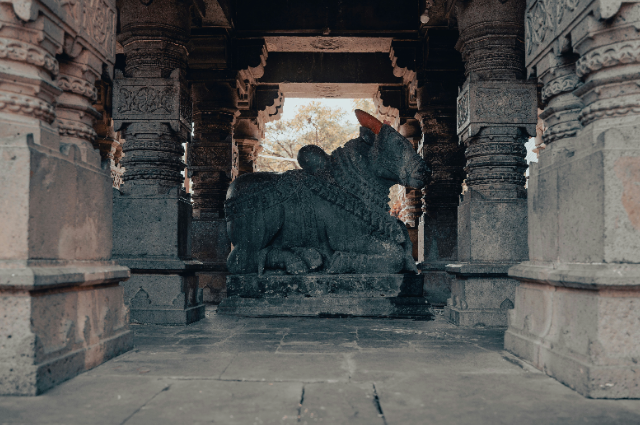
The Monolithic Guardian: Nandi the Bull. Facing the main shrine is the Nandi Mandapam, which contains a monolithic statue of the sacred bull, Nandi. Carved from a single block of granite, this statue is among the largest in India, weighing about 25 tons and measuring 6 meters long. A special ritual contributes to Nandi’s polished, dark look: each evening, it is anointed with oil, protecting the stone from the elements. Although the current pavilion was added later during the Nayaka era, the immense scale of the Nandi continues the Chola tradition of enhancing religious icons to match the temple's grandeur.
A British Surveyor’s Face and Dropped Machinery. The temple has endured more than just the passage of time; it served as an arsenal and barracks for French and British forces in the 18th century, leading to some damage.
During the Great Trigonometrical Survey of India in 1802, British officer Lt Col William Lambton tried to use the temple’s height for his measurements. A local legend shares a humorous and strange story from this time: while lifting heavy equipment to the top of the tower, Lambton accidentally dropped it, smashing a statue on the way down. According to lore, Lambton felt so guilty that he had his own face sculpted into the temple to replace the damaged figure. While this remains a piece of "local lore," it underscores how the temple has been a significant place for everyone from emperors to colonial scientists.
The Economic Heart: A Living Temple The Brihadisvara Temple served as the heart of a sophisticated agricultural economy. Rajaraja I made extensive donations to cattle herders to provide ghee for the 160 lamps and torches that illuminated the temple each evening. The temple also acted as a major charitable institution, offering free meals to pilgrims and devotees every day. The temple remains a "Living Temple" today, one of the few UNESCO sites still actively worshipped. Every year, it hosts the Brahan Natyanjali festival during Mahashivratri, where the world’s fi nest classical dancers perform in front of the very karanas carved by their ancestors 1,000 years ago.
The Brihadisvara Temple is more than just a monument; it holds Tamil identity and showcases the Chola dynasty's skill with stone. From the 80-ton capstone to the 400 dancing women who once fi lled its dedicated streets, every part of the temple tells a story of a civilisation that aimed for the heavens and often succeeded. Whether it’s the mystery of the blank dance blocks or the scientifi c precision of its "shadowless" tower, the Big Temple continues to inspire awe as a "King’s Glory in Stone."
ReFerences:
- 81 dancing sculptures discovered in Big Temple only in 1956 Published by The Times of India (2010), this source provides details on the 1956 discovery of the 81 karanas and the role of the Archaeological Survey of India (ASI) in clearing the hidden passages: https://timesofindia.indiatimes.com
- https://www.ijraw.com
- https://www.livehistoryindia.com
- https://storytrails.in
- http://www.heritageuniversityofkerala.com
- https://www.tamilnadutourism.tn.gov.in
- https://thanjavursmartcity.tn.gov.in
- https://whc.unesco.org