
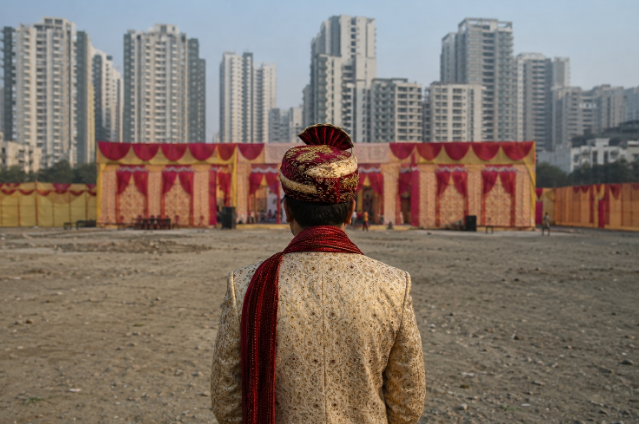
The global gaze often fixates on India as an economic juggernaut, a land of massive infrastructure initiatives, a pioneering space program, and a booming technology sector. Yet beneath this glittering canopy of modernisation lies a parallel reality that is becoming increasingly difficult to reconcile. Over the past several decades, the nation has constructed a complex socio-economic loop in which progress in one arena seems to produce regression in another actively. The recent, bizarre events surrounding a massive matrimonial deception in the Dewas district of Madhya Pradesh, where forty-two grooms arrived at a venue to find that their promised brides were entirely fictitious entities, serve as more than just a headline of a successful con. It acts as a disturbing window into a systemic architectural failure. This is the cycle India created and cannot escape, a self-perpetuating wheel where modern advancements are continually hijacked by archaic societal pressures.
The most immediate question that must be raised is how a society capable of deploying sophisticated digital payments and extensive mobile networks can simultaneously remain so desperately trapped by historical vulnerabilities. The Dewas incident was not merely a failure of local law enforcement; it was a symptom of a profound structural imbalance. For years, massive public and private campaigns have driven high-speed internet into the most remote corners of the agrarian countryside. This rapid digitisation was heralded as the ultimate democratizing force, an economic engine that would uplift the rural populace. Why, then, did this same digital architecture become the perfect execution tool for an industrial-scale fraud? The scammers did not need complex hacking tools; they merely needed WhatsApp, a few stolen social media photos, and the deep, silent desperation of families struggling against a skewed regional gender ratio. We must ask ourselves: Has India’s aggressive push toward a digital future outpaced its cultural capacity to manage the fallout?
To understand the depth of this trap, one must look at the nature of the pressure points being exploited. The difficulty many families face in finding suitable matches for their sons in regions like Madhya Pradesh is not an accident of nature. It is the direct consequence of decades of historical neglect, deep-seated cultural biases, and the systemic marginalisation of women. For generations, traditional structures prioritised male heirs, creating a profound demographic distortion that is now coming due. The cycle becomes evident when we realise how the nation attempted to solve the resulting economic anxieties. Instead of a deep, structural shift in societal values, the response has often been a reliance on superficial economic mobility. As young men in rural areas acquire basic education, smartphones, and aspirations of middle-class respectability, their desire for traditional societal milestones like marriage intensifies. Yet, the physical reality of their communities cannot fulfil these desires.
This brings us to a darker, more haunting question that the reader must consider: Is the very machinery of Indian progress designed to sustain its own shadow economy? The syndicate responsible for the Dewas deception operated with a chilling understanding of human psychology and institutional credibility. They did not invent a fake charity; they falsely aligned themselves with a real, respected orphanage in Indore. They did not demand exorbitant, life-ruining sums upfront; they calibrated their registration fees to be modest, accessible, and easily processed through seamless digital banking networks. By mimicking the exact language of social welfare and leveraging the ease of modern financial transactions, the fraudsters built a mirror image of legitimate state-sponsored initiatives. This implies a terrifying reality: the systems built to foster transparency and trust are so easily replicated that the average citizen can no longer distinguish between an act of state-supported development and a calculated criminal trap.
The tragedy of the forty-two stranded grooms is not an isolated anomaly; it is an echoing refrain seen across various sectors of the nation's development. When the state builds magnificent expressways, land speculation often displaces the very farmers who live alongside them, forcing them into a volatile gig economy. When higher education institutions proliferate, they often turn out thousands of graduates into a job market that cannot absorb them, creating a massive pool of educated, underemployed youth who are highly susceptible to job scams and cyber financial fraud. In every instance, the template remains identical. The state builds the infrastructure of tomorrow, but the unresolved social dynamics of yesterday immediately colonise it. The country appears trapped in a continuous loop of solving twentieth-century problems with twenty-first-century tools, only to accidentally create entirely new, unmanageable crises in the process.
Ultimately, the true mystery of this cycle lies in the collective reluctance to confront the underlying disease. It is far easier to arrest a few local con artists, refund a portion of the stolen registration fees, and dismiss the Dewas incident as a bizarre tale of rural gullibility. But doing so ignores the fundamental questions that this situation demands we ask. How long can a nation sustain a trajectory where technological empowerment serves primarily to amplify cultural vulnerabilities? What happens when the collective disillusionment of an aspiring but structurally trapped youth population boils over? The machinery of Indian growth continues to churn, producing taller buildings, faster networks, and larger data centres. Yet, until the nation addresses the deep cultural distortions and systemic inequities that form the foundation of its social fabric, it will remain bound to this wheel. The infrastructure will continue to expand, the digital networks will grow more pervasive, and yet, the brides will never arrive.
References:
- https://timesofindia.indiatimes.com
- https://indianexpress.com
- https://www.thestandard.com.hk
- https://www.youtube.com