
The history of body art changed completely because of a sailor named Samuel O'Reilly. Before his invention, people had to get tattoos by hand. It was a slow process that took a very long time and hurt a lot. One man looked at an office tool and saw a totally different use for it. That spark of an idea turned a slow craft into a fast modern industry.
Samuel O'Reilly was an Irish American man who spent time in the Navy. Life at sea was hard, but it was also where he discovered tattooing. Sailors loved tattoos. They used them to show where they had travelled or to remember loved ones, at least the ones they left back home. At that time, tattoo artists used small sticks with needles tied to the end. They would tap the needle into the skin over and over again. An artist could only make two or three pokes every second. It took hours just to make a small, simple design. O'Reilly learned this old way of doing things while he was out on the ocean. He became very good at it,t but he knew there had to be a better way to work.
After his time in the navy OReilly moved to New York City. The city was full of people from all over the world, and many of them wanted tattoos. He set up a small shop and started working. He was always looking for a way to make his job faster and less painful for his customers.
The big breakthrough did not come from a tattoo shop. It came from an office. In the year 1876, a famous inventor named Thomas Edison made something called an electric pen. Edison did not care about tattoos at all. He wanted to help businessmen copy documents quickly. The electric pen had a small motor that moved a sharp point up and down very fast. A clerk would write with the pen and the sharp point would punch tiny holes into a piece of paper. Then the clerk would put ink over the paper to copy the words onto another sheet.
Edison thought his electric pen would be a huge hit in offices everywhere. It turned out that office workers did not like using it very much. The machine was heavy and messy. It did not sell well, and most people forgot about it.
O'Reilly did not forget about it. He saw the electric pen and realised it worked exactly like a tattoo needle. The motor moved the point up and down much faster than any human hand could ever move. He realised that if he could fix a few things, he could use the machine to put ink directly into human skin.
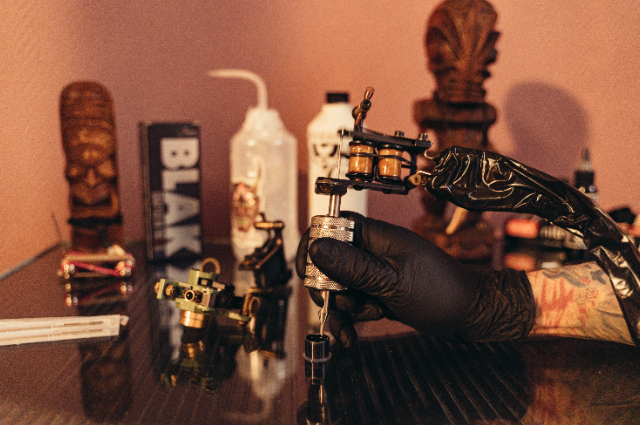
O'Reilly took the electric pen apart and made three main changes to turn it into something new. First, he added a small ink holder to the device. The original pen just punched holes in dry paper,r but a tattoo machine needed a steady supply of ink flowing down to the tip. Second, he changed the shape of the frame. The office pen was awkward to hold for a long time. O'Reilly made the shape fit comfortably in an artist's hand so their muscles would not get tired during long sessions. Third,d he changed the tip so it could hold three needles at the same time instead of just one single point. Holding more needles meant the machine could pack colour into the skin much better and create solid lines.
The results were amazing. The old hand tools could only manage a few pokes per second. O'Reilly's new electric machine could poke the skin fifty times every single second. A tattoo that used to take a whole day could now be finished in less than an hour. The lines were cleaner, and the colours looked much brighter because the needles went into the skin at a perfectly steady depth.
O'Reilly knew his invention was valuable, so he applied for an official patent. In the year 1891, the government granted him the patent for the first electric tattoo machine. This moment changed the history of body art forever. Suddenly tattoos were not just for sailors or outsiders. Everyday people in New York City saw how fast and clean the process was, and they wanted to try it too.
Thomas Edison was not happy about this. When he saw that O'Reilly was making money and getting famous, he tried to step in. Edison claimed that the tattoo machine was his idea because it used his electric pen design. He tried to take the credit and the rights to the invention. O'Reilly had to fight the famous inventor to protect his work. In the end, O'Reilly won. He proved that his changes were unique and that he had created an entirely new tool. The court let him keep his patent.
Winning the fight against Edison made O'Reilly even more famous. People loved the story of a regular sailor who outsmarted a wealthy inventor. By the year 1890, newspapers and customers were already calling him the best tattooer in the world. His shop in New York City became incredibly busy. People lined up down the street to get a piece of art from the man with the electric machine.
Before this invention, tattoos were mostly flat lines and simple shapes. The electric machine allowed artists to try new styles. They could shade colour smoothly and make pictures look realistic. It opened up a whole new world of creative choices. Other tattoo artists saw how successfulO'Reillyy was, and they wanted electric machines too. O'Reilly started building and selling his machines to other artists, which spread the technology across the country and then around the world.
It is interesting to look back at how O'Reilly started his life. He was not a traditional businessman or a trained engineer. He was a rough sailor who had even been in trouble with the law as a young man. Some records show he spent time as a burglar before he joined the Navy. He was an outsider who found a home in the tattoo world. Yet he had the vision to see something no one else saw. He took a failed piece of office equipment and turned it into a tool that created a global culture.
Every modern tattoo shop you see today owes its success to Samuel O'Reilly. The machines that artists use now are lighter and quieter than his first model, but they still operate on the same basic principles. They still use a motor to move needles up and down at high speeds with a steady flow of ink.
O'Reilly proved that great inventions do not always come from fancy labs or famous scientists. Sometimes they come from an ordinary person who looks at a problem and finds a clever way to solve it. He took a slow, painful art form and turned it into something fast, modern and beautiful. His machine did more than poke ink into skin. It built the foundation for the entire modern tattoo world.
References: