
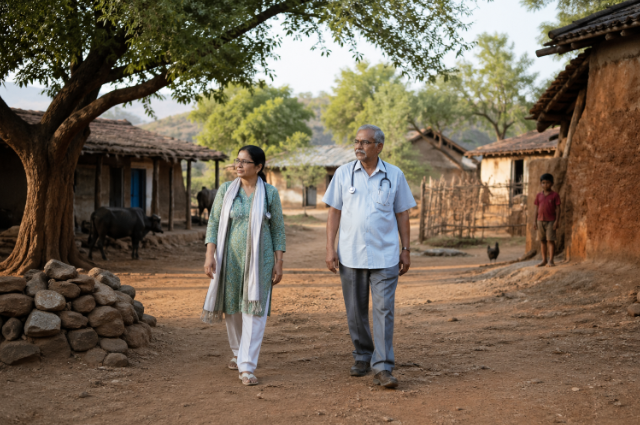
Marriage is quite popularly known as a communion blessed by God. But the prospect of no marriage has taken the world by storm by how one’s individual morals and values tend to clash with the other’s. There is one marriage that stands out when most relationships these days focus on convenience or success. It isn’t easy to give up the modern day luxuries of life that one has come to take highly for granted, to signify the importance of the wellbeing of the ones who don’t get these luxuries often. Dr. Ravindra Kolhe and Dr. Smita Kolhe’s marriage is a union which can only be called as an act of God to bring about the necessary good in the world. Their motivation is not about personal gain, but about supporting each other where it matters. Based in Maharashtra, their marriage gains strength from letting go, not holding on. Leading simple lives, their journey shows no signs of grandeur that one sees in any celebrity or even a civilian’s life. Their story began in a village in Melghat called Bairagarh, where the forgotten people of Amravati reside. He completed his MBBS degree from a Government Medical College and Hospital, Nagpur, Maharashtra, in 1982. One of his college professors, Dr. Jaju, instilled the pre-requisite mantra for practicing in remote areas, stating that to work as a doctor in remote areas, one must learn the three essential medical skills, namely conducting labor and delivery without the facilities such as ultrasonography and blood transfusion, making a diagnosis of pneumonia without X-Ray facility, and, lastly, mastering the cure for diarrhea in resource-limited settings. He was driven by a strong will to deliver social justice and that led him to use his medical knowledge to serve marginalized communities. After Dr. Kolhe graduated, he worked as a House Officer during 1984 to 1985. He then decided to explore the remote areas of Maharashtra and came across Bairagarh, a part of Amravati district. Bairagarh presented itself with significant challenges, such as geographical isolation, as the roadways of Amravati district ended at Harisal, and, thereafter, a person wishing to travel to Bairagarh had to travel 40 kilometers by foot. He started his medical practice at Bairagarh in 1985 for a meagre initial
consultation fee of Rs. 2 and subsequent follow-up at Rs. 1 only. He noted the extreme poverty and lack of basic infrastructure in the region. He lived in a simple house with basic amenities. An incident during his second week of medical practice turned his focus on seeking postgraduate expertise. He was faced with a crisis of a tribal man losing his hand in a blast; he realized that it was difficult as a young practitioner to face this situation. He realized that effective healthcare delivery in Bairagarh required him to pursue higher studies. He returned to Nagpur with a vow to complete an MD postgraduate degree before restarting his service at Bairagarh. In 1988, he completed the MD Degree in Preventive and Social Medicine and decided to get married before venturing back to Bairagarh. Dr. Ravindra Kolhe sought a partner who was ready to fulfill four requirements in order to marry him : She must be ready to travel forty kilometers to Bairagarh, she must agree to a court marriage where the legal fee for getting married through a court is five rupees, she must make do with a four hundred rupees monthly income, and be ready to collect alms if required for the welfare of the communities in Bairagarh. These conditions seemed impossible to every woman and almost every woman declined this marriage… except Dr. Smita Manjare. Hailing from Nagpur herself, she was a pioneering social activist and doctor with a degree in law and a certification in yoga therapy. Together, the couple ventured to Bairagarh with a deep desire to improve the health outcomes of the tribal community. In 1989 Dr. Ravindra Kolhe and Dr. Smita Kolhe got married and their life in Bairagarh began. Initially, the people of Bairagarh were hesitant about Dr Smita as she was a firm fighter for women’s empowerment. However, after two years, the couple expected their first child, but, unfortunately, they faced postnatal complications, with the infant being affected with severe pneumonia, meningitis, and septicemia. They were presented with the option to refer their child to the district hospital of Akola, but Dr Smita decided to continue treating their child with the limited resources available at Bairagarh, winning the respect and the approval of the villagers. Their choice blurred the gap between a doctor and their patient. A relationship strained by the large receipts of treatment was healed through the empathy and equality that the couple was determined to establish for the communities that w on the brink of extinction. Over almost three decades, their dedication transformed healthcare in Melghat. A time ago two hundred infants died for every thousand births, a mortality rate which is now reduced to nearly forty. Additionally, four hundred children per a thousand did not survive to school age, but today, one hundred do and live to make it and see adulthood. Charging such little sums in order to make healthcare accessible for the ones without any money, it soon became clear that medication alone wouldn’t address the area's issues.
Dr. Ravindra Kolhe pointed out that many lives were lost due to multiple reasons, including but not limited to poverty and disease. Cold exposure from lack of clothing led to issues, families faced hunger when fields laid barren resulting in illnesses. Witnessing the ignorance these issues faced, the Kolhes broadened their work beyond healthcare. They shared farming methods, introduced seed varieties to fungi and taught young people about agriculture. They also set up a state-run food distribution center to stabilize access for communities. Slowly but surely, change followed with a positive transformation of a region long marked by struggles for those who worked on the land.
Recognising her efforts and services for the communities, when a home had been offered to Dr. Smita Kolhe as a reward, she turned it down, instead advocating for infrastructural improvements like roads connecting the villages. Her response shifted the focus from personal benefit to community progress. As a result, Melghat now has roads, access to electricity and several nearby clinics providing affordable care.
In 2019, Dr. Ravindra Kolhe and Dr. Smita Kolhe received the Honorary Padma Shri Award, recognising their 35 years of service to the minorities and tribal communities in Melghat. Though they gained a high amount of praise, their daily lives changed very little, wherein each day still unfolded like the first, grounded in their surroundings and the people around them. Dr. Ravindra and Dr. Smita Kolhe are still together, not because of their success or loud recognition for their huge accomplishments, but a mutual desire and a quiet promise - to help - between them that helped them change the lives of over ten thousand tribals in the remote villages of Melghat.
Dr. Ravindra and Dr. Smita Kolhe's union is not marked by a spectacle but is widely recognised as one of the most successful philanthropy endeavours in history. Their marriage shows that sometimes quiet strength speaks louder than celebration and recognition. They began on two different paths as doctors when their journeys merged into something more than titles or awards. As little the applause for them was, one village after another felt the impact of their efforts towards the tribal communities. Their presence was enough to change the whole world around these communities where they settled health improved without fanfare. Soon, the ones who were ignored and invisible were brought to the world with a call for help. Their growth was neither sudden nor loud but the progress and the impact of the change stayed around even long after the headlines faded. In the stillness of Melghat, Dr. Ravindra and Dr. Smita Kolhe’s bond continues to strengthen, showing how empathy and dedication linked with intention can reshape lives. Because of this, their union stands out as one of Maharashtra’s quietest yet strongest partnerships that changed the world of medicine.
References :
- cureus.com
- thebetterindia.com
- thetimesofindia.com
- dailygood.com
- indiatoday.com
- readersdigest.com
- coffeeandconversations.in