
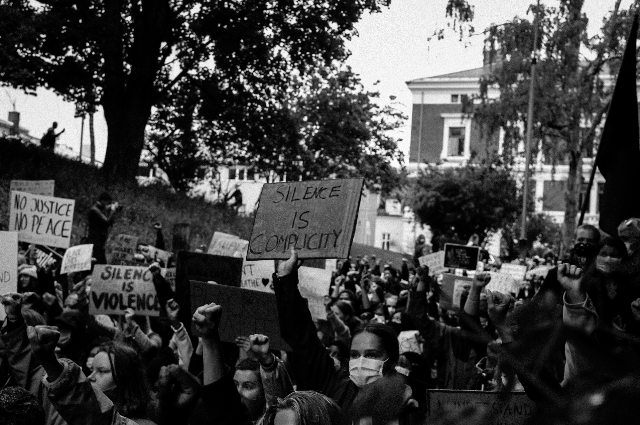
Public protests often present themselves as unified, as if everyone standing in the crowd shares the same anger, the same goals, and the same idea of justice, yet reality rarely works in such clean lines. The Worli protest became a moment where that illusion cracked, and where one woman, Teena Choudhary, stepped into that crack and forced people to look more closely. Her presence did not follow the expected script, and that is exactly why it mattered, because she did not arrive to echo the crowd; she arrived to question it, and in doing so, she shifted the conversation in a way that could not be easily ignored.
Teena Choudhary did something that many people hesitate to do in public spaces. She stood against a movement that claimed to speak for women, and she asked whether it truly represented all women, and whether its methods matched its message. This was not a comfortable position, and it was not designed to win easy support, yet it carried a kind of clarity that cut through the noise. When a protest claims moral ground, it also invites scrutiny, and Teena chose to take that invitation seriously, even when it meant standing alone.
The Worli protest itself had already drawn attention. It had gathered voices, signs, slogans, and energy, and like many protests, it framed itself as necessary and urgent. In that charged environment, disagreement can feel like betrayal, and questioning the movement can be dismissed as opposition to the cause itself. Teena refused that framing. She separated the idea of supporting women from the idea of supporting every protest carried out in their name, and that distinction is where her strength became visible.
Her stance disrupted a pattern that often goes unquestioned, where large movements assume they speak for everyone within a category, and where dissenting voices are pushed aside in the name of unity. Teena showed that unity without reflection can become exclusion, and that speaking for women without listening to all women risks becoming another form of silencing. This was not a rejection of the cause; it was a demand for honesty within it, and that demand forced people to reconsider what representation really means.
What made her intervention powerful was not volume or numbers, it was the refusal to blend in, and the willingness to carry a position that could not be easily simplified. In a space filled with slogans, she introduced questions, and questions have a way of lingering longer than chants. People may not have agreed with her, yet they could not fully dismiss her either, because she exposed a gap between intention and practice, and once that gap is visible, it becomes difficult to ignore.
There is a tendency to view protests as clear battles between right and wrong, between those who stand for justice and those who oppose it, yet Teena’s presence made that view complicated, and that complication is important. Real social change rarely comes from one direction, it comes from friction, from disagreement, and from the courage to challenge even those movements that claim to be on the right side. By stepping into that role, she expanded the space of what protest can look like.
Her actions also highlighted the importance of individual agency within collective movements. It is easy to disappear into a crowd and repeat what is already being said, and much harder to step forward and introduce a different perspective. Teena chose the harder path, and in doing so, she reminded people that participation does not have to mean agreement, and that true engagement often involves questioning rather than following.
The reaction to her presence revealed as much about the movement as her words did. It showed how dissent is handled, how quickly disagreement is labelled, and how willing people are to listen when their assumptions are challenged. Some saw her as disruptive, some saw her as brave, and others were unsure how to place her. Yet all of these responses point to the same fact: she made people stop and think, and that pause is where change begins.
Empowerment is often spoken about in broad terms, yet it becomes real in moments like this, where a person claims space, speaks clearly, and refuses to be reduced to a single narrative. Teena did not wait for permission. She did not adjust her message to fit expectations, and she did not step back when faced with resistance. This kind of presence carries its own force, and it encourages others to consider where they stand and why.
Her intervention also raises a deeper question about how movements grow and sustain themselves. Growth without reflection can lead to rigidity, and rigidity can weaken the very cause it aims to strengthen. By introducing a challenge from within the broader conversation around women’s rights, Teena contributed to a more honest and resilient form of dialogue, one that allows for disagreement without collapsing.
The significance of the Worli protest, in this context, is not limited to the event itself. It extends to the conversations that followed, the debates that emerged, and the awareness that representation is never complete. Teena’s role in that moment cannot be reduced to a simple label, because it exists in the tension she created, and in the space she opened for others to speak.
There is also something important about visibility here, since being seen and heard in a public space carries risks, especially when the message goes against the dominant narrative. Teena accepted those risks, and in doing so, she made it easier for others to imagine doing the same. Representation is not only about numbers, it is about the range of voices that are allowed to exist, and her presence expanded that range.
At the same time, her story challenges the idea that empowerment must always look unified and harmonious. Real empowerment often includes disagreement, conflict, and the willingness to stand apart. This does not weaken a movement, it strengthens it, because it prevents it from becoming stagnant and disconnected from the people it claims to represent.
The conversations sparked by her stance continue beyond the protest itself. They touch on how people define support, how they engage with causes, and how they navigate differences within shared goals. These are not easy questions, yet they are necessary, and they become visible only when someone is willing to raise them in a public and direct way.
Teena Choudhary’s role in the Worli protest stands as a reminder that change is not only driven by large groups and loud voices. It is also shaped by individuals who choose to question, to disrupt, and to speak with clarity even when it is uncomfortable. Her actions did not follow a predictable path, and that unpredictability is what gave them power.
In the end, empowerment is not about fitting into a movement. It is about shaping it, challenging it, and holding it accountable to its own values. That is what Teena brought into the open. She did not simply participate in a moment, she transformed it. In doing so, she showed that one voice, when used with intention and courage, can shift the direction of a conversation and leave a lasting mark.
Resources: