
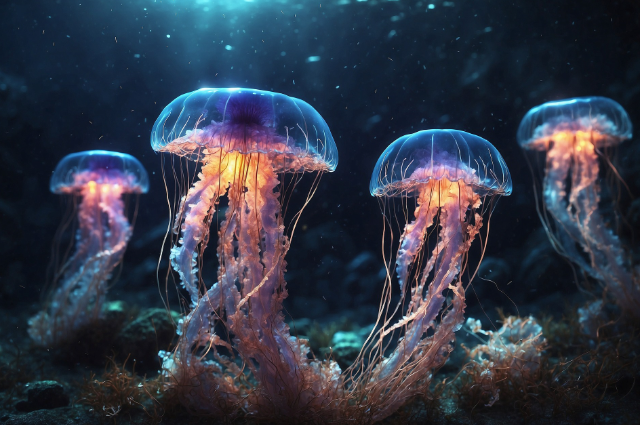
Try this. Drop a stone over the side of a boat and imagine following it down. For the first two hundred metres there is still light, blue and growing thinner. After that the colour leaks away until everything turns grey, and somewhere past a thousand metres even the grey is gone; the sun simply doesn’t reach that far. What lies below, all the way to the seafloor, is the largest living space on Earth, and for the most part it sits in complete darkness.
And yet it glows. The animals down there have spent millions of years working at a problem any of us would understand straight away: how do you tell anyone anything when there is nothing to see by? Their answer was to make their own light, cell by cell, and carry it with them into the black.
Calling that light “nature’s WiFi” is a stretch, I know. There is no router on the seabed, no network humming away in the dark. But in a world the sun never touches, where a sound only announces you to whatever is hungry and close, light becomes the way the deep sea speaks to itself- a way to warn off an attacker, to slip out of sight, to find a mate in all that emptiness, or just to say that you exist. It may be the most widely spoken language on the planet, and we have only recently begun to listen in.
The Dark That Glows
For a long time we treated glowing animals as oddities, rare flickers in an otherwise empty dark. It turns out we had it almost exactly backwards. In 2017, two researchers at the Monterey Bay Aquarium Research Institute, Séverine Martini and Steve Haddock, sat down with seventeen years of deep-sea footage and simply counted: every creature the cameras had caught between the surface and four thousand metres. Roughly three out of every four could make their own light, about 76 per cent of them. Among the jellyfish and their relatives it was nearly all, somewhere between 97 and 99.7 per cent.
So light is not the exception in the open ocean. It is closer to the rule. A second study, this one of animals living on the seafloor, found the glow a little rarer but still almost everywhere, present in close to half the species they looked at. Between them, the two pieces of work quietly turned the question around. The interesting thing is no longer why so many deep-sea animals glow. It is why a few of them still don’t.
Cold Light, Made to Order
The light itself is a simple chemical trick, and a very old one, invented over and over on branches of the tree of life that otherwise have nothing to do with each other. A molecule called luciferin meets oxygen, an enzyme called luciferase hurries the reaction along, and the energy comes off as light instead of heat. Cold light, biologists call it: almost nothing is wasted, and you could hold it against your skin without feeling a thing. Some animals brew all the ingredients themselves. Others can’t, and have to eat their way to a glow, taking the chemistry from whatever they swallow.
Most of that light is blue, and not by accident. Blue-green travels further through seawater than any other colour, and over millions of years the eyes of deep-sea animals have tuned themselves to catch exactly that range. It leaves the whole place speaking in a kind of shared default: you glow in blue because blue is what everyone else is built to see.
A Signal, a Signature, a Private Channel
The strangest example of light-as-conversation is also the clearest. A group of deep-sea predators called dragonfish have given up on blue altogether and make red light instead, from a small organ tucked under each eye, and down there almost nothing else can see red at all. That is the whole point. The dragonfish moves through the dark carrying a searchlight its prey cannot detect, reading the water on a private wavelength while everything around it stays blind. If most bioluminescence is broadcast in the open, this is a conversation no one else was ever meant to overhear.
Most signalling is friendlier than that, and works more like a name badge. Plenty of fish and squid wear rows of light organs, called photophores, laid out in patterns that belong to their species and no other. In the dark, those patterns read as a kind of signature, enough to recognise your own kind, to court someone, to keep a loose school together without ever being seen whole. The light is doing more than lighting the way; it is telling everyone nearby exactly who you are.
Hiding in Plain Light
Light can also make an animal vanish, which sounds like a contradiction until you see how it works. Even in the deep there is a last trace of sunlight sifting down from far above, not enough to see by, but enough to throw a faint shadow. A predator hanging lower and looking up can catch that silhouette against the glow. So the hunted learned to erase it: they line their undersides with light organs and shine gently downward, matching the dim wash from the surface until their outline melts into it. Counterillumination, it is called, and it is a peculiar kind of hiding, lit up to precisely the brightness that makes you disappear.
Lures, Alarms, and Smokescreens
Other animals push their light outward, to hunt or to get away. The anglerfish is the famous one: it dangles a glowing bead in front of its mouth like a lantern on a line, except the light isn’t even its own. It is made by bacteria the fish keeps and feeds for the purpose. Smaller creatures use light the opposite way, to stay alive. Certain dinoflagellates flash hard the instant something jostles them, a trick biologists call the burglar alarm: the sudden light draws in something bigger, which may then turn and eat whatever was bothering them. A cornered vampire squid does something stranger still, spewing a cloud of glowing mucus and slipping away while its attacker is left blinking in the sparkle.
Borrowed Light
A good deal of the ocean’s glow is, strictly speaking, borrowed. The anglerfish’s lure, the lamp of certain squid, the shine of all sorts of fish: much of it is produced not by the animal but by bacteria living inside it, housed in special pockets, fed and sheltered in return for their light. The bobtail squid, a small creature much loved by laboratories, hatches with no glow at all and then takes in a particular strain of bacteria from the water around it, using them to soften its own shadow as it hunts at night. The arrangement is so precise that the bacteria hold their light until enough of them have gathered to make it worth the trouble, a tiny roll-call in the dark that has become one of biology’s favourite examples of microbes sensing each other’s company.
The Jellyfish That Lit Up Biology
The ocean’s light did not stay in the ocean. In the 1960s, a chemist named Osamu Shimomura spent years coaxing apart the chemistry of a glowing jellyfish and drew from it a protein that shone green under the right light: green fluorescent protein, or GFP. For a while no one was quite sure what it was good for. Then biologists realised they could borrow the gene, stitch it into other living things, and use the glow as a tag, a way to watch a single cell light up, to follow a protein moving through it, to trace a cancer spreading or map the wiring of a brain. A faint green shimmer from a jellyfish became one of the most useful tools modern science owns, and in 2008 it was recognised with a Nobel Prize. The deep had been writing in light for millions of years. We finally learned to read a little of it, and then to use it ourselves.
What the Metaphor Misses
At some point the WiFi comparison gives out, and it is worth being honest about where. There is no protocol down there, no addresses, no messages in any sense we would really call language. What there is instead is harder to name and, I think, more astonishing: a whole world running on light, the same answer reached again and again by animals that never met, in a place we have barely set foot in. Most of the deep ocean has still never been seen by a human eye. Whenever we do go down to look, the thing worth holding onto is that it was never empty and it was never silent. It has been talking the whole time, in a language we are only beginning to make sense of.
References
- MBARI — “New study shows that three quarters of deep-sea animals make their own light” (2017). https://www.mbari.org
- Martini, S. & Haddock, S.H.D. (2017). “Quantification of bioluminescence from the surface to the deep sea demonstrates its predominance as an ecological trait.” Scientific Reports. https://www.nature.com
- Martini, S., Kuhnz, L., Mallefet, J., & Haddock, S.H.D. (2019). “Distribution and quantification of bioluminescence as an ecological trait in the deep-sea benthos.” Scientific Reports. https://www.ncbi.nlm.nih.gov
- Haddock, S.H.D., Moline, M.A. & Case, J.F. (2010). “Bioluminescence in the Sea.” Annual Review of Marine Science. https://www.annualreviews.org
- The Nobel Prize in Chemistry 2008 — Green Fluorescent Protein (Shimomura, Chalfie, Tsien). https://www.nobelprize.org
- Smithsonian Ocean — “Bioluminescence.” https://ocean.si.edu