
The song starts the way it always did. A woman walks toward the camera as the opening notes of Aapke Pyaar Mein begin, the track that once made her one of the most recognised faces on Indian television between films. Anyone who grew up with early 2000s Bollywood would know that melody instantly. What they would not expect is the setting behind her: not a film set, not a studio, but a farm in the Sahyadri hills, vegetables growing somewhere just out of frame. The woman is Malini Sharma, and this is the first time she has appeared on camera in twenty-three years.
The Face Everyone Half Remembered
In the late 1990s and early 2000s, Sharma was everywhere without quite being a film star, which was its own kind of fame. She built her name first as a commercial model in Mumbai, then as one of the defining faces of India’s booming non-film music video scene, appearing in Bombay Vikings’ Kya Soorat Hai and Mika Singh’s Saawan Mein Lag Gayi Aag, songs that ran on heavy rotation long before streaming existed. Television work followed, including a dual role in the serial Hum Dono. Then came Raaz in 2002, Vikram Bhatt’s supernatural horror hit, in which she played an obsessive, haunting presence opposite Bipasha Basu and Dino Morea. The role won her the Zee Cine Award for Best Female Debut and a Filmfare nomination alongside it. By any ordinary measure, a film career was opening up in front of her.
Two Days Before Shooting
She did not take it. Sharma had signed on to play the female lead in Gunaah opposite Dino Morea, and then, two days before shooting was due to begin, she walked away from it, saying simply that she wanted distance from the screen. It is a striking thing to do at the exact moment an industry is asking you to become one of its faces, and Sharma did not treat it as a door closing so much as a door she chose to shut herself. She stayed near the industry for a while longer, but from behind the camera rather than in front of it, working as an art director on two films, Thoda Pyaar Thoda Magic and Just Married. Somewhere in there, acting simply stopped being the thing she did.
Her personal life had its own quiet chapter around the same time. She married the actor Priyanshu Chatterjee in 1997; the marriage ended in divorce in 2001. Beyond that, she said very little publicly, then and for two decades afterwards. There was no dramatic farewell to the industry, no interview explaining the choice in full. She simply stopped appearing, and the distance she had asked for at twenty-five became a distance that lasted most of her adult life.
What She Was Building in the Silence
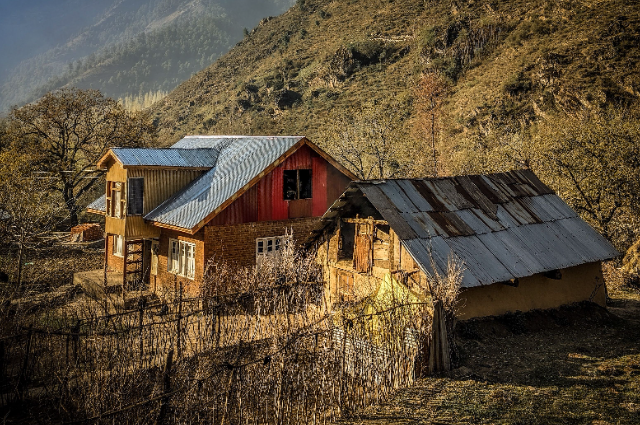
What she was building in that silence has only become visible now. Sharma relocated to a village in the Sahyadri hills, roughly two hours from Pune, and set up a small homestay there called The Slow Local. It is a working farm as much as a place to stay: she grows vegetables on the land herself and cooks for the guests who come through, a life built around slowness in more or less the literal sense of the word. For years this existed quietly, known mostly to the people who found their way to it, until pictures and videos from the property began circulating online and viewers started to notice that the woman running this peaceful farmstay was the same face they remembered from Raaz.
Rather than retreat from that attention, Sharma leaned into it, on her own terms. She launched a video series called The Slow Local Diaries, documenting the rhythms of the farm and the life she has built around it. In the first instalment, she addressed the very question that had followed her online, telling people, in effect, that she was alive and simply had a new story to tell. Then came the video revisiting Aapke Pyaar Mein, the song from Raaz that had once introduced her to millions, sung again more than two decades later, not on a film set but on the land she now calls home.
Not a Comeback, a Reveal
It would be easy to describe this as a comeback, and easier still to wonder, as some fans immediately did online, whether an acting return might follow. That reading misses what actually happened. Sharma has not signalled any interest in returning to film or television. What she has done is something quieter and, in its way, more interesting: she has finally let people see the life she chose over acting, on the same terms and with the same song that once made her famous, but with the meaning of both entirely rewritten. The attention that followed even became enough of a burden that she had to ask people, gently, to stop calling the farmstay directly, since it was a small operation being overwhelmed by sudden curiosity.
There is something worth sitting with in a story like this, especially at a moment when public life so often rewards constant visibility. Sharma had the version of fame most young actresses are told to want, the hit film, the award, the recognisable face, and she chose to step away from it at the height of it, toward a life of vegetables, guests and quiet hills instead. Two decades on, she has not undone that choice by returning to the screen. She has simply, finally, shown her audience what she chose instead, and let the same old song mean something completely new.
References:
- Wikipedia: “Malini Sharma.” https://en.wikipedia.org/wiki/Malini_Sharma
- Brut India: “Remember Malini Sharma From Raaz? Here's What She Does Now.” https://www.brut.media
- MissMalini: “Who Is Malini Sharma? All We Know About The Raaz Actress Who Is Now Going Viral Again.” https://www.missmalini.com
- Wikipedia: “Raaz (2002 film).” https://en.wikipedia.org