
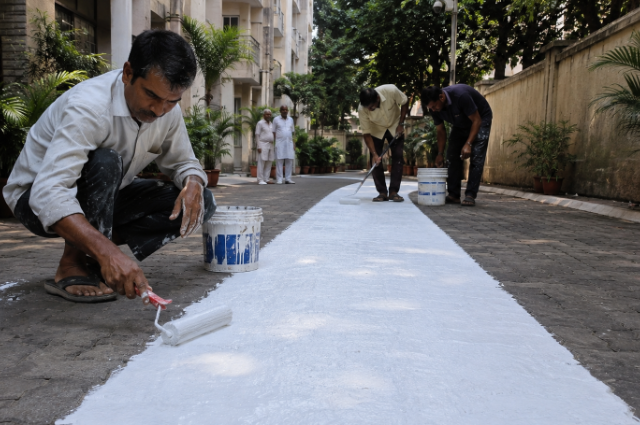
It started with a line of white paint on a path, and within about a week it had collected a viral video, a police inquiry, two separate complaints pointing in opposite directions, a suspended Instagram account, a chief minister asking everyone to calm down, and party workers in three Mumbai neighbourhoods busy either painting stripes or scrubbing them off. Buried somewhere underneath all of that was a fairly ordinary question about who gets to decide what happens in the shared spaces of a housing society. By the time the dust settled, almost nobody was arguing about that question any more.
A Strip of White Paint
The setting was Kailas Avenue Society in Ghatkopar, in Mumbai’s eastern suburbs. Ahead of the monsoon, a white coating was applied to a stretch of common pathway inside the complex, meant to ease the passage of Jain monks who visit homes on foot to collect alms. The reasoning, once you hear it, is gentler than the fight that followed. Bhoomi Sanghvi, the resident who had arranged for the line to be drawn, explained that during the rains a film of moss spreads across the society’s paver blocks, and that moss is alive with tiny organisms. Jain monks, bound by a vow of ahimsa that extends to the smallest creatures, will not walk where they might crush them and so, in the wet months, they simply stop coming to the societies. The pale coating was an attempt to keep a clear path open for them.
It was not a one-off. Similar white markings were going up across Ghatkopar that season, on footpaths and inside other complexes, in the run-up to Chaturmas, the four-month monsoon period during which monks halt their wandering and stay in one place. In the fierce pre-monsoon heat, residents pointed out, the reflective white also kept the tar from scorching bare feet. None of this was new to the families who had grown up around the practice. To them it was a small, familiar courtesy.
The Video
Prasad Vedpathak saw it differently. A social media influencer with long-standing ties to the property, he posted a video questioning the whole thing, and the video travelled fast. His stated objection was procedural: a permanent, oil-painted marking had been laid down in a shared area without consulting or seeking the approval of all the residents who own that space in common. Common areas, he argued, should not be altered for any one group without a proper discussion, and he asked whether a comparable request from followers of another faith would have been waved through as quietly. Put plainly, it is not an unreasonable question, and plenty of people who have sat through a fractious housing-society meeting would recognise it.
But the video did not stay on that ground. According to a complaint later filed against him, Vedpathak reached for the phrase “Jain Jihad” and made remarks his critics read as deliberately provocative. That was the hinge. The moment a disagreement about paint on a shared path was given the vocabulary of a religious conspiracy, it stopped being a society matter and became something far harder to put down.
Police at the Door
As the clip spread, the dispute reached the police. Officers from the Ghatkopar police and the Criminal Investigation Department visited the society to work out how and why the markings had been made. They also went to Vedpathak’s home and conducted a preliminary inquiry — the police at the door of the title. Vedpathak, for his part, said he had begun receiving threats and had asked for protection. His Instagram account was, around the same time, suspended.
At the level of the society itself, the row was actually settled, and settled quickly. With the police mediating, residents reached an understanding, the disputed strip was repainted to match the surrounding pavement, and Vedpathak issued a public note thanking the journalists who had covered the matter. Had the story ended there, it would have been a minor parable about neighbours and shared walls. It did not end there.
Two Complaints, Two Grievances
A second front had opened, and this one was about words rather than paint. Pravin Chheda, a BJP corporator and former Leader of the Opposition in the city’s municipal corporation, went with members of the Jain community to meet a deputy commissioner of police and submitted a written complaint seeking a case against Vedpathak over the “Jain Jihad” remark. The charge, in essence, was that he had stirred hostility against a small and famously peaceable community and defamed it in the process. Chheda’s defence of the practice was brisk and practical: the paint protected monks who walk barefoot over summer tar, much as some Hindu temples mark out white paths for their own devotees, and it was a convenience rather than any kind of claim on territory. He added, pointedly, that Jainism is not the preserve of Gujaratis and Marwaris alone.
So the city now held two grievances that never quite met in the middle. One was about dignity and the danger of communal language aimed at a minority. The other was about consent, ownership and the quiet way a shared space had been changed. Both had something real in them, and each side largely heard only its own.
The City Picks Sides
By then the paint had outgrown the society altogether. White markings of the same kind in Dadar and Girgaon drew protests from the Maharashtra Navnirman Sena and the Shiv Sena (UBT), who cast them as an encroachment on public roads. In Girgaon, someone painted black over a white strip; MNS workers and members of a local outfit, the Amhi Girgaonkars, demonstrated, and the police detained several of them. The municipal corporation began scrubbing the stripes off public roads or spraying them over in black. What had started as a question between neighbours had been absorbed into Mumbai’s older and rawer argument about migration, identity and whose customs get to be written onto the streets.
Harmony, on Request
Into this stepped the chief minister, Devendra Fadnavis, who appealed for harmony and said that if a community follows a tradition it should be free to keep it while others extend it some respect. He was blunt about the politics, too, suggesting that those inflaming the issue were chasing attention and that pitting one community against another brought no one any gain, electoral or otherwise. It was a sensible thing to say. It was also, by that stage, being said over the heads of an argument that had stopped listening.
What the Row Was Actually About
Strip away the noise and the original question is genuinely a fair one: can a housing society repaint a common path for the needs of one group without first asking everyone who shares it? It is also a question with a dull, available answer — a residents’ meeting, a show of hands, a minute in the register. The reason it never reached that answer is that, very early on, it was renamed. Once a disagreement about a pathway was branded a “jihad,” it could no longer be solved by neighbours, because disputes in that language do not belong to neighbours any more; they belong to parties, and parties are not in the business of settling them.
The strangest part is what sat at the centre of it the whole time. The paint existed so that a monk would not have to crush the small lives hidden in a skin of monsoon moss. A custom built around not harming the least visible creature alive became, within a week, a quarrel that left almost no one in it unharmed.
References:
- Lokmat Times — “White Line Drawn for Jain Monks in Ghatkopar Housing Society Triggers Row; YouTuber Prasad Vedpathak Alleges Threats.” https://www.lokmattimes.com
- Pune Pulse — “White Line For Jain Monks Triggers Controversy In Mumbai Society, Police Launch Probe.” https://www.mypunepulse.com
- Free Press Journal — “Mumbai Society Repaints White Pathway After Online Row Over Jain Monks’ Route; Activist Says Issue Resolved.” https://www.freepressjournal.in
- Oneindia — “Jain Jihad remark row: BJP corporator seeks police case against Prasad Vedpathak.” https://www.oneindia.com
- Free Press Journal — “Maharashtra CM Devendra Fadnavis Appeals For Harmony Amid White Stripes Row On Mumbai Roads For Jain Monks; MNS Protests.” https://www.freepressjournal.in
- Deccan Chronicle — “Fadnavis Slams Row Over White Road Strips For Jain Monks.” https://www.deccanchronicle.com