
On the evening of 7 May 2025, two women in two different uniforms walked into a briefing room in Delhi and, for the next half an hour or so, became the official voice of the Indian state.
Colonel Sofiya Qureshi of the Indian Army’s Corps of Signals spoke first, in Hindi. Wing Commander Vyomika Singh of the Indian Air Force followed, in English. Between them, with Foreign Secretary Vikram Misri to one side, they walked the country and the watching world through Operation Sindoor — the tri-services precision strike India had carried out hours earlier on nine sites across Pakistan and Pakistan-occupied Kashmir, in response to the terror attack at Pahalgam in April that had killed twenty-six people, most of them tourists.
It was, in the most literal sense, a working briefing. There was a map. There was footage. There was a careful, lawyered cadence around what had and had not been targeted. India had struck terrorist infrastructure; Pakistani military establishments, the country was told, had not been hit. Two officers had done their job.
It was also one of the most-photographed moments in the recent history of Indian women in uniform.
For the first time in Indian military history, the two voices delivering an official account of a major strike were both women.
One came from the Army, from the Corps of Signals, from a parade ground in Pune nine years earlier.
The other came from the Air Force, from over two thousand five hundred hours in a helicopter cockpit above some of the most punishing terrain India patrols.
Colonel Sofiya Qureshi: the woman of the earth
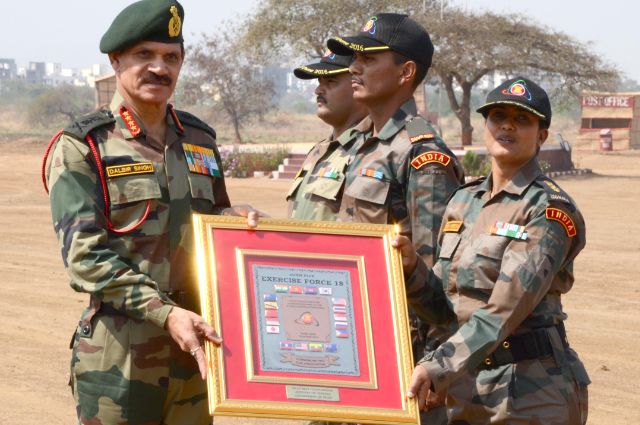
Nine years before that briefing, on a parade ground in Pune, a thirty-five-year-old Lieutenant Colonel from the Corps of Signals stepped forward at the head of a forty-strong Indian Army contingent. The exercise was Force 18, the largest multinational military drill India had ever hosted at the time. Eighteen ASEAN-plus nations had sent contingents — the United States, Russia, China, Japan, Australia, New Zealand, Korea, among others.
The exercise focused on peacekeeping and humanitarian mine action. Eighteen contingents marched in. Exactly one of them was led by a woman.
It was the first time in the history of the Indian Army that a woman officer had commanded an Army contingent in a multinational military exercise.
In an interview given years later, Qureshi would put it simply: “It was about skill, not gender. I was proud to lead.”
To understand why she was the person India sent to that parade ground, it helps to go back further. Sofiya Qureshi was born in 1974 in Vadodara, Gujarat, into a family where the uniform was not unfamiliar; her grandfather had served in the Indian Army. She studied science, took her postgraduate degree in biochemistry from Maharaja Sayajirao University of Baroda, and might have stayed in a lab. She did not. In 1999, she was commissioned into the Corps of Signals from the Officers Training Academy.
The Corps of Signals is the part of the Army that runs communication, encryption, and the wiring that lets one part of the force speak to another.
It is the kind of indispensable specialisation that produces officers who are good at calm explanation under pressure.
By 2001, still early in her career, she was part of the team that helped develop the Army’s first mobile digital communication network. In 2006, she was deployed to the Democratic Republic of Congo as part of the United Nations Peacekeeping Mission — by some accounts, the first Indian woman to serve as a military observer there. She went on to study at the Defence Services Staff College in Wellington and later at the National Defence College in Delhi, focusing on strategic cybersecurity.
This is the long, quiet, mostly unphotographed half of a soldier’s life. Operations. Postings. Schools. Commendation cards from generals nobody outside the Army has heard of. It is the part of her career that did not trend.
Then came Pune. Then, nine years later, came Delhi.
Wing Commander Vyomika Singh: the woman of the sky
The other officer at the microphone that evening had decided to fly when she was eleven.
In a now widely repeated story, Vyomika Singh was in Class 6 when a teacher, going through the meanings of every child’s name in the room, got to hers. Vyom, the teacher said, means sky. Vyomika, then, means the one who owns it. Something in the girl decided then and there that she would. She joined the National Cadet Corps in school. She studied engineering. She became, in the end, the first person in her family to wear a uniform.
In December 2004, she was commissioned into the Flying Branch of the Indian Air Force. From there, she did what helicopter pilots in the IAF do — she flew. Chetaks and Cheetahs over Jammu and Kashmir, over the Northeast, into high-altitude sectors where the air is thin enough to make a rotor feel like it is grasping at nothing. Over the years, she would log more than two and a half thousand flight hours. Reconnaissance. Troop movement. Disaster relief. The kind of flying that does not make the evening news because everything went the way it was supposed to.
The pieces that did become public are striking in their own right. In November 2020, in Arunachal Pradesh, she led a twenty-eight-day mission to recover personnel and equipment stranded on a snow-covered peak near the border, using a “low hover” technique amid tall trees and unpredictable weather. In 2021, she joined an all-women tri-services mountaineering expedition to Mount Manirang, at over twenty-one thousand feet — women in extreme endurance roles, photographed in oxygen masks against a sky that, finally, looked like hers.
But there is a quieter and more significant date in her file. On 18 December 2019, after years in which women in the IAF’s flying branch could serve but not stay — could fly the missions but not access the same career permanence as their male peers — she was granted a Permanent.
Commission. The shift, which followed a long policy and legal battle around women’s permanent commissioning in the armed forces, meant that women like her could finally serve in leadership roles with the same benefits as men. It is the kind of paperwork milestone that does not photograph well. It is also, in many ways, why she was eligible to stand at that podium five and a half years later.
What it meant to send both of them
There is a temptation, when two women are placed at the centre of a national moment, to flatten them into a single image. Two women in uniform, briefing the nation. Cut to the still photograph. Roll the inspirational soundtrack. Move on.
But the two of them did not arrive at that microphone by the same road, and pretending they did would do a quiet violence to both their careers.
Col. Qureshi came from the Army’s nervous system. From signals, from cyber, from the years-long discipline of being the person who can explain, calmly and precisely, what has just happened on a battlefield. From a parade ground in Pune in 2016, where she had already walked into a room where no woman had stood before. She briefed in Hindi.
Wg Cdr Singh came from the sky. From a cockpit, from snow-covered peaks in Arunachal, from a child’s decision in a Class 6 classroom that has, against the odds, held. From a permanent commission, she received only in late 2019. She briefed in English.
What both of them being in that room at once meant was something larger than either of their individual stories. It meant the Indian state, on a day when it had reached for force, had chosen two women to be the face and voice of that force. Not as decoration. Not as a gesture. As the people best placed, by service and specialisation, to tell the country what its armed forces had just done.
It is easy to forget that this had never happened before. Decades of briefings in Indian history, and the official tri-services voice on the day of a strike had never been, until that evening, a woman, let alone two.
Across the country, schoolgirls watching the news that night were watching two women, in two uniforms, calmly explaining a military operation to their own nation. In Lucknow and Vadodara and Kolkata and small towns nobody on cable news will ever name, the picture rearranged a quiet thing in many young heads — the picture of who gets to stand at the microphone when a country decides to speak.
Col. Sofiya Qureshi and Wg Cdr Vyomika Singh did not ask to become symbols. They walked in to do a job. The image went where it went anyway.
The woman of the earth.
The woman of the sky.
And somewhere, a girl who was eight years old on 7 May 2025 is going to grow up assuming this is just what officers look like. That is, in the end, the quietest and the most far-reaching kind of revolution there is.
References
- “Who Is Colonel Sofiya Qureshi and What Did She Achieve in Operation Sindoor?”, The Better India, 8 May 2025
- “Who is Colonel Sofiya Qureshi, the Indian Army officer who briefed India on Operation Sindoor?”, India Sentinels, 7 May 2025
- “Who is Colonel Sophia Qureshi? The trailblazing Army officer who briefed India on Operation Sindoor, Business Today, 7 May 2025
- “Sofiya Qureshi”, Wikipedia•
- “Wing Commander Vyomika Singh Takes National Spotlight After Operation Sindoor Briefing”, She Inspires Magazine
- “Wing Commander Vyomika Singh — Early Life, Career, Achievements”, Vajiram & Ravi, 12 May 2025
- “Inspiring Story of Wing Commander Vyomika Singh”, Officer's Details
- “Lieutenant Colonel Sophia Qureshi and Wing Commander Vyomika Singh”, Goodreturns, 10 May 2025