
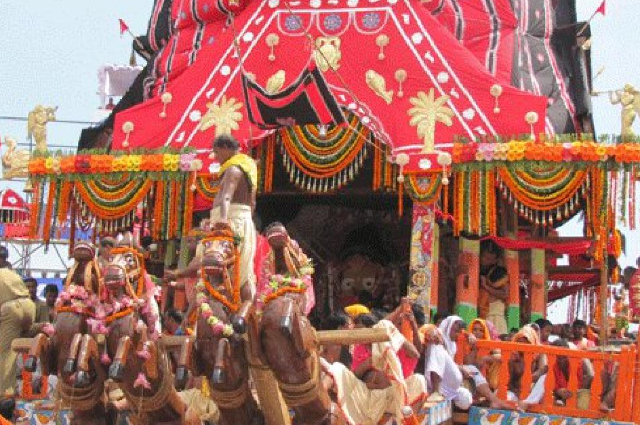
Every summer in Puri, on the coast of Odisha, three wooden towers roll down a wide avenue on the shoulders of an enormous crowd. The tallest stands around forty-five feet high, higher than a four-storey building, riding on sixteen great wheels, and thousands of people haul it forward on thick ropes. It carries a god. And in the whole of it, across all three of these vast machines, there is not a single nail, not a screw, not one scrap of iron or steel. That is not an accident, and it is not a limit the builders have failed to overcome. It is the point.
Temples on Wheels
The chariots belong to the Rath Yatra, the festival in which Lord Jagannath, his brother Balabhadra and their sister Subhadra leave their temple once a year and travel, in public, through the streets. Each deity has a chariot, and each chariot has a name. Jagannath rides Nandighosh, the tallest, on sixteen wheels. Balabhadra rides Taladhwaja, a little lower, on fourteen. Subhadra rides Darpadalana, smaller again, on twelve. Their sizes, their colours and their shapes are fixed by a scheme laid down centuries ago and never altered since.
These are not vehicles in the way a cart is a vehicle. They are closer to temples that happen to move, sanctums built for a single journey. The sight of them bearing down the avenue so struck visiting Europeans that they took a version of the god’s name home with them: “juggernaut,” the English word for an unstoppable, crushing force, comes from Jagannath and these very chariots, wrapped up in a colonial myth about devotees hurling themselves beneath the wheels that was mostly invention.
No Nails, and Yet They Hold
What makes the chariots a quiet marvel is that they are rebuilt from nothing every single year, and held together by wood alone. Around two hundred craftsmen do the work, members of hereditary carpenter families known as Maharanas, whose right and duty this has been for generations. They work without a single drawing or manual. There are no measurements in feet or inches; sizes are reckoned in haat, the length of a hand, and anguli, the width of a finger, carried in memory and handed on by doing. Year after year, out of that ancestral knowledge alone, they turn out chariots that come very nearly identical.
In place of nails they use the wood itself. Large wooden pegs, joints cut to lock into one another, and rope bind the whole thing together, in a method known locally as salabendha. It sounds precarious, and it is not. These are objects that will carry priests and attendants and then be dragged the length of the Grand Avenue by a straining crowd, and they manage it on joinery a carpenter from a thousand years ago would recognise, without a gram of metal anywhere to help.
Wood That Is Treated as Alive
The material is chosen as carefully as it is joined. The chariots are made from particular sacred trees, among them phassi, dhausa and simili, identified through a ceremonial forest search and, by tradition, worshipped before they are felled. The signal to begin comes from the temple itself, as a garland sent to mark divine consent. More than eight hundred trees go into a single year’s chariots; in the older practice the logs were floated down the Mahanadi river as rafts and gathered near Puri. The timber is handled less like raw material than like something alive.
That is not only poetry. In this tradition, wood is the very stuff of the divine. The images of Jagannath and his siblings are themselves carved from neem, and are periodically renewed in a solemn rite rather than kept forever. A god who is made of wood, and remade, sits easily in a chariot of the same substance. Metal simply belongs to a different order of thing.
Why No Metal, Then?
So why no iron, and no steel? The honest answer is that the rule is older than any single explanation offered for it, and devotees and scholars tend to reach for several reasons at once. The first is purity. The chariot is a consecrated object, a temple in motion, and tradition holds that it should be built of living, sacred wood; metal has no sanctioned place in that scheme, and some add that iron, bound up as it is with tools and weapons, carries associations of violence that do not suit a deity’s ride. The second is continuity. The design has been kept deliberately unchanged for centuries, and the absence of metal is part of exactly what is being preserved; to introduce steel would be to break faith with the thing itself. The engineering, in other words, is not the reason. It is only the proof that the reason works.
Built to Be Unbuilt
There is one more idea folded into all this, and it is the one that lingers. The chariots are meant to be temporary. After the festival, once the deities have come home, the great structures are taken apart. Some of the wood is auctioned; much of it goes to the temple kitchen, to feed the fires that cook the food shared with pilgrims, so that even in ending the chariot keeps serving. None of it drifts off into ordinary commercial use. And the next year the whole labour begins again from the first log, identical and completely new.
A steel chariot could be built once and wheeled out every summer for a century. That is precisely what this tradition refuses. The aim is not to make something that lasts; it is to make it again, by hand and in full, each time. The Gajapati king of Puri catches the spirit of it during the festival when he sweeps the chariot floors with a golden broom, the ruler as servant. Even a king, even a god, sets out afresh.
What the Absence Is For
Ask why these chariots have no steel, then, and the plainest answer is that steel would miss the point of them completely. They are not machines built to endure. They are acts of devotion, made to be built, offered and let go, and then built once more. The wood is chosen because it is alive, joined because the craft is inherited, and dismantled because renewal matters more than permanence. Iron would outlast the faith. The wood is meant to be renewed alongside it.
References:
- Rath Jatra (Government of Odisha official portal): “Chariots.” https://rathjatra.nic.in
- Odisha Bytes: “No Manuals, No Machines, No Feet Or Inches But Identical Year After Year: The Making Of Jagannath Rath Yatra’s Chariots.” https://odishabytes.com
- The Bridge Chronicle: “Temples on Wheels: Inside the Sacred Art of Making Jagannath’s Chariots.” https://www.thebridgechronicle.com
- Free Press Journal: “Jagannath Yatra 2026: Lord Jagannath’s Chariots Are Built Without A Single Iron Nail.” https://www.freepressjournal.in
- Jay Jagannath: “Rath Yatra Chariots Are Rebuilt Every Year, Not Reused.” https://jay-jagannath.com