
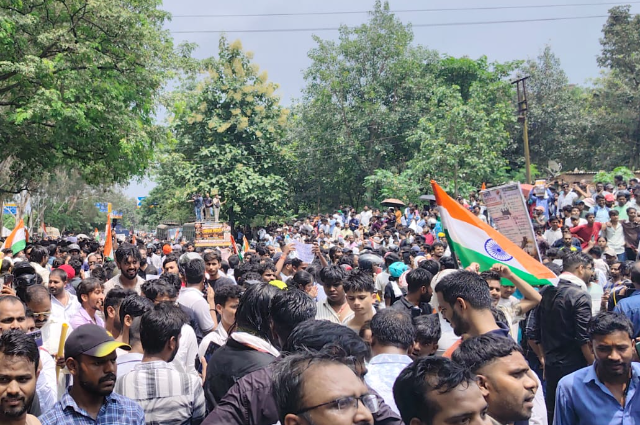
Two stages have gone up at Ranchi’s Jaipal Singh Munda Stadium this August, facing each other across the same field, and the crowd between them cannot quite agree which one speaks for it. Hunger strikers sit ringed by portraits of Ambedkar, Gandhi and Bhagat Singh, a few of them holding copies of the Constitution against their chests. Political leaders from more than one party have walked the grounds on the very same afternoon. And every so often a voice comes over the loudspeaker to remind the crowd, again, that no party owns this stage, before the chant rises on its own: politics will not work here, long live student unity.
It is an odd thing to keep insisting on. The students filling that stadium are angry about precisely the kind of failure politics exists to fix: government jobs, government exams, government accountability. And yet the one message repeated more often than any other, from either stage, is not a demand aimed at a party. It is a demand that no party come near the demand at all.
A Viral Answer Sheet, and a Longer History
The trigger was small and oddly specific. About a month before the protest began, a copy of a successful candidate’s answer sheet from the Jharkhand Public Service Commission’s preliminary exam started circulating online. It showed he had answered fewer than half the questions on one paper and still cleared the round. Police eventually arrested him, along with ten others accused of running the leak behind it. None of that settled anything, because for the students who kept gathering at the stadium, this was never really about a single exam.
Jharkhand’s recruitment exams have carried a taint almost since the state was carved out of Bihar in 2000. A leaked history paper forced a cancellation in 2003. A 2012 exam produced a CBI case naming successful candidates who were related to sitting politicians and commission officials, and the resulting charges were filed a full 12 years later. A 2024 recruitment drive was cancelled over a leak and then stuck in court for more than a year. The firm handling this year’s exam, TSR Data Processing, had already been blacklisted once, for pulling out of an earlier contract midway, and was hired again regardless. For aspirants who have spent years cycling through this, the toll is less about any one scandal than about the accumulation of them. One protester in his mid-thirties, who has cleared the early rounds of the state’s exams seven times over without ever landing the job, described the entire process itself, the waiting, the cancellations, the endless delay between rounds, as having become a kind of punishment in its own right.
What the Students Want, and What They Got
What the protesters are asking for is specific. They want this year’s JPSC civil services exam and the JSSC’s combined graduate level exam both cancelled, TDPL barred permanently from ever running a Jharkhand exam again, and, above everything else, a Central Bureau of Investigation probe rather than one run by the state’s own Crime Investigation Department, on the reasoning that a state inquiry cannot be trusted to look hard at the state’s own officials.
The government of Chief Minister Hemant Soren has not simply waited this out. By the middle of August it had cancelled the JSSC-CGL exam, blacklisted TDPL and voided the results tied to it, widened the CID’s inquiry back to 2014, set up a reforms committee under a senior civil servant, and floated both a judge-led panel for the CGL matter and a separate probe into alleged financial irregularities. Judged against how state governments usually respond to street pressure, it is a substantial list of concessions. It has still not been enough for the protesters, because the demand sitting at the very centre of the movement, an investigation the state itself has no power to order, is the one concession Soren’s government cannot simply grant. Talks between the two sides have broken down more than once over exactly that gap.
The Case for Staying Apolitical
None of that, on its own, explains the insistence on staying apolitical, so it helps to listen to how the students organising the protest describe their own reasoning. One member of the core committee running the main stage has said, in essence, that the group grew wary of the platform slowly turning into a party’s platform, and made a point from early on of telling any visiting leader not to bring their party’s agenda anywhere near the microphone. Another organiser, who says he already carries three police cases from earlier, shorter protests in Ranchi, has pointed to a different kind of evidence entirely: weeks earlier, in Delhi, a similarly non-partisan, youth-led movement calling itself the Cockroach Janta Party kept up pressure over a leaked medical entrance exam until the Union Education Minister resigned. That outcome, he has said, is what convinced this group that an indefinite protest, held at arm’s length from any party, could actually force a government’s hand.
Put plainly, staying apolitical here looks less like a matter of principle and more like a fairly hard-headed tactic. A demand that belongs to no party is a demand a government finds much harder to write off as opposition mischief. A crowd built out of thousands of aspirants who otherwise vote every possible way stays large only for as long as the grievance is about jobs and fairness rather than about who holds power. The moment either of those things breaks, the leverage tends to go with it.
A Magnet Nobody Could Resist
Saying that, though, has proven far easier than enforcing it, because a stadium full of angry young people turned out to be a magnet nobody in Jharkhand politics could quite resist. On a single afternoon in early August, leaders from the Congress-affiliated National Students’ Union of India and Indian Youth Congress met the hunger strikers on one stage while the BJP-aligned Akhil Bharatiya Vidyarthi Parishad arrived fresh from its own march nearby and burned an effigy of the chief minister. A member of a religious organisation showed up separately and told reporters, in effect, that the chief minister ought to step down on moral grounds if the students’ peaceful appeal went unanswered, an argument he pointedly modelled on the Delhi minister’s resignation. The opposition’s state leader brought his own delegation to meet the students and used the moment to press the CBI demand himself. Every visitor arrived offering solidarity. Each arrival was also, unmistakably, a party trying to stand a little closer to a popular cause than its rivals.
The clearest evidence of how hard the students have had to work to keep their distance is the second stage itself. It belongs to the youth wing of a regional party, whose members set up their own independent hunger strike once the core student committee declined to let the party help lead the movement. One of those strikers has been compared in the press to Sonam Wangchuk, the Ladakhi activist behind this year’s Delhi protest, and carries a string of pending criminal cases his colleagues attribute to earlier rounds of student activism. Whatever the truth of that particular history, the split itself says something the chants alone cannot: even a sympathetic political ally was not folded into the students’ own stage, and had to go build one of its own instead.
Where the Line Has Started to Fray
It is worth being honest that the line has not held perfectly. As the agitation stretched past three weeks with its central demand still unmet, a faction organising under a separate banner went further than the original core committee ever had, calling openly for the chief minister to resign and urging the Congress, the ruling party’s coalition partner in the state assembly, to walk out of the government altogether. That is not a neutral position by any reasonable definition. It is a direct partisan demand, and it shows what tends to happen to almost any protest that runs on long enough without getting what it came for. Patience wears thin, some participants move faster than others toward harder positions, and the discipline the main stage worked so hard to establish starts fraying at its edges even while the loudspeaker keeps repeating the same chant it started with.
A Discipline, Not a Guarantee
None of this makes the apolitical framing dishonest. It looks closer to a fragile discipline that a group of students keeps having to defend, over and over, against a political system that keeps trying to adopt them, sometimes out of genuine sympathy and sometimes for the votes a viral grievance can bring. Whether that discipline survives long enough to reach an actual CBI order, or quietly dissolves into the coalition politics it was built to resist, is the real question still hanging over that stadium once the television cameras and the party delegations eventually pack up and leave. For now, the chant keeps going, because for now, it remains the one thing every stage on that ground can still agree to shout together.
References
- ThePrint: “Jharkhand students are protesting ‘cycle of paper leaks’ CJP-style. It began with a viral answer sheet.” https://theprint.in
- ThePrint: “Anatomy of Jharkhand protests: 2 stages, 8 on hunger strike, a quest to be ‘non-political’.” https://theprint.in
- Organiser: “How Jharkhand students forced Soren govt to act on recruitment irregularities.” https://organiser.org
- The Indian Tribal: “JPSC-JSSC Protest: Jharkhand Govt Agrees to Cancel 14th JPSC Exam, But CBI Probe Demand Keeps Standoff Alive.” https://theindiantribal.com
- Organiser: “Jharkhand Students to Hemant Soren as Protest Intensifies: Fulfil Demands by August 18.” https://organiser.org
- Wikipedia: “2026 Jharkhand student protests.” https://en.wikipedia.org