
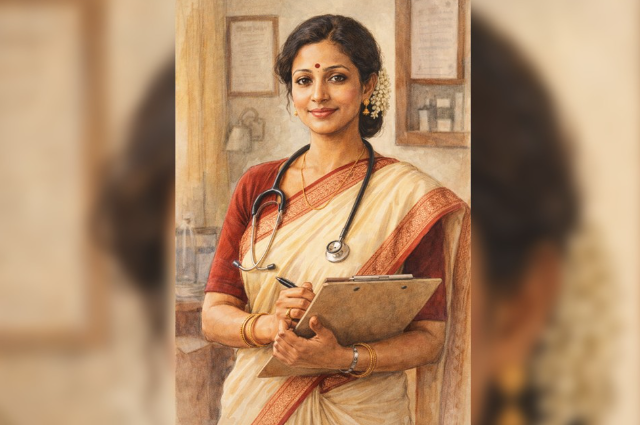
This is a story from United Bengal, from a time when Bangladesh was not yet born. Bengal was prospering with handloom industries, indigo cultivation, print houses, and many other occupations for men to work in.
But what about the women of Bengal?
Were they happy?
Maybe they were.
Or maybe many of them did not live long enough to experience happiness.
Some women were forced to sit beside the burning pyres of their dead husbands, and many others lost their lives while giving birth.
Now you may say that a woman’s body is designed well enough to give birth. Then why did such tragedies happen?
Yes, nature has beautifully designed a woman’s body to carry a soul within her. But sometimes I feel that nature forgot to remind the people around her that a woman’s body is also made of bones and muscles. It needs nourishment, preparation, and care. And those bones and muscles can be treated by a doctor—even if that doctor is a man.
At that time, there were no special hospitals for women. During childbirth, dais (traditional midwives) used to assist pregnant women. However, they were not medically trained and had very limited knowledge about maternal health. As a result, many mothers either lost their lives during childbirth or survived with poor health conditions.
This story begins in the 19th century, when the British were still ruling India. The year was 1861.
A couple, Mr Brajkishore Basu and his wife, living in Bhagalpur (now in Bihar), were expecting their first child. On 18 July 1861, they were blessed with a beautiful baby girl. They named her Kadambini.
I would say that the child was fortunate to be born to a father who was a school headmaster and a social reformer, associated with the Brahmo Samaj.
In short, the Brahmo Samaj was a reform movement started by Raja Ram Mohan Roy to modernise Hindu society and promote social equality. One of its major reform movements focused on women’s education and social equality, and Mr Brajkishore Basu was an active supporter of this cause.
He was not just a supporter of these ideas—he implemented them in his own life. He decided that his daughter would receive a proper education.
In an era when daughters in India were expected to marry in their teenage years and become mothers soon after, Mr Brajkishore Basu encouraged his daughter to continue her education, defying societal norms.
At the right time, she was admitted to Banga Mahila Vidyalaya, where she completed her early education. And when we talk about “education” in Bengal, it was not limited to alphabets and numbers. It included history, culture, reforms, and rights.
Naturally, Bengal’s intellectual and reformist environment uniquely shaped Kadambini. She grew up hearing discussions about women’s rights and social reforms.
Time passed, and she entered her teenage years.
During this time, she noticed that many women around her were not receiving proper medical treatment. People were reluctant to consult male doctors. They were ready to suffer—or even die—but not willing to be examined by a man.
This situation deeply affected Kadambini. It made her think about the condition of women around her. Slowly, a thought began to grow in her mind—to do something for them.
Soon, that thought turned into a decision.
She decided that she would serve the nation as a doctor.
But this dream came with many challenges. Society, relatives, and even some of the very women she wished to serve were against her decision. She had to fight many battles.
Fortunately, she had one strong supporter—her father. He was proud of her ambition and encouraged her to pursue her dream.
With that support, she moved forward and appeared for the entrance examinations for Calcutta Medical College.
Even there, she faced strong opposition. Many professors and administrators believed that women were meant for the kitchen, not for surgery.
Despite all the resistance, Kadambini remained determined. Finally, the authorities allowed her to appear for the examinations. She cleared them and became one of the first women medical students in India.
During this time, she also caught the attention of Dwarkanath Ganguly, a well-known social reformer and a member of the Brahmo Samaj. He was deeply impressed by Kadambini’s determination and courage—qualities that were rare for women to express openly in that era.
The two eventually married in 1883.
After marriage, Dwarkanath strongly supported and encouraged Kadambini to continue her medical education.
But the challenges did not end there. In fact, the real challenge had just begun.
She had to attend classes in rooms filled with male students. It took time for her classmates to accept her presence because it was the first time they had ever seen a woman studying medicine.
Practical classes were even more challenging. It is not easy for a sensitive heart to witness surgeries—let alone perform them. But Kadambini knew that this was necessary for the welfare of patients. She overcame her fears and focused on her studies.
During her college years, she became pregnant with her first child. Her son, Prabhat Chandra Ganguly, was born in 1884.
Life became even more demanding. Yet she never complained. She embraced motherhood, managed her family responsibilities, and continued her studies at the same time.
There were days when she held a book in one hand and a cooking spatula in the other, studying while preparing meals for her family.
Her husband remained a strong pillar of support. He shared responsibilities, cared for the children, and ensured financial stability. Kadambini never had to face her struggles alone.
After years of perseverance, the day finally arrived.
In 1886, she completed her initial medical qualification and received the Graduate of Bengal Medical College (GBMC) certificate, which allowed her to practice medicine.
Later, in 1892, she travelled to Edinburgh and earned additional medical diplomas from:
- Royal College of Physicians of Edinburgh
- Royal College of Surgeons of Edinburgh
- Faculty of Physicians and Surgeons of Glasgow
These international qualifications strengthened her position as one of India’s earliest female physicians trained in Western medicine.
And that is how India received one of the first women doctors.
Kadambini’s life is not just a story—it is an inspiration. Especially for women. If a woman truly decides to achieve something, there is almost nothing she cannot do. And Kadambini’s life stands as a powerful example of that truth.