
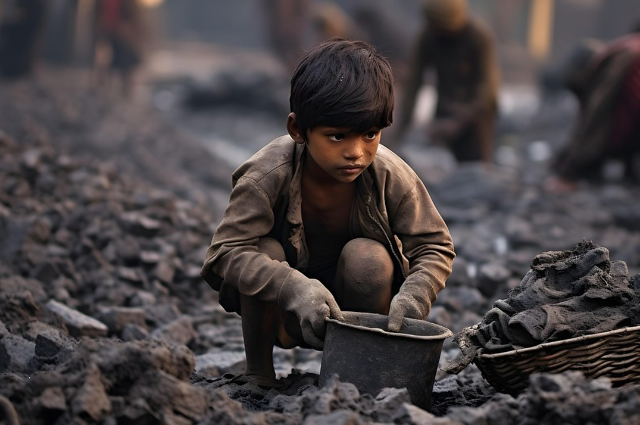
Image by Dipak Patel from Pixabay
At 5:47 a.m., before the first rays of sunlight enter the narrow balcony of a middle-class apartment in Lucknow, a fourteen-year-old girl quietly walks into the kitchen and lights the gas stove. Her school uniform hangs behind the bedroom door, still unironed. Her younger brother is asleep. Her mother has not spoken much since the previous night’s argument about money. Her father returned home exhausted after a twelve-hour shift and fell asleep with the television still running.
The girl prepares tea carefully so the sound of utensils does not wake anyone.
Before leaving for school, she reminds her mother to take her medicine, checks whether her brother has packed his notebook, listens silently while her father complains about rising expenses, and assures everyone that “everything will be fine,” even though she herself has been struggling with anxiety for months.
At school, teachers describe her as mature.
Relatives call her understanding.
Neighbours call her well-behaved.
Nobody notices that she has slowly stopped behaving like a child.
By evening, she will help with cooking, mediate family tensions, comfort her younger sibling before an exam, smile politely at visiting relatives, finish unfinished homework after midnight, and apologise for becoming emotional if she ever appears tired.
She is not called a worker.
But she works.
And millions of children across India work exactly like this every day.
Across India, millions of children perform invisible emotional responsibilities inside homes, schools, workplaces, and digital spaces. They become listeners, peacekeepers, caretakers, motivators, emotional shock absorbers, and silent therapists for adults who are themselves overwhelmed by modern life.
This labour is unpaid, unrecognised, and deeply normalised. It is called emotional labour.
Traditionally, emotional labour refers to the management of emotions in order to satisfy the emotional expectations of others. The term was popularised by sociologist Arlie Hochschild while studying service workers who were expected to smile regardless of personal suffering. But emotional labour extends far beyond hotels, airlines, or corporate offices.
Today, children themselves are increasingly carrying emotional burdens that society refuses to acknowledge.
India notices children when they top examinations, become athletes, crack competitive exams, or represent national pride. But it rarely notices the child who grows up too early because the emotional survival of the family quietly depends upon them. These children exist everywhere.
The daughter who acts mature because her parents constantly fight. The son who suppresses grief because his father believes boys should never cry. The teenager who becomes an emotional translator between stressed parents and younger siblings. The student who comforts suicidal friends while secretly struggling alone. The child influencer online who monetises smiles for strangers while privately collapsing under pressure. India celebrates sacrifice.
But it often forgets to ask who is being sacrificed.
The Childhood That Disappears Quietly
Not all childhoods are stolen dramatically.
Some disappear slowly.
A child does not suddenly become emotionally burdened overnight. It happens gradually through repeated expectations. Adults begin depending on them emotionally because they appear “understanding,” “mature,” or “responsible.” Over time, the child learns an important survival lesson: keeping others emotionally stable matters more than expressing personal pain.
This transformation is especially common in financially or emotionally stressed households.
In many families, the eldest daughter unconsciously becomes the emotional centre of the home. She listens to her mother’s frustrations, manages household tensions, comforts younger siblings, and learns to regulate her own emotions so that others remain calm.
Society praises her.
Relatives call her sensible.
Teachers call her disciplined.
But very few people notice that she may simply be emotionally exhausted.
The emotional burden placed on children is often romanticised as maturity.
A boy who never complains is called strong.
A girl who sacrifices constantly is called ideal.
A child who suppresses emotions to avoid creating problems becomes the “good child.”
The reward for emotional silence is social approval.
Yet suppressed emotional strain rarely disappears. It often resurfaces later through anxiety, burnout, depression, anger issues, emotional numbness, or an inability to form healthy relationships.
Many adults today who struggle to express emotions were once children trained to prioritise everyone else’s emotional comfort above their own.
Coaching Culture and Emotional Survival
The hidden economy of emotional labour becomes even more visible inside India’s academic culture.
Millions of students preparing for competitive examinations are expected to maintain emotional stability under extreme pressure. They carry not only their own ambitions but also the dreams, anxieties, and financial expectations of entire families.
A teenager preparing for NEET or JEE often becomes responsible for maintaining hope inside the household.
Parents make sacrifices.
Relatives ask questions.
Neighbours compare ranks.
The student absorbs everything.
In cities like Kota, where thousands migrate for coaching every year, students frequently live away from family support systems while carrying unbearable emotional expectations. Many learn to hide fear because vulnerability is treated like weakness.
Some continue smiling during video calls so their parents do not worry.
Some lie about their mental health to avoid disappointing family members.
Some suppress panic attacks because they fear appearing ungrateful.
Their emotional management itself becomes labour.
The country debates examination results every year, but rarely discusses the emotional performance students are forced to maintain simply to survive.
When children become symbols of family aspiration, they slowly stop feeling like human beings.
They become projects.
The Service Smile and the Young Workforce
India’s rapidly expanding service economy has also normalised emotional labour among young workers.
Walk into any restaurant, retail store, airline counter, call centre, or hotel. Behind the practised politeness of customer service are often young employees trained to regulate emotions professionally.
They must smile even when insulted.
They must remain calm while facing humiliation.
They must appear cheerful regardless of personal grief.
A hospitality trainee may lose a family member and still be expected to greet guests warmly the next morning.
A call centre worker may handle verbal abuse from customers while following scripts that demand emotional politeness.
Delivery workers are rated not only for speed but also for friendliness.
The human personality itself becomes part of the product being sold.
This emotional exhaustion increasingly begins early.
Internships, influencer culture, content creation, customer-facing jobs, and digital freelancing push young people to transform emotional expression into performance. Many teenagers now learn branding before emotional self-understanding.
Online, they are taught to smile for engagement.
Offline, they struggle to process loneliness.
Social Media and the Commercialisation of Emotion
Perhaps the most dangerous form of emotional labour today exists online.
Social media platforms reward emotional exposure but rarely provide emotional safety.
Young users are encouraged to share personal struggles publicly because vulnerability generates attention. Crying videos, trauma confessions, relationship breakdowns, motivational speeches, and emotional storytelling often receive massive engagement.
Pain becomes content.
A teenager speaking about depression may receive millions of views, yet remain emotionally unsupported in real life.
The internet creates a strange contradiction: people become emotionally visible without becoming emotionally cared for.
Algorithms are designed to maximise engagement, not healing.
The more emotionally reactive the content, the longer users remain online.
This transforms human emotion into digital currency.
Young influencers especially face invisible psychological pressure. They must constantly appear interesting, relatable, attractive, productive, and emotionally available to audiences.
Their happiness becomes performance.
Their sadness becomes branding.
Even authenticity becomes marketable.
The line between real identity and performed identity slowly collapses.
As a result, many young people today feel emotionally observed but personally unknown.
They are seen.
But they are not understood.
Why Society Prefers Emotionally Useful Children
Emotionally burdened children are often easier for society to manage.
A child who constantly considers everyone else’s feelings creates fewer disruptions.
They obey more.
They complain less.
They mature early.
They adapt.
From families to schools to workplaces, institutions quietly reward emotional usefulness.
Students are taught discipline before emotional literacy.
Children are told to respect elders but rarely taught how to communicate distress safely.
In many households, emotional expression is tolerated only when it does not inconvenience adults.
As a result, children learn to edit themselves emotionally.
This emotional editing continues into adulthood.
Many professionals who appear highly functional externally are internally exhausted because they have spent years performing emotional stability for others.
Some cannot ask for help.
Some feel guilty while resting.
Some associate love with sacrifice.
Some only feel valuable when emotionally useful.
What society calls maturity is sometimes simply untreated emotional fatigue.
The Gendered Burden of Emotional Labour
Although boys and girls both experience emotional pressure, emotional labour in India is heavily gendered.
Girls are often raised with the expectation that caregiving is natural to them.
From childhood itself, many daughters are trained to anticipate emotional needs automatically.
They are expected to adjust.
To calm.
To understand.
To tolerate.
To nurture.
A girl who reacts emotionally may be called dramatic. A girl who sacrifices quietly is praised as ideal.
This conditioning continues into adulthood, where many women become emotional managers inside families, relationships, and workplaces.
Meanwhile, boys frequently experience a different form of emotional restriction.
They are taught emotional suppression.
“Boys don’t cry.”
“Be strong.”
“Handle it like a man.”
These statements may appear harmless, but they disconnect boys from emotional vulnerability at an early age.
As adults, many men struggle to communicate fear, loneliness, grief, or emotional dependence because they were conditioned to equate vulnerability with weakness.
Thus, both genders suffer emotionally, but in different ways.
One is trained to over-carry emotion.
The other is trained to hide it.
Neither is healthy.
What Happens When Children Become Emotional Caretakers
The long-term consequences of emotional labour during childhood are profound.
Psychologists increasingly observe patterns among adults who were emotionally parentified as children. Parentification occurs when children take on emotional or practical roles normally expected from adults.
These individuals often grow into highly responsible adults, but many also struggle with chronic anxiety, emotional burnout, perfectionism, low self-worth, or difficulty establishing boundaries.
They become experts at understanding others while remaining strangers to themselves.
Some constantly fear disappointing people.
Some feel responsible for everyone’s happiness.
Some enter one-sided relationships because emotional over-functioning feels familiar.
Others emotionally shut down completely.
The tragedy is that society often celebrates these people without recognising the invisible exhaustion underneath.
The child who survived by becoming emotionally useful eventually becomes the adult who no longer knows how to rest emotionally.
The Cost of Ignoring Emotional Labour
India frequently discusses economic growth, digital transformation, artificial intelligence, and demographic advantage.
But a nation cannot remain emotionally healthy while ignoring the invisible burdens carried by its young people.
Rising anxiety, loneliness, academic burnout, emotional isolation, and mental health crises among youth are not disconnected problems.
They are symptoms of a society where emotional care is increasingly absent and emotional performance is increasingly demanded.
Children today are expected to succeed academically, remain socially present online, support family expectations, maintain emotional composure, and prepare constantly for economic uncertainty.
Many are surviving emotionally rather than living.
A society that continuously consumes emotional energy from its young without providing emotional support eventually creates adults who are productive but internally fractured.
And fractured societies become easier to manipulate, exploit, and exhaust.
The Dangerous Normalisation of Silent Suffering
One of the most disturbing aspects of emotional labour is that society has stopped recognising it as suffering.
When children become emotionally over-responsible, people admire them instead of questioning why they were forced to mature so early.
A girl sacrificing her emotional needs for the family is called संस्कारी.
A boy hiding his tears is called strong.
A student functioning under unbearable pressure is called ambitious.
A young employee tolerating humiliation politely is called professional.
Society repeatedly rewards emotional suppression because emotionally exhausted people are easier to manage.
They create fewer conflicts.
They tolerate more exploitation.
They ask for less care.
The problem is that emotional suppression does not disappear quietly. It accumulates.
Eventually, it emerges through panic attacks, emotional numbness, burnout, loneliness, sudden anger, self-harm, relationship instability, or the terrifying feeling of being emotionally empty despite appearing successful.
India today is witnessing rising conversations around youth anxiety, depression, academic stress, loneliness, and emotional isolation. But these crises are not appearing from nowhere.
They are deeply connected to a culture that teaches young people how to perform emotional strength long before teaching them how to process emotional pain.
A nation obsessed with producing successful children may accidentally end up producing emotionally exhausted adults.
Conclusion
The most invisible workers in India may not be inside factories, offices, or construction sites.
They may be sitting quietly at dining tables, inside classrooms, on hostel beds, behind customer-service smiles, or in front of glowing phone screens.
- They are the children who absorb tension before others notice it.
- The teenagers who comfort everyone while silently collapsing.
- The daughters who become emotional anchors too early.
- The sons who are never allowed to appear vulnerable.
- The young workers who sell emotional warmth because modern economies demand it.
The internet often calls this maturity. But perhaps much of it is survival.
A truly developed society is not one where children simply become successful.
It is one where children are allowed to remain emotionally human.
Because the moment a nation begins depending on children to emotionally sustain adults, childhood itself quietly starts disappearing.
And the most dangerous losses are often the ones society never notices while they are happening.
Because sometimes the most painful form of child labour is not physical.
It is emotional.
It is the silent labour of children who spend their childhood carrying the emotional weight of a world that should have been protecting them instead.
. . .