
“The fight will go on.”
-Captain Lakshmi Sehgal
Captain Laxmi Sehgal was the epitome of leadership. This article explores her life journey through the various roles she donned and her contribution to the making of Independent India.
‘Leader’ – a word we have grown up with, it is ubiquitous. Although one never realises the magnitude of what it entails. Does it merely imply gaining obedience from one’s subordinates? We use the adjective ‘inspirational’ before it, but the word itself encompasses everything. A leader is meant to inspire, guide and transform the individual to transcend their limits. In the annals of history, there are numerous tales of bravery and valour of men; the contributions of women leaders are mainly forgotten or written in footnotes, resulting in one believing that they had little or no role at all in major events in world history. Now, through a renewed interest in the research about the contributions that women made, we are discovering the valiant women of the 20th century. This essay is inspired by one of the courageous women of India who led others at a time when women were barely allowed to get educated in India – Captain Lakshmi Sehgal.
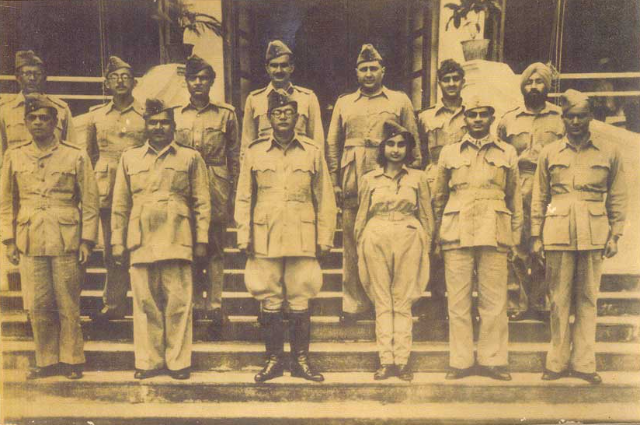
Lakshmi Sehgal was born on October 24, 1914, in Madras to S. Swaminadhan, a dynamic lawyer, and A.V. Ammukutty, a social worker and freedom fighter. Lakshmi was a rebel from birth with a feisty spirit and an iron will. She stood against all forms of injustice, such as caste, creed, gender or religion. Lakshmi studied at the Madras Medical College, from where she completed her MBBS in 1938. She went to Singapore in 1940 as a young doctor, merely 26 years of age. After three years, she met with Subhash Chandra Bose, another eminent Indian freedom fighter. Her meeting with him changed the entire course of her life. Subhash Chandra Bose was forming an Army known as the Indian National Army (INA) and was drafting women into the organisation. She arranged a meeting with him in Singapore and emerged from a five-hour interview with a directive to set up a women’s regiment, which was to be called the Rani of Jhansi regiment. Rani of Jhansi was another great woman warrior of India, a befitting name for a revolutionary regiment. There was a tremendous response from women to join the all-woman brigade. Dr Lakshmi Swaminadhan became Captain Lakshmi, a name and title that would stay with her for life. She was appointed at the rank of Colonel (although she is popularly known as ‘Captain’) in the women's army unit, which was the first of its kind in the entire Asian continent. She headed a highly trained combat force of women recruits and oversaw active duty on the Burma front. She was a pioneer for women in the field; she proved that women need not simply watch from the sidelines but can contribute much more to their nation.
After the war, Captain Lakshmi married Col Prem Kumar Sehgal in March 1947. The couple shifted to Kanpur, where she began her medical practice in full swing, working among the flood of refugees who had come from Pakistan due to the partition of India and Pakistan. She was the only doctor in Kanpur who would treat Muslims at that time. Amongst intense riots between the two groups of Hindus and Muslims in the country, she earned the trust and gratitude of both groups for her exemplary work.
During the 20th century, the role of women in the public sphere, especially in India, was extremely limited. A woman’s identity was either that of her father or, after marriage, her husband’s. In a man’s world, she made a mark of her own and increasingly worked for the betterment of women. She was the founding member of the All-India Democratic Women's Association (AIDWA). AIDWA is a women’s organisation working towards the upliftment of women in the poor rural and urban areas. Captain Lakshmi led many camps and campaigns and worked towards making women independent.
Her list of accomplishments does not end there; she became an active politician in the 1970’s. “The fruits of independence were benefiting only a few— the white rulers had been replaced by darker ones,” she said. She became the leading figure in the Communist Party of India (Marxism) and was elected to the Upper House of the Indian Parliament. She used this platform to further spread her philanthropic work of socio-economic upliftment. She organised relief aid during the Bangladeshi crisis and stayed in Calcutta for more than 2 months, helping refugee establishments.
On December 2nd, India woke up to a tragedy of immense destruction- the Bhopal Gas Tragedy, a gas leak at the Union Carbide India Limited (UCIL) pesticide plant in Bhopal, led to the deaths of about 4000 people and severely affected the health of lakhs of people. It was the first major industrial disaster that Independent India had faced. Captain Lakshmi leapt right into action and led a medical team into the city. She played a significant role in providing medical attention to victims of the tragedy. Her disregard for her own personal well-being and working towards elevating the welfare of others is nothing short of selfless, and it fires the imagination of the subsequent generations of not only India but of the world.
“Be the change you wish to see in the world”, these words were spoken by Mahatma Gandhi, a phenomenal political ethicist. He re. Mahatma Gandhi knew nothing of the local Indians, but that did not deter him from making a difference. He toured the entire country and got to know the grassroots of the humongous, diverse culture in India. He transformed his ignorance into enlightenment and became the change he wished to see. During tumultuous times, one needs leaders who are without fear and favour. In the transition between the old and the new, every individual, poor or rich, wants to feel heard and seen- this is a basic human want, so just as Mahatma Gandhi, Captain Lakshmi proved herself to be dependable in all these factors that make a true leader. She approached the transformation challenge of India, from being a country of subjects to an independent democratic nation with an open mind, a determination to listen and a will to relearn old truths. She was awarded a Padma Vibhushan- the second-highest civilian award in India in 1998 for exceptional and distinguished service to the nation.
In 2002, she was nominated by leftist parties to stand in the Presidential elections. The President is the head of state of the Republic of India; she was the only opponent to the equally distinguished APJ Abdul Kalam. She did not win the elections, but that did not matter to this lion-hearted lady. She was a true soldier in every sense and was on active duty as a doctor till her last breath. She departed for the heavenly world on 23rd July 2012 in Kanpur at the age of 97 after suffering from a prolonged ailment.
Captain Lakshmi Sehgal is admired across generations of Indians, especially for her contributions in public and social affairs. It is said that the purpose of living is to make the world a better place than it was found, and there is no doubt that she truly lived. She is a symbol of courage for many; her life’s work has been and always will be a pivotal part of India’s destiny- its struggle against attaining freedom from colonial rule and now to its maturing as a secular democratic nation through the years. In this transition, Captain Lakshmi was a freedom fighter, a devoted medical doctor and a formidable leader of women's empowerment in India. Captain Lakshmi is the epitome of the finest of Indian leadership.
We are the daughters of India,
We have raised the sword
Look at the history shown,
We are the free spirits of India
-The song of the Rani of Jhansi Brigade