
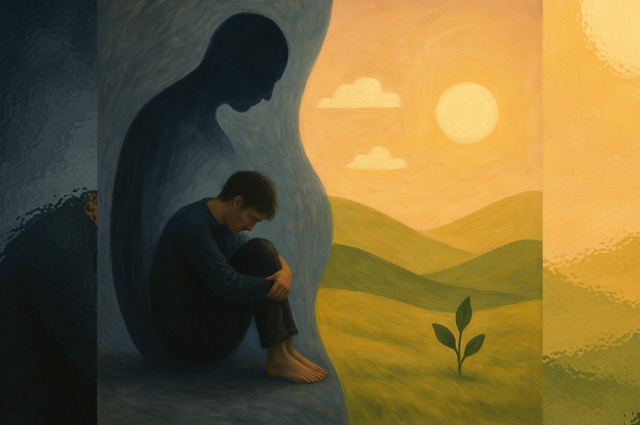
Image by Carol Burley from Pixabay
Not all wounds bleed, and not all pain is visible. Psychological trauma is often silent, deeply rooted, and misunderstood. Many people carry emotional scars that shape their thoughts, behaviours, and identities without ever being acknowledged. This is a real-life-inspired reflection on trauma—not as a single dramatic event, but as a quiet, persistent force that alters how a person experiences the world. It is a story of survival, awareness, and the slow, often painful path toward healing.
The Day Nothing Looked Wrong
On the outside, Aarav’s life seemed perfectly normal.
He attended college, laughed with friends, and maintained good grades. His social media reflected a life full of moments—birthdays, outings, achievements. To anyone observing from a distance, he seemed to be doing well. But trauma rarely announces itself loudly. Inside, Aarav felt a constant tension he could not explain. It was not sadness in the usual sense, nor was it visible distress. It was something quieter—an uneasiness that never left, like a shadow that followed him even in bright light.
“Some battles are fought in silence, where even the warrior forgets what peace feels like.”
The Origin of Silence
Aarav had grown up in a household where emotions were not expressed—they were controlled. Mistakes were met with harsh words. Achievements were expected, not celebrated. Vulnerability was seen as weakness. He learned early that expressing pain led to more pain. So he adapted. He became quiet. He learned to suppress his feelings, to smile when he wanted to cry, and to remain calm when he felt overwhelmed. Over time, this suppression did not disappear—it accumulated. Childhood experiences do not simply fade away. They settle into the mind, shaping beliefs about self-worth, safety, and trust.
“Trauma is not always what happens to us; sometimes, it is what we were never allowed to feel.”
When the Mind Learns to Protect Itself
As Aarav grew older, his mind developed ways to cope. He avoided confrontation. He overthought small situations. He constantly feared making mistakes. Even minor criticism felt like a personal failure. These were not personality traits—they were survival mechanisms. His brain had learned to stay alert, to anticipate danger, even when none existed. This is how trauma works—it rewires perception. A harmless comment could feel like an attack. Silence could feel like rejection. A delay in response could create anxiety. “The mind remembers what the heart tries to forget.”
The Weight of Being ‘Fine’
One of the most difficult aspects of trauma is the expectation to appear normal. Aarav often heard phrases like:
- “You’re overthinking.”
- “Just relax.”
- “It’s not a big deal.”
What people failed to understand was that his reactions were not choices—they were conditioned responses. So he learned another skill: pretending. He became “fine.” He smiled in conversations, participated in events, and fulfilled responsibilities. But internally, he felt disconnected. “Sometimes, the strongest people are those who hide their pain behind the most convincing smiles.”
Triggers Without Warning
Trauma does not stay in the past—it resurfaces. For Aarav, certain situations triggered intense emotional responses:
- A raised voice
- Sudden criticism
- Feeling ignored
These moments would cause his heart to race, his thoughts to spiral, and his body to tense. He didn’t always understand why. That’s the nature of psychological trauma—it is not always logical. The brain reacts based on past experiences, not present reality. “The past does not knock before entering the present—it simply appears.”
The Breaking Point
There came a time when Aarav could no longer ignore what he was feeling. It was not one big event, but a series of small moments:
- Losing focus in class
- Feeling exhausted without reason
- Avoiding people he cared about
One evening, while sitting alone, he asked himself a question he had avoided for years: “Why do I feel this way when nothing is wrong?” That question marked the beginning of awareness. “Awareness is painful, but it is also the first step toward freedom.”
Understanding Trauma
Through reading and reflection, Aarav began to understand that what he was experiencing had a name: trauma. Not the kind often portrayed dramatically, but a quieter form—emotional trauma shaped by repeated experiences. He realised:
- His fear was learned
- His anxiety had roots
- His reactions had reasons
This understanding did not immediately heal him, but it gave him clarity.“You cannot heal what you refuse to understand.”
The Struggle to Heal
Healing was not easy. Aarav tried to change his habits, but patterns built over the years do not disappear overnight. There were days when he felt progress:
- Speaking up for himself
- Staying calm in difficult situations
And there were days when he felt like he had gone backwards. Healing is not linear. It is a process of unlearning, relearning, and confronting uncomfortable truths. “Healing is not about becoming someone new; it is about returning to who you were before the world taught you to be afraid.”
The Role of Support
One of the most important turning points in Aarav’s journey was finding someone who listened without judgment. It was not advice or solutions that helped him—it was understanding. For the first time, he felt heard. This experience highlighted an important truth: support does not require expertise; it requires empathy. “A single safe space can begin to repair years of silent damage.”
Breaking the Cycle
Aarav slowly began to challenge his patterns:
- He allowed himself to express emotions
- He questioned negative thoughts
- He practised self-compassion
These changes were small, but significant. Trauma often creates cycles—fear, avoidance, self-doubt. Breaking these cycles requires conscious effort.“Courage is not the absence of fear; it is choosing to move forward despite it.”
The Hidden Reality of Many
Aarav’s story reflects a larger issue. Many individuals live with psychological trauma without recognising it. Society often overlooks emotional pain unless it is visible or extreme. People are taught to:
- Be strong
- Ignore feelings
- Move on quickly
But unprocessed emotions do not disappear—they remain within us. “What is buried alive does not die—it grows.”
Redefining Strength
For a long time, Aarav believed strength meant staying silent and unaffected. Over time, he learned that true strength lies in:
- Acknowledging pain
- Asking for help
- Allowing vulnerability
Strength is not about suppression—it is about awareness.“Real strength is found not in hiding wounds, but in facing them.”
The Long Road to Healing
Healing is not a destination; it is a journey. Even now, Aarav experiences moments of doubt and discomfort. But the difference is that he understands them. He no longer blames himself for his reactions. Instead, he observes, reflects, and grows. Progress is not measured by perfection, but by persistence.“Small steps taken consistently can lead to profound change.”
Conclusion
Psychological trauma is often invisible, yet its impact is deeply real. Aarav’s journey reminds us that behind normal appearances, there may be unseen struggles. It teaches us the importance of awareness, empathy, and patience. In a world that often values strength over sensitivity, we must learn to recognise that emotional pain is valid. Healing takes time. Understanding takes effort. But both are possible. Let us create spaces where people feel safe to express, not pressured to suppress. Because sometimes, the deepest scars are the ones no one sees. And sometimes, the bravest thing a person can do is simply admit:
“I am not okay—but I am trying.”