
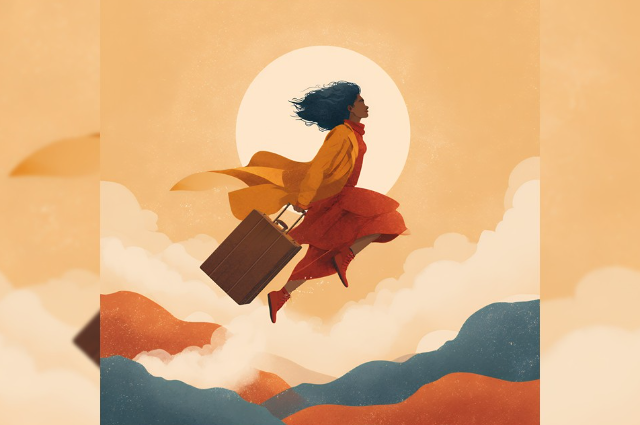
Image by Vilius Kukanauskas from Pixabay
There is a certain kind of magic that exists only on the road, not in destinations, not in photographs, but in the quiet moments in between. It lives in the hum of a bus engine at dawn, in the smell of rain on unfamiliar soil, in the way strangers become stories you carry forever. Travel, at its heart, is not about places. It is about transformation.
I did not understand this when I began.
Like many, I started travelling for the obvious reasons—to see famous landmarks, to escape routine, to collect pictures worthy of admiration. My bags were packed with expectations, itineraries neatly printed, each hour accounted for. I believed that control would give me the perfect journey.
I was wrong.
The First Step Away:
My first real journey began on a train heading north, where the landscape slowly shifted from crowded cities to open fields, from noise to silence. I remember sitting by the window, watching the world blur past, realising for the first time how vast everything was—and how small my worries seemed in comparison.
Across from me sat an elderly man with kind eyes. He didn’t speak much, but when he did, his words carried weight. “You don’t travel to see the world,” he said. “You travel to see yourself in it.”
At that moment, I smiled politely, not fully grasping what he meant. But his words stayed with me, echoing quietly as the journey unfolded.
Lost to Be Found:
Every traveller, at some point, gets lost. Mine happened in a narrow alley of a small hill town. The GPS signal had vanished, my phone battery was dying, and the streets all looked the same—winding, unfamiliar, endless.
Panic crept in. I had places to be, plans to follow. Getting lost was not part of the schedule.
But then something unexpected happened. I stopped rushing.
I noticed the details—the way sunlight filtered through old wooden balconies, the laughter of nearby children, the aroma of spices drifting from a kitchen window. A woman sitting outside her home noticed my confusion and gestured for me to come closer. She didn’t speak my language, but she didn’t need to. With simple gestures and a warm smile, she offered me water and pointed me in the right direction.
That brief encounter changed everything.
Getting lost, I realised, wasn’t a mistake. It was an invitation—to slow down, to connect, to experience something real.
The Stories in Strangers:
Travel has a way of bringing people into your life at the exact moment you need them. There was the café owner who shared stories of his youth over a cup of strong coffee, his laughter filling the room like music. There was the backpacker who had been on the road for years, chasing sunsets and finding meaning in simplicity. There was the taxi driver who spoke of his dreams for his children, his voice filled with hope.
None of these people knew me. I would likely never see them again. Yet, in those fleeting moments, there was a connection deeper than many long-term relationships.
It made me wonder—how many stories do we miss in our everyday lives because we are too busy to listen?
The Illusion of Control:
Before travelling, I believed that everything had to go according to plan. But journeys have a way of dismantling that illusion.
Flights get delayed. Weather changes. Plans fall apart.
And yet, those unexpected disruptions often lead to the most memorable experiences.
One evening, stranded in a small town due to a cancelled bus, I found myself sitting under a sky full of stars—something I rarely noticed back home. A group of locals invited me to join them for dinner. We sat on the ground, sharing food and laughter, speaking in a mix of broken words and gestures.
There was no itinerary, no expectation—just a moment, pure and unfiltered.
That night, I understood something important: the best parts of travel cannot be planned.
The Language Beyond Words:
One of the most beautiful aspects of travel is discovering that communication goes far beyond language.
A smile can open doors. A kind gesture can bridge cultures. Eye contact can convey understanding in ways words sometimes cannot.
In a remote village, where I couldn’t understand a single spoken word, I was welcomed with warmth and generosity. A family invited me into their home, offering food they had prepared with care. We sat together, laughing at our attempts to communicate, yet somehow understanding each other perfectly.
It was in that moment that I realised how often we complicate connection.
We don’t always need words.
The Mirror of Travel:
Travel does something subtle yet powerful—it reflects who you are.
Away from the familiar, stripped of routine and comfort, you begin to see yourself clearly. Your patience, your fears, your adaptability, your kindness—they all come to the surface.
I discovered parts of myself I didn’t know existed. Strength in moments of uncertainty. Courage in unfamiliar situations. A sense of curiosity that had long been buried under daily responsibilities.
But travel also showed me my limitations—the times I was impatient, the moments I resisted change, the discomfort I felt in letting go.
And in recognising those things, I began to grow.
The Beauty of Simplicity:
In many places I visited, life was simpler. People found joy in small things—a shared meal, a conversation, a sunset.
It made me question the complexity of my own life.
Why do we chase so much when so little can bring happiness?
One morning, I woke up early in a quiet village. There was no rush, no notifications, no noise—just the sound of birds and the gentle breeze. I sat outside, watching the sunrise, feeling a sense of peace I hadn’t experienced in a long time.
It wasn’t a grand moment. There was nothing extraordinary about it.
And yet, it felt perfect.
The Return Home:
Eventually, every journey comes to an end.
Returning home after travelling is a strange experience. Everything looks the same, yet nothing feels quite the same.
The streets you once walked without noticing now seem different. The routine you once followed feels unfamiliar. The things you once worried about seem less important.
Because you have changed.
Travel doesn’t just show you the world—it changes the way you see it.
The Roads That Stay:
People often think travel is about moving forward, about reaching new destinations. But in reality, it’s also about what stays with you.
The lessons. The memories. The people.
The roads you travel never truly leave you. They become a part of who you are, shaping your perspective, influencing your choices, reminding you of what matters.
Even now, long after my journeys have ended, I find myself revisiting those moments—not through photographs, but through feeling.
The warmth of a stranger’s kindness. The thrill of discovering something new.The quiet understanding that the world is vast, and there is always more to learn.Why We Travel. In the end, travel is not about escaping life. It is about understanding it.
It teaches you that the world is bigger than your problems, yet smaller in its shared humanity. It shows you that differences exist, but so do connections. It reminds you that no matter where you go, there is always something to discover—not just about the world, but about yourself.
So, if you ever find yourself standing at the edge of a journey, unsure whether to take that first step—do it.
Not because you need to see new places.But because you need to see with new eyes.
A Journey That Never Ends:
Even when you are not travelling, the journey continues. In the way you notice details. In the way you connect with people. In the way you approach life with curiosity instead of certainty. Because travel, at its core, is not about distance. It is about perspective. And once that perspective changes, you never really return to who you were before.
Final Thought:
The world is full of roads—some well-travelled, others waiting to be discovered. But the most important journey is not the one you take across countries or continents.
It is the one that takes you deeper into yourself.
And that journey? It never truly ends.
As Mark Twain famously said, “Travel is fatal to prejudice, bigotry, and narrow-mindedness.” It opens your mind, challenges your beliefs, and expands your understanding of the world.