
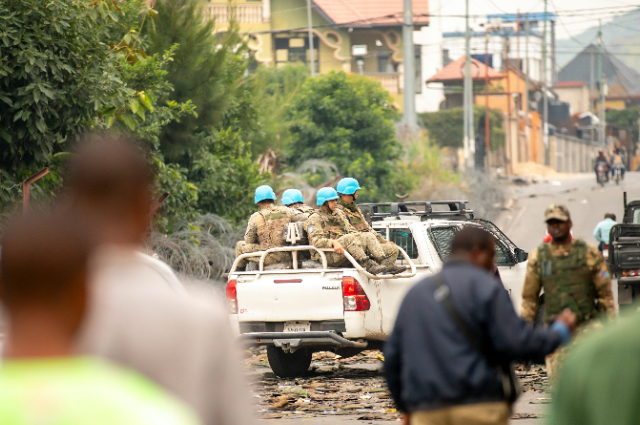
The Manipur Crisis originated on May 3rd, 2023, due to the ethnic clashes between the Meitei community of the Imphal valley and the Kuki-Zo tribal groups from hill districts. The exact trigger was the court recommendation to consider Scheduled Tribe status for Meitei, which raised fear amongst the Kukis over land and political rights.
What began as an ethnic conflict in Manipur in May 2023 has now evolved into one of the most serious internal security crises in recent Indian history. The large-scale looting of over 6,000 weapons from the police armouries and their circulation among civilians has fundamentally altered the nature of the conflict.
Today, the state is not just grappling with ethnic divisions between the Meitei and Kuki-Zo communities, but also with a deeper challenge, the erosion of its monopoly over violence , as armoured civilian groups increasingly continue to shape the course of the conflict.
The Tronglaobi bomb attack on April 7, 2026, in Bishnuour district, which killed two children and heavily injured their mother. Following the attack, the locals staged protests, torching oil tankers near a petrol pump, and burning tyres in different parts of Imphal. This shows that the conflict has not ended yet, and has evolved into recurring violence cycles.
This conflict has now quickly escalated into hundreds of deaths and mass displacements of over 60,000 people. Even in 2026 the situation remains to be “fragile”, with viol;ence persisting through protests, arson, street blockades and unrest. This confirms the prolonged breakdown of lae and order, and that this is not just a one-time crisis.
The reason why this is a critical escalation is that over 6,000 weapons were looted from police armouries, with large quantities of ammunition stolen. Some of these being, INSAS rifles, AK-series weapons and Carbines. This transformed the crisis from a mere civil unrest, to an armed civilian conflict.
With the weapons in circulation, civilians formed ethnic militias and “village volunteers.” armed groups like Kuki-Zo and the Tangkhul Naga village volunteers were actively involved in these clashes, like in the firing incident in Ukhrul district on April 10, 2026. This tells us that civilians are no longer passive victims, they are active armed participants.
These armed groups now actively guard territories and engage in firefights which leads to incidents like when A BSF personnel was killed by a stray bullet, indicating that these conflict zones are unpredictable, and even trained forces can become targets and are vulnerable. This reflects a highly militarised environment, with continuous militarisation and violence.
Some government responses to this crisis are: the deployment of central forces, recovery operations for stolen weapons, Internet shutdowns since April 2026 across multiple districts, some of the services suspended being mobile data, Broadband and VSATs and VPNs. The main purpose of these control measures is to prevent the spread of misinformation and control further escalation of the incident. It shows that these control mechanisms being put in place now, rather than before makes them reactive and not preventative.
Some ongoing security operations include authorities continuing to seize illegal arms, which lead to a large cache of arms being seized in the chandel district. However, despite these security operations,thousands of
looted weapons still remain unaccounted for, meaning the state has not regained full control over the weapons.
However governance instability has been a major issue as presidents rule was imposed earlier. Also on Feb 4, 2026 a new government was formed and Yumnam Khemchand Singh was sworn in as Chief Minister. This reflects their attempts to restore political normalcy, but those efforts are going to waste as governance is still operating in a conflict environment.
The conflict in Manipur has resulted in a severe humanitarian crisis, which is indicated by large-scale displacement and creation of relief camps where thousands of people continue to live in uncertain, unstable and often inadequate conditions. Communities that once coexisted with each other are now deeply segregated due to ethnic lines, reinforcing mistrust and prolonging division. Beyond the political and security dimensions, the crisis has had devastating human consequences.
A particularly shocking incident was the rape and murder of a seven-year-old girl living in a displacement camp, which sparked widespread outrage and highlighted the vulnerability of the people who are affected, especially women and children. Such events really put a spotlight on how the situation in Manipur is not just an ethnic or political conflict, but a profound human security and human rights crisis.
The situation in Manipur has been increasingly defined by a persistent cycle of violence and retaliation. Incidents like the bomb attacks, armed clashes between rival groups and arson during the protests are not just isolated events but a part of a recurring problem that needs to be addressed. Usually, an attack is followed by public outrage and protests which leads to security crackdowns that often trigger further counter-attacks. This continuous loop has made it more difficult to restore and go back to normalcy, as each incident of violence feeds into the next, deepening tensions and prolonging instability.
A critical result of this prolonged conflict is the erosion of the state's monopoly over violence. Traditionally, the authority to use force is solely with the state: however, in Manipur, this control has significantly weakened. The widespread presence of armed civilians, the emergence of village militias and the frequency of armed confrontations indicate that weapons and power are no longer just confined to the state and its official forces. This shift is a defining characteristic of an internal security collapse, where the state struggles to assert authority and maintain order.
As a result, the present situation in Manipur remains fragile and unresolved. While efforts are being made through security operations and political dialogue, these exist alongside ongoing protests and unpredictable violence. The coexistence of these simultaneous processes highlights the absence of long-term solutions. Rather than moving towards a state of stability, the state continues to experience a prolonged phase of uncertainty, where peace remains tentative and the risk of escalation persists.
References:
- Reuters: https://www.reuters.com
- NDTV: https://www.ndtv.com
- India Today:
https://www.indiatoday.in
https://www.indiatoday.in - The Guardian: https://www.theguardian.com
- The Hans India: https://www.thehansindia.com
- India Today NE: https://www.indiatodayne.in/
- Press Information Bureau: https://www.pib.gov.in
- Amnesty International: https://www.amnesty.org
- South Asia Terrorism Portal: https://www.satp.org
- Wikipedia: https://en.wikipedia.org