
On the surface, the Artemis II is a technical milestone, something that was carefully engineered to return to deep space after more than half a century. But beneath all the layers of propulsion systems and mission protocols lies a quieter, more human story.
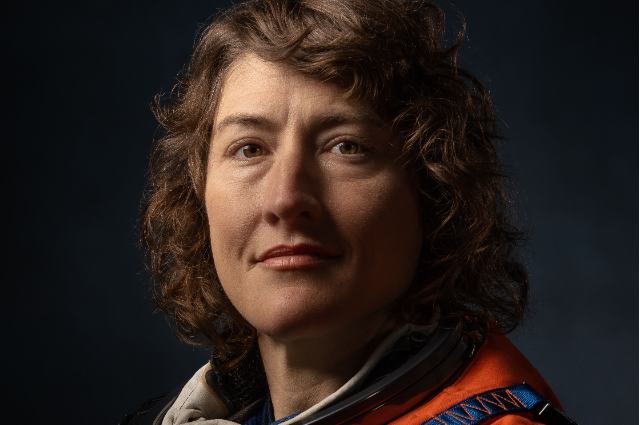
The story of Christina Koch. When Christina boards the Orion spacecraft, she won't just be circling the moon: she will be crossing a boundary no woman has crossed before: leaving the earth's orbit and stepping into a domain historically defined without her. In doing so, Koch transforms a test flight into something more profound: a moment where progress is not declared, but lived.
Christina Hammock Koch: an American engineer and NASA astronaut, who conducted the first all-female spacewalks and set the record for the longest single spaceflight by a woman, on her long-term mission to the International Space Station in 2019-2020.
Now the Artemis II is NASAs first crewed mission of the Artemis program, a lunar flyby mission, which was designed to test systems before landing, to test the ground before landing missions like the Artemis III.
It will use the Orion spacecraft and the Space Launch System to send astronauts beyond low earth orbit for the first time since Apollo and test life support systems, navigation and crew operations in deep space.
Currently the Artemis II is an ongoing US spaceflight mission, sending four astronauts on a flyby around the Moon. It launched from the Kennedy Space Center on April 1, 2026 and is the first crewed mission of the Orion spacecraft, and the first crewed mission beyond low earth orbit since the Apollo 17 in December 1972.
The Artemis II crew includes NASA astronauts Commander Reid Wiseman, Pilot Victor Glover and mission Specialist Christina Koch and CSA astronaut mission specialist Jeremy Hansen, on an approximately 10-day mission around the moon and back to earth.
During the Apollo 17 mission in December 1972, all the astronauts assigned to the mission were male. However the Artemis crew is deliberately diverse. Including Christina Koch who is now the first woman to travel beyond earth orbit. It shows a historic and stark shift from the Apollo-era exclusion.
Koch being included in this mission doesn't just stand for representation, she is not “representing only” but also a trained engineer, a veteran astronaut and is integral to mission execution.
She has previously spent 328 days in space, a record for women at the time. She was also the one to conduct all-female spacewalks. She basically went from the ISS to deep space, not just for the sole cause of representation, but also due to her being extremely talented and knowledgeable.
Now the Artemis II doesn't just test whether the systems are appropriate for landing missions, but also has a psychological dimension. The Artemis II tests isolation, how distance from land affects humans and communication delays. Koch ISS experience makes her a case study in human adaptability in extreme environments.
This mission marks the end of a 50-year gap as no human has gone beyond the LEO since 1972. Artemis II is now reopening deep space exploration for humans again.
The Apollo was all “flags and footprints,” short missions that marked the beginning of exploring space. However the Artemis signifies long-term lunar presence, a sort of gateway station, and preparation for mars.
NASA explicitly structured Artemis to include women and international partners. It wasn't a coincidence but a policy as the Apollo mission was about national prestige whereas Artemis is about global collaboration.
The Orion spacecraft is specifically designed for deep space radiation protection. SLS is one of the most powerful rockets NASA has built. This is the technology that enabling human vulnerability in hostile space.
Artemis II is primarily a systems validation mission, which focuses on crew safety, navigation and deep-space operations.
In the end, Artemis II is not just about returning humans to the vicinity of the moon, it's about redefining who gets to be a part of that journey. Through Christina Koch, this mission becomes more than just a technical research for future landings; it becomes a reflection of how space explorations in and of itself is evolving. What was once an arena, an industry dominated by a narrow group is now slowly, but decisively, opening up to a broader more representative humanity.
Koch’s presence is not just for the purpose of a spectacle. There are no grand declarations attached to her role, no overt framing of history being made. And yet that is where the meaning lies. By simply doing the job: training, flying and contributing as any astronaut would, she shifts the narrative from exception to expectation. The idea of a woman traveling beyond the earth's orbit was once something that was unheard of, unprecedented, but now it's inevitable.
As Orion carries its crew around the moon and back, it will also carry forward a quieter transformation, which suggests the future of space exploration will not just be about how far humanity can go but who gets to go there.
References:
- NASA Artemis II Overview https://www.nasa.gov
- NASA Artemis Program https://www.nasa.gov
- Christina Koch NASA Profile https://www.nasa.gov
- NASA Orion Spacecraft https://www.nasa.gov
- Space Launch System (SLS) https://www.nasa.gov