
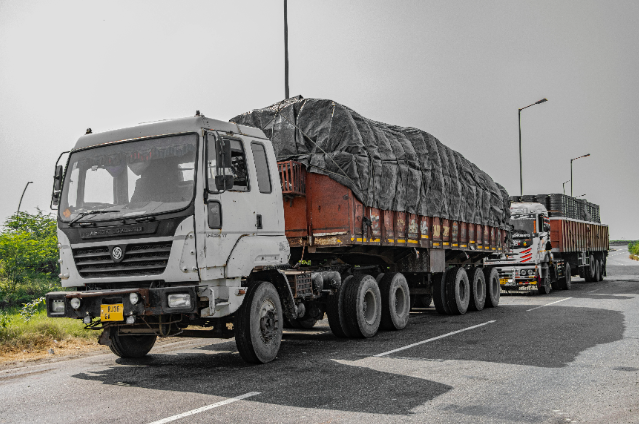
“Horn OK Please” is a phrase that every highway seems to be decorated with in India.
Amid the variations of colourful truck art, religious symbols, poetry and declarations of love, this phrase appears with remarkable consistency. For generations, motorists have read it without necessarily questioning its origin or its meaning. Yet the origins of these three simple words appear to be far less straightforward than they first seem to mean.
What makes this phrase intriguing is that no explanation appears to have been universally accepted. Instead, “Horn OK Please” sits at the intersection of road safety, wartime shortages and advertising history.
Here, the least controversial part of this phrase appears to be “Horn Please.” Before the widespread use of modern mirrors, cameras and advanced safety systems, truck drivers often had limited visibility of vehicles approaching from behind. The message, therefore, may have functioned as a simple request for communication between drivers. Several transport commentators suggest the phrase emerged as a practical tool for safer overtaking on crowded roads.
From a human perspective, this interpretation is perhaps the most revealing. Long before digital warning systems were present, road users relied on mutual awareness and improvised communication. The slogan may therefore be viewed as an example of ordinary people developing their own solutions to everyday risks.
One of the most used and repeated explanations that traces to this phrase is its connection to World War II. And according to this theory, fuel shortages allegedly forced some vehicles to operate using kerosene or transport kerosene in significant quantities. Because kerosene is highly flammable, trucks were supposedly marked with warnings indicating they were operating “On Kerosene.” Over time, this phrase shortened and evolved into the now-famous “Horn OK Please.”
However, it is worth noting that any strong documentary evidence directly linking “OK” to “On Kerosene” appears limited. Discussions among researchers and enthusiasts frequently describe the explanation as plausible but unverified. Some commentators have argued that the story may have developed into a popular urban legend because it is memorable and dramatic.
This uncertainty may actually make the story more interesting. The theory reflects how wartime experiences can leave traces in everyday culture, even when the historical record remains incomplete.
Another explanation links the phrase and the mysterious OK in the middle of the phrase to commercial branding. Some reports suggest that Tata Oil Mills once marketed a soap brand called “OK,” and according to this interpretation, truck operators may have painted the brand name onto vehicles as a form of mobile advertising. Over time, the separate elements of the ad phrase and the truck allegedly merged into a single phrase that people began reading as “Horn OK Please.”
Now, whether or not this theory is correct, it still highlights something uniquely Indian about public space. Trucks have often served not just as transport vehicles but as moving canvases carrying advertisements, personal messages, religious imagery and local art.
Another possible reason stated is that Indian drivers rarely use their side mirrors and instead use horns to communicate and indicate when they are about to overtake a car. Trucks, in particular, are often not even equipped with side mirrors in the first place. As a result, the backs of trucks may be painted to urge drivers to use their horn as a signal to the truck driver when they are overtaking.
Some observers have suggested that the “OK” may have been a visual marker placed between “Horn” and “Please” for readability. Various regional explanations continue to circulate online and among drivers, though many remain difficult to verify historically.
As concerns about noise pollution increased, in 2015, Maharashtra's transport department tried to ban “Horn Ok Please” to reduce the excessive honking that increased noise pollution. An effort was taken to make the environment quieter. However, the age-old practice and protest from the public made it a futile event.
Now, regardless of the phrase's origins, “Horn OK Please” appears to have evolved beyond a mere traffic instruction. The phrase became deeply associated with India truck art. It has since appeared in films, popular culture, photography projects and discussions about Indian roads. Many truck owners reportedly view vehicle decoration as a form of personal expression, making the slogan part of a larger cultural tradition.
In this sense, this phrase may reveal something about the people who spend their lives moving goods across vast distances. Truck drivers often remain largely invisible despite performing work essential to daily life. The slogan, painted by hand and passed from one generation to another, perhaps serves as a small creative reminder of the human stories that travel India's highways.
The true origin of the phrase “Horn Ok Please” may never be fully settled. The wartime kerosene theory remains widely repeated but appears difficult to conclusively prove. The advertising explanation is similarly intriguing yet not universally accepted. What seems clearer is that the phrase likely survived because it fulfilled a practical purpose before gradually becoming a part of India's visual and cultural landscape.
Perhaps the enduring appeal of “Horn OK Please” lies in its ambiguity. It is simultaneously a safety message, a folk tradition, a design motif and a historical puzzle— one that continues to travel thousands of kilometres every day on the backs of India's trucks.
Sources:
- https://timesofindia.indiatimes.com
- https://www.moneycontrol.com
- https://www.trucksbuses.com
- https://en.wikipedia.org
- https://www.atlasobscura.com