
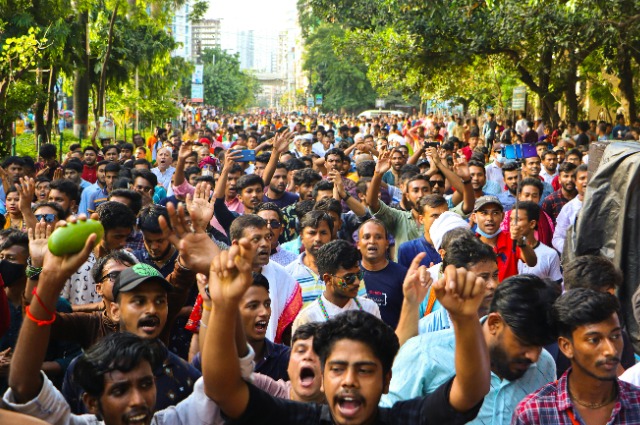
On May 15th, 2026, India's Chief Justice Surya Kant remarked during a Supreme Court hearing, comparing certain individuals to “cockroaches and parasites of society.” This comment was then misquoted, taken out of context, and then went explosively viral, framing it as an attack on India's unemployed youth.
The following day, Abhijeet Dipke, a 30-year-old PR professional, Boston University graduate, and former AAP social media strategist, launched the Cockroach Janta Party (CJP).
The Cockroach Janta Party, often shortened to CJP, emerged as a satirical online political movement. It gained traction after remarks by India's Chief Justice, although later clarifications were reportedly issued, the phrase quickly spread across social media platforms.
Instead of rejecting the label outright, many users allegedly reclaimed it as a symbol of survival and resilience. The cockroach, often associated with surviving in harsh conditions, became a metaphor for young people who feel ignored yet continue to persist through unemployment, exam stress, inflation, and uncertainty.
Rather than presenting itself as a conventional political organisation, the movement toes the line between satire, protest, performance art, and digital activism. Its supporters seem to view it as a voice for the unemployed and frustrated youth, while critics have alleged that it may simply be another viral social-media campaign with no institutional accountability.
The name of the party itself also appears to mock/parody the name of India's ruling political party, creating a blend of satire and political commentary that resonated strongly with Gen Z internet culture.
Unlike traditional political parties, CJP seemingly grew through reels, memes, AI- generated graphics, ironic slogans, and short-form content. Reports claimed the movement gained millions of followers within just days, especially on Instagram. Some reports even suggested that its follower count temporarily surpassed that of some of the major established parties online, showcasing how Gen-Z connected with CJP more than the government parties responsible for the Indian government.
The movement's messaging allegedly focused on: youth unemployment, rising living costs, paper leaks and exam scandals, political distrust, gender representation in politics, media independence and digital censorship, with many reels and posts on the page being about the recent NEET and CBSE issues.
However, many of these discussions were framed humorously, often through absurdist internet humour rather than formal political language.
This may explain why the movement spread so quickly among younger people. It appeared through debates or manifestos alone, through memes, Instagram stories, ironic edits, and shareable outrage, something that Gen-Z could understand and connect with easily.
However, one of the biggest questions that surrounds this ongoing phenomenon is whether the party actually exists.
Multiple reports indicate that the Cockroach Janta Party may not be officially registered with the Election Commission of India. Several articles explicitly describe it as a satirical movement or public-pressure campaign rather than a legally recognised political party.
Some reports also suggest that there may be no formal office, no recognised election symbol, no publicly declared organisational structure, and no legal status as a registered national or regional party. Because of this, observers have questioned whether the “party” label is symbolic rather than literal.
At the same time, supporters allegedly argue that the lack of legal structure is intentional and that the movement is meant to exist outside traditional systems.
Most reports link the movement to Abhijeet Dipke, who has been described in various articles as a political communications professional and public relations student based in Boston. Some reports also allege that he previously worked with or volunteered for the social-media ecosystem surrounding the Aam Aadmi Party.
This association has become somewhat controversial online.
Critics on Reddit and social media have speculated about possible political motivations behind the campaign, with some alleging it could be strategically anti-establishment or selectively critical of specific parties. Others have accused the movement of functioning more like influencer marketing rather than grassroots activism.
No publicly available evidence appears to conclusively prove these allegations, but the speculation itself may reveal how suspicious audiences have become of viral political branding online.
The reaction to CJP appears to be deeply divided.
Supporters of the movement see it as a rare youth-driven political expression, a humorous response to institutional arrogance, a symbol of frustration among unemployed young Indians, and a digital alternative to traditional protest culture.
Some users allegedly participated in offline symbolic activities, including cleanup drives while dressed in cockroach costumes.
Sceptics, however, have questioned whether the movement has any real-world strategy. The heavy use of AI-generated content has furthered the scepticism. Its lack of transparency and any organisational structure has also led to the creation of doubt among people, and has made them wonder whether its followers are mistaking virality for political legitimacy.
Several Reddit discussions have described the moment as a possible “social experiment,” “grift,” or short-lived internet trend.
Whether the Cockroach Janta Party survives or disappears, its sudden rise may reflect something larger about modern political culture in India.
The movement appears to demonstrate how meme culture can rapidly influence political conversations. How young audiences increasingly engage with politics through humour, how internet identity can sometimes matter more than institutional legitimacy, and how viral storytelling may now shape political perception faster than traditional campaigning.
Most importantly, the phenomenon may reveal a growing emotional disconnect between the young citizens and formal political systems. Even if many followers joined ironically, the anger, exhaustion, and sarcasm behind the movement seem very real.
It also reveals the frustration of the youth about the exam scams, 16% unemployment among the youth, an opposition too weak to inspire, and a government too comfortable to listen.
In that sense, the Cockroach Janta Party may not necessarily be important because it exists legally. It may be important because millions briefly acted as though it did.
Sources:
- Reuters report on the movement
- Associated Press explainer: The
- Times of India reports on the withheld X account
- News9 reports on X restriction
- Nepal News explainer
- ProCapitas explainer
- The Week report
- OU Prep Hub explainer
- Telangana Tribune article
- EQMint analysis
Reddit discussions: