
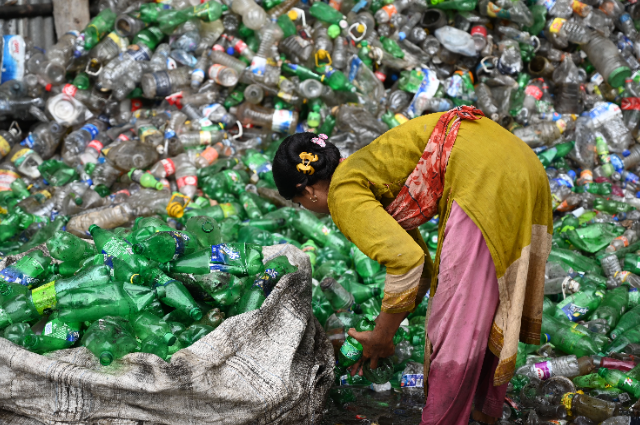
A woman wakes up early in the morning, navigating through winding and narrow lanes, moving past trash bins and dumping grounds to collect items that can still be sold, like different kinds of plastic items, scraps of metal, cardboard and glass. After carefully sorting through these items, she puts them in bags and takes them to a kabadiwala, a local recycler who could make use of these scraps. On a good day, she can earn between Rs 200 and Rs 400.
Now you won't find any employment records or discussions of her work in India's economy, but her role is extremely important in keeping that very system alive.
India's waste management system. India generates tens of millions of tonnes of solid waste every year, and a concerning amount of it ends up in landfills. The problem is that many of these aren't properly engineered landfills; instead, they're open dumps where waste simply piles up until it just can't fit anymore. This excess waste then leaks harmful chemicals into the soil and water, and when organic materials break down without oxygen, they produce methane, a gas that's even more harmful than carbon dioxide in the short-term climate picture.
A satellite analysis conducted in April 2026 by Carbon Mapper and the Stop Methane Project at UCLA found that India had two of the world’s largest methane-emitting landfill sites in 2025: one in Secunderabad, Telangana and another in Mumbai, Maharashtra.
Yet these environmental challenges raise an important question: who actually prevents even more waste from reaching these overflowing dumps?
In practice, much of India's recycling economy operates through an informal network rather than a fully integrated formal system. It was made through an informal network that grew out of need, shaped by poverty, survival and a kind of everyday ingenuity that rarely gets acknowledged.
Behind this informal recycling economy is a workforce estimated at roughly 1.5 million people, often referred to as Safai Saathis or waste pickers. They are the very first link in a long chain of people and workers collecting, sorting and moving waste into the recycling economy. Without them, plastic waste recovery in many cities would decline dramatically.
These workers manage around 60 to 70% of urban recyclable waste, based on ILO and Chintan data. An estimated 70% of plastic recycling in India depends on these workers in the informal sector.
Their work feeds into the same tiered network. Waste moves first from Safi Saathis to Kabadiwalas, then to informal recyclers, processors and finally manufacturers. And each step then adds value to these materials, especially in plastic recycling, but it also reveals something uncomfortable. The more you move up the chain, the more flexible, comfortable and profitable it becomes, while those at the bottom continue to operate with the least security.
Therefore, when officials talk about waste. The focus is typically on cleaning up landfills, creating waste-to-energy plants and enhancing mechanical processing. The Swachh Bharat Mission has made urban cleanliness a visible priority for governance.
However, the demographic composition of this workforce is extremely embedded in societal discrimination. This triad of caste, class and gender positions them at the bottom of informal labour hierarchies in cities. Most of them are illiterate, unskilled and burdened by generational poverty, compounded by their migratory status.
The environment that these waste pickers work in is extremely risky. With prolonged exposure to toxic substances and the repeated strain from doing physical chores, their health is taking a heavy toll. The 2017 study at the Deonar dumping area in Mumbai enumerated prevalent morbidities among the waste pickers: respiratory ailments (28%) like chronic cough and dyspnea, Musculoskeletal disorders (MSDs) due to repetitive bending and lifting of heavy loads, and gastrointestinal distress, including nausea and dysentery.
The systemic exclusion of Safai Saathis (waste pickers) from governmental welfare schemes starkly reflects their marginalisation within public policy frameworks. Migrants make up a substantial sector of this workforce, with a 2021 UNDP study finding that 88% of surveyed waste pickers are migrants. This demographic therefore faces some barriers to accessing social protection, including the non-availability of identification documents such as Aadhaar or caste certificates.
As a result, 23% of the surveyed waste pickers do not possess ration cards, and only 0.5% have caste or income certificates-essential documents for access to social welfare entitlements.
The millions of people who keep India's cities clean and make recycling that much more economically viable and these people are the ones who often remain invisible in policy, public disclosure and labour statistics. India's recycling success is not just driven solely by technology or municipal systems, but also by an informal workforce of waste pickers, kabadiwalas, sorters and recyclers who recover a significant share of recyclable materials.
Many of these workers operate without formal contracts, social security, healthcare, safety equipment or even actual legal recognition despite providing an essential environmental service. Discussions about sustainability, circular economies and climate action risk are incomplete if we overlook the people performing and doing the most labour-intensive parts of recycling.
So behind every recycled bottle, piece of cardboard or scrap of metal is often a worker whose contribution is rarely acknowledged. The future of India’s recycling economy may depend not only on better waste management systems, but also on whether society chooses to recognise, protect and dignify the millions whose labour has sustained the system for decades.
Sources: