
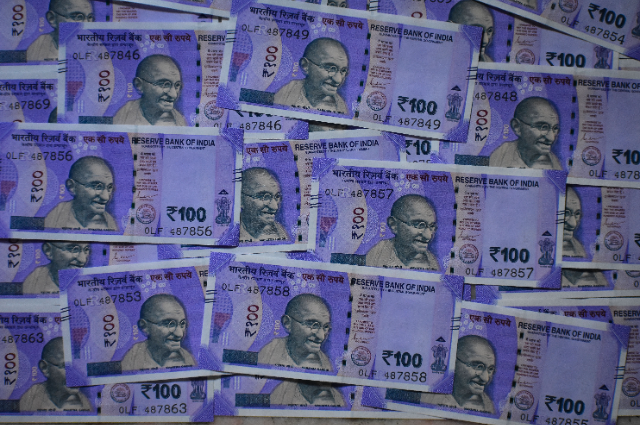
For decades after Independence, India’s currency carried no portrait of Mahatma Gandhi. Instead, Indian banknotes featured the Lion Capital of Ashoka and other national symbols. Gandhi only became the face of all Indian currency in 1996, after the Reserve Bank of India launched the Mahatma Gandhi series. And even then, the decision wasn’t simply about honouring the Father of the Nation— it was also about making Indian currency easier to recognise and harder to counterfeit.
The series before this relied on symbolic Indian motifs like the Lion Capital of Ashoka for the front, but they were then replaced by the new design, substituted with the portrait of Mahatma Gandhi, which was selected due to his universal rejection as the Father of the Nation to allow rapid public authentication of genuine currency.
Did you know? The portrait used on Indian banknotes is based on a photograph taken in 1946 when Gandhi was meeting the British politician Lord Frederick Pethick-Lawrence.
The decision to standardise Gandhi’s portrait across all denominations in the 1996 Mahatma Gandhi series reflected the shift toward using his universal recognizability among India’s diverse population to enhance familiarity with the public and facilitate better counterfeit detection, prioritising practical usability over just neutral symbolism.
RBI officials viewed Gandhi's image as instantly recognisable even in regions with different languages and literacy levels, making it a practical anti-counterfeiting measure as well as a symbolic one.
The series initially debuted with Rs. 10 and Rs. 500 denominations in 1996, which were then progressively expanded to include Rs. 5, Rs. 20, Rs. 50, Rs. 100, and Rs. 1000 notes by the late 1990s.
And by the 1990s, the RBI recognised the need for enhanced security features on currency notes due to advancements in reprographic techniques. A human face was hence deemed less susceptible to forgery than inanimate objects.
The Mahatma series banknotes also feature a framed/ windowed security thread that is partially exposed on the front and embedded on the back, and is designed for both manual and machine verification. In denominations such as Rs.10, Rs. 20, and Rs. 50, the silver-coloured thread is windowed on the front side and includes demetallized inscriptions reading “Bharat” in Devanagari script and “RBI” in English, which facilitates a see-through alignment when seen against a light source.
Denominations of higher values like Rs.100, Rs. 500, and Rs.1000 employ a similar kind of windowed thread with alternating exposed and embedded segments that resist tampering better by integrating a metallic strip into the paper substrate during the manufacturing process. This configuration allows the thread to resist removal or replication without compromising note integrity, as the demetallized windows register properly when backlit.
There's also a watermark in the Mahatma Gandhi Series consisting of a portrait of Mahatma Gandhi, positioned in the lighter areas of the notes, for better visibility against light. It was introduced uniformly across all denominations from the 1996 launch, and it employs a multi-tonal light-and-shade effect that mirrors the front portrait's contours, enhanced by multi-directional lines that complicate photographic duplication or reproduction.
Early issues maintained this core design with subtle shading variations, while mid-issue updates refined the tonality for greater fidelity and distinctiveness from counterfeits, ensuring the watermark’s opacity and detail remain undetected without magnification. This embedded paper characteristic, formed during the papermaking process, serves as a passive, non-reproducible authentication layer.
These primary features, like the security thread and watermark, enable straightforward detection by holding the note against light, which promotes public vigilance against counterfeits. Reserve Bank of India guidelines emphasise their role in initial screening, where misalignment or absence of certain features clearly signals forgery, contributing significantly to reductions in the circulation of fakes through heightened awareness and institutional checks. Audits by the RBI have documented improved detection efficacy, which is attributed to such embedded elements, underlining their mechanical reliability over surface-level indicators.
Over the years, several political groups and public figures have suggested that Indian currency should feature other national icons alongside Gandhi. Some suggest Jawaharlal Nehru, Subhas Chandra Bose, Sardar Patel or even religious figures like Goddess Lakshmi and Lord Ganesh. In 2016, however, the government clarified that a high-level committee had decided “there is no need to change Mahatma Gandhi’s photo on the currency notes.”
While Gandhi remains the face of India's banknotes, commemorative coins have allowed the country to honour many other leaders and reformers. India's first-ever commemorative coin was a Rs.1 coin issued in 1964 following Jawaharlal Nehru’s demise. Dr B. R. Ambedkar was also commemorated with special Rs.125 and Rs.10 coins. Commemorative coins were released for Sardar Vallabhbhai Patel’s birth anniversary, featuring highly sought-after Rs.2 variants as well as a Rs.150 special silver-alloy coin. To mark Rabindranath Tagore’s 150th birth anniversary, the government issued Rs.150 and Rs.5 special edition coin sets in proof and uncirculated (UNC) finishes. And for Dr APJ Abdul Kalam, special tribute collector coins, including a Rs.100 coin, have been minted.
While Mahatma Gandhi’s image on Indian currency is often seen as a tribute to the Father of the Nation, the decision to place him on every banknote in 1996 was also driven by practicality. His instantly recognisable face provided a simple way for millions of Indians to identify genuine notes and helped strengthen public defences against counterfeiting. Nearly three decades later, despite periodic debates around featuring other national icons, Gandhi’s portrait remains a symbol of both India's history and its approach to securing the rupee.
Sources:
- Reserve Bank of India (RBI) – Banknotes and Security Features https://www.rbi.org.in
- Civilsdaily – Story of Mahatma Gandhi's Portrait on Indian Banknotes https://www.civilsdaily.com
- Hindustan Times – Mahatma Gandhi Did Not Initially Appear on Indian Currency Notes. Find What Happened Later https://www.hindustantimes.com.
- The Economic Times – If Mahatma Gandhi Wasn't India's First Choice for Banknotes, Then How Did He Become the Rupee's Forever Face? https://economictimes.indiatimes.com
- Grokipedia – Mahatma Gandhi Series https://grokipedia.com
- Wikipedia – Mahatma Gandhi Series https://en.wikipedia.org