
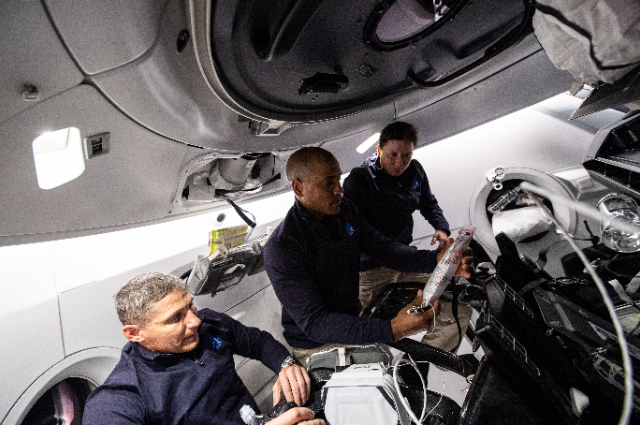
In an age where space exploration is once again attaining global imagination, the story of Victor J. Glover stands out: not just as a story of technical achievement, but something that's deeper, and human, a journey shaped by discipline, perseverance and representation. Glover's path, from serving as a pilot in the U.S. Navy to becoming a central figure in NASA's lunar return initiatives, is a testament to his individual grit and the changing landscape of inclusivity within space exploration.
He was born in 1976 in Pomona, California, in a middle-class family that valued education and service. He then attended the California Polytechnic State University, where he earned a degree in general engineering. Later, he furthered his academic credentials with advanced degrees from Air University and Naval Postgraduate School. Now this strong academic background served as more than just a credential; it became a foundational pillar of his professional trajectory, demonstrating how the intersection of technical mastery and an enduring commitment to education supports excellence within such high-stakes, high-risk environments.
Now Glover's early professional life was largely shaped by the structure and rigor introduced to him by the US military. As a naval aviator in the United States Navy, he flew F/A-1 Hornet aircraft and then later became a test pilot, logging over 3,000 flight hours in more than 40 aircrafts. Now this specific phase of his professional life was less about just accumulating hours in the cockpit and more about the mastery of precision while under immense pressure. As a test pilot, one usually operates at the very precipice of engineering capabilities, a realm where minute errors often cause catastrophic failure. For Glover, this rigorous environment served as a crucible for his decision-making and resilience: traits that would later prove indispensable in the high-stakes world of spaceflight.
In 2013, NASA selected Glover as part of Astronaut Group 21. This shift from military pilot to astronaut is famously intense, involving years of training in robotics, survival, and scientific research. For Glover, this period was as much about a psychological shift as a technical one; preparing to leave the atmosphere he had spent his life navigating.
Glover achieved a major career milestone in 2020 when he launched aboard the SpaceX Crew Dragon Resilience as part of the SpaceX Crew-1 mission. This mission was significant for several reasons: it represented NASA's inaugural operational crew flight and established Glover as the first Black astronaut to complete a long-duration assignment on the International Space Station. During his six-month occupancy in orbit, he executed a number of scientific experiments and conducted spacewalks, serving as a powerful symbol of diversity in a field that has traditionally been represented by a limited demographic.
Yet his story does not end here. He was then selected as a crew member for the Artemis II mission, a part of NASA’s ambitious Artemis program. Artemis II aims to send astronauts on a lunar flyby: the first crewed mission to travel beyond the Earth's orbit since the Apollo era. And it has been successful, making Glover one of the very first humans in over 50 years to journey toward the Moon, orbiting it before returning to Earth. This mission was not just some technical rehearsal: it is and was a symbolic bridge between the past and future explorations.
Glover's path shows us how much the right environment and early support matter. While big institutions like NASA and the Navy provide the roadmaps for success, getting on those paths often starts with having the right educational opportunities early on. His story really drives home why we need to keep investing in STEM and mentorship, making sure these doors are open for everyone.
Another very important dimension here is representation. Glover has spoken repeatedly and publicly about the significance of being “the first” in certain roles but also about the responsibility that is bestowed on a person along with it. His presence in space challenges longstanding perceptions of who belongs to elite scientific fields. For young people from marginalized backgrounds seeing someone like Glover in orbit can transform unknown ambition into something known and tangible.
There's also a human cost to such careers. Long-duration space missions require extended separation from your family, physical strain on your body and psychological resilience. Keep in mind Glover is a husband and a father and hence his journey reflects the balancing act faced by many other professionals in such high-stakes careers. His story is what reminds us that behind every astronaut is a network of personal relationships that sustain them through uncertainty.
Looking at the bigger picture, Glover's path reflects how space exploration itself is changing. The move from missions run only by governments to partnerships with companies like SpaceX is opening up a whole new era of innovation and access. At the same time, programs like Artemis are making a real effort to bring in international partners and diverse voices, aiming to make our journey into space more inclusive than it’s ever been.
In the end, Victor Glover's journey is about much more than reaching lunar orbit; it's about redefining the very paths that lead there. His life is a powerful example of what happens when discipline, education, and opportunity come together to create something truly excellent. More importantly, it reminds us of the human stories behind these massive technological milestones, the quiet years of hard work, the risks taken, and the many barriers broken along the way.
As humanity gets ready to return to the Moon, people like Glover serve as both pioneers and symbols for all of us. They remind us that exploring space isn't just a scientific mission; it's a deeply human one, driven by the dreams and determination of people who dare to push further.
Sources:
- NASA Astronaut Biography – Victor J. Glover https://www.nasa.gov
- NASA Artemis II Mission Overview https://www.nasa.gov
- SpaceX Crew Dragon Overview https://www.spacex.com
- Cal Poly San Luis Obispo – Alumni Profiles https://www.calpoly.edu
- Naval Postgraduate School Overview https://www.nps.edu
- Air University (U.S. Air Force) https://www.airuniversity.af.edu