
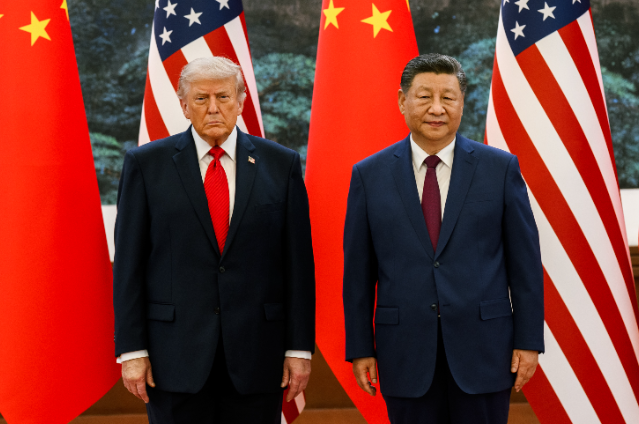
United States President Donald Trump arrived in Beijing ahead of a high-risk summit with Chinese President Xi Jinping, after many weeks of unsuccessful US efforts to persuade China to help bring Iran back into negotiations and ease tensions around the Strait of Hormuz.
This summit is particularly significant because Trump will be the first US leader to visit China in nearly a decade. Originally expected earlier this year, the meeting was delayed by the war with Iran.
Trump’s visit to Beijing came at a tense geopolitical moment with ongoing tariff disputes, concerns over Taiwan, the AI and technology rivalry, the supply chain instability, and global economic uncertainty. Multiple reports have suggested expectations for a historic breakthrough were relatively low before the summit had even begun.
Analysts appeared to interpret the meeting as an attempt to "stabilise" relations rather than primarily repair them. Ordinary citizens in both countries may experience these rising diplomatic tensions through inflation, manufacturing insecurity, export slowdowns, or job instability rather than through just basic ideology.
The visit highlighted the widening gap between the central interests of the two major powers. Although both sides projected warmth and stability, the meetings showed the reality of how difficult it has become to turn these high-level engagements into meaningful cooperation on major issues, such as a truce in Iran, with the focus being on reopening the Strait of Hormuz, Taiwan, and technology.
The low-hanging fruit here seemed to be only trade. The summit was more about protocol and pomp, and less about major concrete deliverables. Some of the possible reported understanding of these talks was: China was reportedly expected to increase purchases of American agricultural goods, aircraft, and energy products.
Reports have suggested that these discussions may have also included tariff adjustments, trade truce extensions, and new trade cooperation mechanisms. Some comments even suggested that Trump may have been trying to project economic toughness while simultaneously seeking market stability ahead of political pressure at home.
Reportedly, the US-China relationship has been described as a paradox where both countries seek autonomy while remaining economically dependent on one another. Farmers, factory workers, and exporters in both countries may remain caught between nationalist rhetoric and economic dependence.
The summit could be framed as a recognition that neither economy can easily disconnect from the other without bigger consequences.
Reuters and other reports seem to suggest the visit involved elaborate ceremonial gestures, with military salutes, state banquets, cultural events, and carefully choreographed symbolism. Trump was even reportedly welcomed with an honour guard and a gun salute at the Great Hall of the People.
Some people have appeared to interpret this as Beijing attempting to engage Trump through personal diplomacy and spectacle. However, simultaneously, reports indicated there was no sweeping joint declaration, no transformational agreement, and limited concrete policy change.
Now the summit may have reflected modern diplomacy’s increasing dependence on televised optics and political messaging rather than durable institutional consensus.
Multiple reports have suggested that Xi warned that Taiwan remains the most dangerous issue in US-China relations. Trump reportedly referred to the pending Taiwan arms discussions as potential “negotiating chips,” which some observers viewed as strategically ambiguous.
Analysts appear to be divided on this matter, with some believing that this vagueness could create negotiating leverage, while others have feared it might deepen regional uncertainty.
For many people in Taiwan and across East Asia, these geopolitical strategy discussions may translate into lived anxiety about conflict, economic shocks, or regional instability.
Analysts have observed that the US and China seem to be entering the summit with different priorities.
Now, despite the carefully staged diplomacy and symbolic gestures, several of the deepest fault lines between the United States and China have reportedly remained unresolved after the meeting. Questions surrounding Taiwan, semiconductor dominance, AI regulation, export restrictions, tariffs, military activity in the Indo-Pacific, and control over rare earth supply chains appeared to continue lingering beneath these pleasantries.
For ordinary people, these disputes may feel distant when discussed in diplomatic halls. Yet their effects are often deeply personal, influencing the price of electronics, the stability of jobs, access to technology, and even fears surrounding regional conflict. While leaders may shake hands for the cameras, many analysts seem to believe the broader strategic rivalry between both nations still remains intact, only temporarily softened by the language of diplomacy.
Beyond these headlines and diplomatic gestures lies the effects of the US-China rivalry, which may continue to fall mostly and heavily on ordinary people. Farmers are facing export uncertainty, workers are remaining vulnerable to supply chain disruptions, and families are increasingly feeling economic pressure through rising prices and unstable markets. At the same time, the growing discussions around Taiwan and military power appear to have deepened public anxiety about global instability.
Citizens around the world may now find themselves as spectators to a “great power competition” that feels both distant and personal. While leaders negotiate strategy and trade behind closed doors, ordinary people are often left carrying the uncertainty of what comes next. The Beijing meeting may ultimately be remembered less for resolving tensions and more for reflecting a fragile effort to prevent them from escalating further.
Sources:
- Reuters – Xi’s contrasting ties with Trump and Putin
- Times of India – Trump‑Xi summit analysis
- Reuters – Taiwan discussions during the summit
- Los Angeles Times – What’s at stake in the summit
- Al Jazeera – Key issues shaping the summit
- CBS News – Trump and Xi meeting coverage
- South China Morning Post – Trump’s return to Beijing
- The Straits Times – Rivalry and tensions before the summit
- Washington Post/AP – Trade war and summit tensions
- China Briefing – What was agreed and not agreed
- Economic Times – Summit overview