
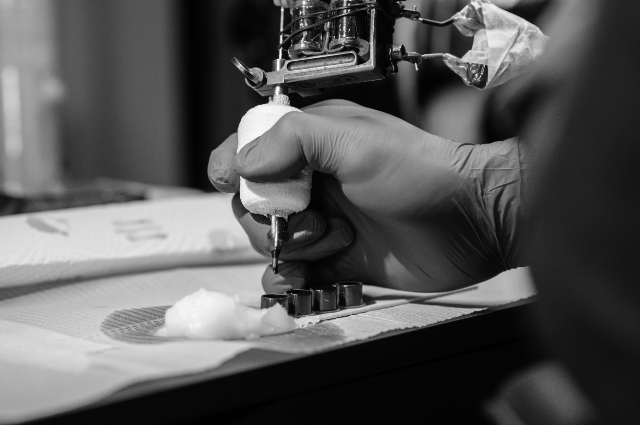
The rhythmic buzz of a modern tattoo studio is a sound anchored in a striking historical irony. Walk into any parlour today, and you are listening to the direct descendant of a failed 19th-century office automation device. In 1891, an Irish-American tattooist named Samuel O’Reilly permanently altered the landscape of body modification by patenting the first electric tattoo machine. Yet, the foundational technology was not his own. It belonged to Thomas Alva Edison, the "Wizard of Menlo Park," who had engineered the device fifteen years prior with a completely different objective in mind: duplicating office documents. By repurposing a corporate flop into a cultural phenomenon, O’Reilly transitioned tattooing from a gruelling, marginalised maritime ritual into a mainstream global industry.
Before O’Reilly’s intervention, the tattooing process in the Western world was an exercise in extreme patience and physical endurance. Sailors and societal outliers relied on the "hand-poked" method, utilising bone, shark teeth, or basic sewing needles bound to wooden sticks. A highly skilled practitioner could manage roughly two to three skin punctures per second. Because the process was remarkably slow, large-scale designs were rare, expensive, and incredibly painful, limiting the clientele to a small subculture of mariners and carnival performers. O’Reilly, who had honed his craft while serving in the United States Navy, recognised that the lack of mechanical efficiency was the primary bottleneck preventing tattooing from achieving widespread commercial viability.
The catalyst for change arrived via Edison’s 1876 patent for the "Stencil-Pen." Driven by a rotary motor and a small battery, Edison’s pen was designed to rapidly puncture holes into a sheet of waxed paper, creating a stencil that could then be used to replicate letters and documents with ink. The business world, however, rejected it; the device was heavy, the batteries were notoriously messy, and superior copying technologies soon eclipsed it. While the corporate sector saw a failure, O’Reilly saw a breakthrough. He realised that if a machine could rapidly perforate paper, it could, with a few modifications, perforate human skin to deposit pigment.
O'Reilly acquired the electric pen and systematically re-engineered it for human anatomy. His modifications were precise and transformative. First, he added a specialised ink reservoir directly above the assembly to ensure a continuous, controlled flow of pigment. Second, he modified the structural casing, shifting the centre of gravity to optimise the tool's grip for an artist during long sessions. Finally, and most crucially, he reconfigured the single-needle shaft to accommodate a multi-needle configuration, allowing artists to group up to three needles at once for cleaner lines and faster shading.
The impact of these changes was staggering. When O’Reilly secured U.S. Patent No. 464,801 on December 8, 1891, he introduced a machine capable of delivering approximately 50 punctures per second—an exponential leap from the manual standard. This technological surge democratised the art form almost overnight. Sessions that previously required days were compressed into hours. The drastic reduction in procedural pain and cost triggered an unprecedented craze across New York City. O’Reilly set up shop in Manhattan's Bowery district, drawing an eclectic mix of clients ranging from rough-hewn dockworkers to affluent high-society elites seeking a taste of the avant-garde.
The sudden commercial success of the machine sparked a bitter rivalry. Thomas Edison, realising the lucrative potential of the market he had inadvertently created, attempted to contest O’Reilly's dominance and assert control over the modified technology. However, the legal system sided with the practical innovator. O’Reilly successfully defended his patent, proving that his modifications constituted a distinct, novel utility. By the turn of the century, O’Reilly’s reputation was so formidable that contemporary publications frequently heralded him as the premier tattooist in the world, a remarkable trajectory for a man who had once been a compromised sailor drifting through the naval ranks.
The legacy of O'Reilly's adaptation cannot be overstated. A statistical look at the modern industry reveals a straight line connecting back to the Bowery of 1891. According to market research data from IBISWorld, the global tattoo industry has grown into a multibillion-dollar market, with over 30% of American adults sporting at least one piece of body art. The core mechanics of the modern rotary tattoo machine still mirror the exact push-and-pull principles of Edison’s stencilling pen and O'Reilly's ink feed. Samuel O’Reilly did not just invent a new tool; he took a discarded piece of American corporate ambition and used it to write the opening chapter of modern subculture history.
References
- National Museum of American History. "Edison's Electric Pen." Smithsonian Institution. https://www.si.edu
- United States Patent and Trademark Office. "S. F. O'Reilly Tattooing-Machine Patent No. 464,801." USPTO Patent https://patentimages.storage.googleapis.com
- New York Historical Society. "Tattoos and the Bowery: The Rise of Samuel O'Reilly." NYHS Digital Collections. https://www.nyhistory.org
