
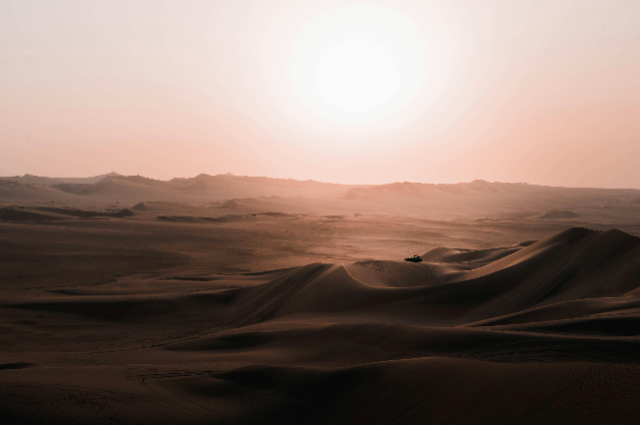
India is burning up. Every day feels like a new personal record for heat. Roads shimmer under the afternoon sun, ceiling fans push around air that feels more like heat from a furnace, and even after midnight, the walls continue to radiate warmth back into our homes. In cities like Delhi, Jaipur, Nagpur, and even parts of Punjab, stepping outside in May no longer feels like walking into summer. It feels like stepping into an oven. What sounds even more unbelievable is that many deserts around the world are sometimes recording lower temperatures than Indian cities. The places we once imagined as endless lands of unbearable heat are now, at times, cooler than the crowded streets of urban India. The reason lies not only in climate change but also in the way our cities have been built and expanded over the years.
The Thar Desert in Rajasthan can cross 45 degrees Celsius during peak summer, but several Indian cities have recently touched similar temperatures while feeling far more unbearable. In 2024, Delhi recorded 52.3 degrees Celsius at a weather station in Mungeshpur, making headlines across the world. Even though experts later questioned the exact reading, large parts of North India remained above 47 degrees for days. According to the India Meteorological Department, heatwave days across the country have increased sharply over the last two decades. Scientists from the Intergovernmental Panel on Climate Change have repeatedly warned that South Asia is becoming one of the most vulnerable regions for extreme heat because of rising temperatures, dense populations, humidity, and rapid urban growth. What was once considered an uncomfortable season is now turning into a serious public health crisis.
One of the biggest reasons deserts can sometimes feel cooler than Indian cities is something called the urban heat island effect. Deserts are mostly open landscapes. Sand heats up quickly during the day but loses heat just as quickly after sunset. Cities behave very differently. Concrete roads, asphalt, metal roofs, and glass buildings absorb heat throughout the day and continue releasing it long after the sun goes down. This is why nights in Delhi or Mumbai often remain above 35 degrees Celsius while desert temperatures begin falling rapidly. The lack of trees makes the situation even worse. A study by the Centre for Science and Environment found that areas with dense greenery can be several degrees cooler than neighbourhoods filled with traffic and concrete structures.
Humidity also plays a major role in making Indian heat feel more dangerous than desert heat. Dry heat and humid heat affect the body in completely different ways. In desert regions, sweat evaporates quickly, helping the body cool itself naturally. In many Indian cities, especially coastal and densely populated ones, humidity slows this process down. Scientists describe this using the term wet bulb temperature, a condition where the human body struggles to release heat even through sweating. Researchers from the Massachusetts Institute of Technology have warned that parts of South Asia may approach dangerous wet bulb conditions by the end of the century if global emissions continue rising. In simple words, the air could become so hot and humid that even healthy people resting in the shade would face serious health risks after prolonged exposure.
Delhi has become one of the clearest examples of this growing problem. Over time, open land has been replaced by highways, apartment towers, shopping complexes, and industrial zones. Thousands of vehicles release waste heat into the atmosphere every day while air conditioners pump hot air back onto already overheated streets. Poorer communities suffer the most during these conditions. Homes with tin roofs often become dangerously hot during summer afternoons, with indoor temperatures rising several degrees above outdoor levels. A 2023 report by the World Bank warned that increasing heat stress could lead to major economic losses for India by reducing worker productivity and affecting millions of jobs. Construction workers, farmers, factory workers, delivery workers, and street vendors are among those most exposed because they spend long hours outdoors under direct sunlight.
The harsh reality is that the people contributing least to climate change are often the ones suffering the most from it. Wealthier families can stay indoors with air conditioning, backup electricity, and better-insulated homes. Daily wage workers and people living in crowded settlements rarely have that option. In 2015, a severe heatwave killed more than 2,500 people across India, especially in Andhra Pradesh and Telangana. Hospitals reported rising cases of dehydration, heat stroke, and organ failure. Scientists believe these events may become more common in the coming years. Research published in the journal Nature Communications found that extreme heat events in India have become significantly more likely because of human-caused climate change.
There is also a visible emotional and psychological shift taking place. Older generations often describe summer as difficult but manageable. Today, many Indians describe it as exhausting, suffocating, and endless. Schools shut down earlier than usual, electricity grids struggle under the growing demand for cooling, and water shortages worsen as reservoirs dry more quickly. Summer itself seems to stretch longer every year. Cities continue expanding rapidly without enough planning for green spaces, cooling systems, or heat-resistant infrastructure. In many places, trees disappear faster than they are planted. Ironically, modern development has created surroundings that trap more heat than the deserts people once feared.
Even so, experts believe there is still time to reduce the damage if action is taken quickly. Cities like Ahmedabad have introduced Heat Action Plans that include early heat warnings, public cooling centres, water distribution systems, and awareness campaigns. Urban planners are also encouraging reflective rooftops, shaded streets, rainwater harvesting, and larger green spaces. Even simple solutions such as painting rooftops white can lower indoor temperatures
significantly. Researchers in Hyderabad found that cool roof programs reduced temperatures inside homes by several degrees during periods of extreme heat. These measures are no longer futuristic ideas. They are becoming necessary strategies for survival.
India’s heat crisis is no longer just about the weather. It is about how millions of people will live, work, and survive in the years ahead. The frightening reality is that while some deserts begin to cool after sunset, many Indian cities continue trapping heat deep into the night. Deserts were once seen as the harshest places on Earth, but now many Indian cities are beginning to feel even more unforgiving. The difference is that much of this heat has been created by us. Concrete roads, glass buildings, traffic, and endless construction have turned cities into giant heat traps. The temperatures flashing on weather apps are no longer just numbers. They are warnings. Every extra degree changes how people sleep, travel, study, work, and survive. India is no longer simply facing another summer. It is slowly entering an age of extreme heat where survival itself may depend on how quickly we rethink the cities we have built.
References
- India Meteorological Department Heatwave Guidance — Official heatwave data, forecasts, and reports from the India Meteorological Department.
- IPCC Climate Change Report on Asia — Details how South Asia is becoming increasingly vulnerable to extreme heat and heat stress.
- MIT Study on Deadly Heatwaves in South Asia — Research explaining dangerous wet bulb temperatures and the future risks of humid heat in South Asia.
- Science Advances Research on Heatwaves and Human Survivability — Scientific paper discussing deadly heatwave projections in densely populated regions,s including India.
- Nature Communications Study on Heat Stress in India — A study examining increasing heatwave days and humid heat stress across India.
- Centre for Science and Environment — Research and reports on urban heat islands, green cover, and climate impacts in Indian cities.