
In the winter of 2023, a NASA satellite image went viral. It showed the Indo-Gangetic Plain blanketed under a thick brown haze stretching from Pakistan to Bangladesh, a visible testament to what the World Health Organisation had already confirmed in data: India is home to 11 of the world's 20 most polluted cities by PM2.5 concentration. Delhi, Byrnihat, Muzaffarpur, and Begusarai are names that appear year after year on lists no nation wants to top. And yet, these are cities in a country whose ancient civilisation at Mohenjo-daro, some 4,500 years ago, engineered covered brick sewers and public baths that would not look out of place in a modern European town. The distance between that past and this present is India's great cleanliness paradox.
India's relationship with cleanliness is not a simple story of neglect. It is a collision of scale, poverty, culture, colonial legacy, and governance layered over a civilisation that holds the river Ganga to be sacred while simultaneously discharging 2.9 billion litres of raw sewage into it every single day, according to the Central Pollution Control Board. To dismiss India as 'dirty' is to miss almost everything. To ignore the crisis is to miss the rest.
Air pollution is perhaps India's most measurable environmental failure. The 2024 World Air Quality Report by IQAir ranked India as the third most polluted country in the world by annual average PM2.5, with a national mean of 54.4 μg/m³, more than ten times the WHO guideline of 5 μg/m³. In Delhi, the figure frequently exceeds 300 μg/m³ in November, when stubble burning from Punjab and Haryana's paddy fields converges with vehicular emissions, construction dust, and cold stagnant air. The city essentially becomes an open gas chamber for six to eight weeks each year.
But Delhi is not unique; it is a magnified version of a national problem. Kanpur, one of India's major industrial cities with over 400 tanneries, recorded annual PM2.5 levels of 77 μg/m³ in recent surveys. Patna, the capital of Bihar, regularly ranks among the most polluted cities globally due to brick kilns, poorly regulated traffic, and open waste burning. A 2019 study in The Lancet estimated that air pollution is responsible for approximately 1.67 million deaths annually in India, accounting for nearly 18% of all deaths in the country. These are not abstractions; they are schoolchildren walking to class through brown fog, elderly patients with deteriorating lungs, and infants in ICUs across cities from Agra to Ahmedabad.
The causes are structural and deeply tied to economic development patterns. India still generates over 70% of its electricity from coal. The country has more than 300 million two-wheelers, many running on older, polluting engines. Its rapid urbanisation, with over 500 million people expected to live in cities by 2030, means construction activity that kicks up silica dust across every major metropolitan area. Tackling this is not a matter of civic will alone; it requires a fundamental restructuring of the energy and transportation economy.
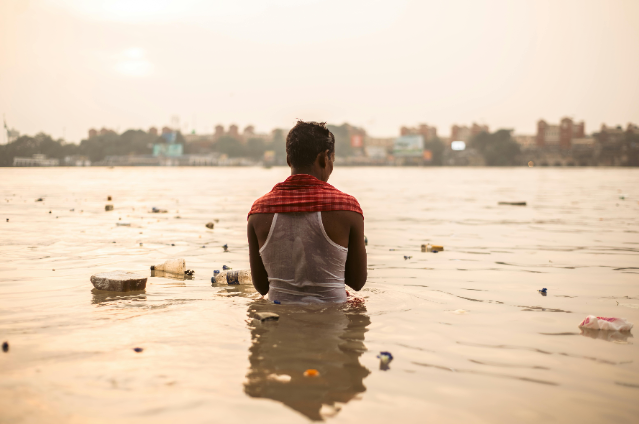
No contradiction in India's cleanliness narrative is sharper than the one playing out on its riverbanks. The Ganga, revered by over a billion Hindus as the goddess Ganga Mata, believed to wash away sins and purify the dead, is also one of the most biologically contaminated rivers on Earth. The National Mission for Clean Ganga (NMCG) data shows that of the 97 towns along the river's main stem, only a handful have functional sewage treatment plants operating at full capacity. Varanasi, one of the holiest cities on the Ganga's banks and a destination for millions of pilgrims annually, discharges approximately 300 million litres of untreated sewage directly into the river every day.
The Yamuna, which flows through Delhi before joining the Ganga at Prayagraj, offers an even more dire case study. A 22-kilometre stretch through Delhi, i less than 2% of the river's total length, receives approximately 80% of its total pollution load, according to the Delhi Pollution Control Committee. During Chhath Puja, when millions wade into the Yamuna to offer prayers to the sun god, they do so in water whose faecal coliform count is tens of thousands of times above safe bathing limits. The river that runs through India's capital, and where Mughal emperors once held court above its clear waters, is today little more than a slow-moving drain for portions of its route.
India has spent significant resources trying to address this. The Namami Gange programme, launched in 2014 with an outlay of ₹20,000 crore (approximately $2.4 billion), has built new sewage treatment infrastructure and intercepted major drains in several cities. Haridwar and Rishikesh have seen measurable improvement in water quality. But the challenge is immense: the Ganga basin supports 600 million people, more than the entire population of Latin America, and the industrial estates, distilleries, paper mills, and leather tanneries along its banks continue to discharge effluents with inadequate regulation.
When India's Swachh Bharat Mission (Clean India Mission) was launched on Gandhi Jayanti, October 2, 2014, its stated goal was audacious: to eliminate open defecation in India by 2019, the 150th anniversary of Mahatma Gandhi's birth. What followed was one of the largest sanitation campaigns in human history. The government claims to have constructed over 110 million household toilets between 2014 and 2019, bringing toilet coverage from approximately 39% to near universal access in rural areas.
The programme achieved genuine, measurable success in reducing open defecation. The National Annual Rural Sanitation Survey (NARSS) 2018-19, conducted with World Bank oversight, found that 93.4% of rural households had access to a toilet, and 96.5% of those were being used. Child diarrhoea and related mortality rates fell in districts with high sanitation coverage. A randomised controlled trial in Madhya Pradesh, published in PLOS Medicine, found a 30% reduction in child stunting in villages that achieved open-defecation-free status.
Yet the story is also more complicated than government headlines suggest. Independent researchers, including teams from the Research Institute for Compassionate Economics (RICE), found in their 2018-19 survey that open defecation persisted at significant rates in several states despite official open-defecation-free declarations. In Bihar, some studies found that over 40% of rural men still defecated in the open even where household toilets existed, a behavioural gap that infrastructure alone cannot close. Many of the quickly constructed toilets lacked water connections or proper pits, making them non-functional. The lesson from Swachh Bharat is that the scale of construction is not the same as the transformation of sanitation and that the latter requires sustained investment in behaviour change, water supply, and maintenance.
On the eastern edge of Delhi, visible from the adjacent highway and now taller than the Qutub Minar, stands the Ghazipur landfill. At over 65 metres in height and still receiving 2,000 tonnes of garbage a day as of 2023, it has long exceeded its design capacity and official closure date. Parts of it have literally collapsed, killing waste-pickers in 2017. It is home to thousands of people who live by sorting recyclables from the mounds. It is also symbolic of a national crisis: India generates approximately 62 million tonnes of municipal solid waste annually, and less than 20% of it is scientifically processed, according to the Ministry of Environment, Forest and Climate Change.
The reasons are systemic. India's urban local bodies, the municipalities responsible for waste management, are chronically underfunded. A 2021 report by the Centre for Science and Environment found that most Indian cities spend less than $30 per tonne on waste management, compared to $100–150 per tonne in cities with functioning systems. Door-to-door collection, while improving under Swachh Bharat 2.0, remains patchy in secondary cities and peripheral urban areas. Waste segregation at source, mandatory since 2016 under the Solid Waste Management Rules, is rarely enforced. The informal waste-picker economy, estimated at 1.5 to 4 million people nationally, processes a significant fraction of recyclables but operates without legal protection or health safeguards.
There are, however, pockets of genuine success worth studying. Indore, a city of 3.3 million in Madhya Pradesh, has topped India's Swachh Survekshan (national cleanliness survey) rankings every year since 2017. The city runs 24/7 door-to-door waste collection, processes organic waste into compost and biogas, and enforces fines for public littering with visible deterrence. Its garbage trucks play music, a cultural signal borrowed from Japan, so residents bring out segregated waste on time. Indore's model demonstrates that Indian cities can achieve high cleanliness standards; the challenge is replicating institutional will and sustained investment across 4,000 towns and cities.
One of the most striking observations made by anthropologists and urban planners studying India is the sharp disjunction between the cleanliness of private and domestic space versus public space. Walk into almost any middle-class Indian home, and you will find it immaculate floors mopped daily, shoes removed at the door, and kitchens scrubbed. Step outside the gate and you may find a mound of garbage on the footpath, a wall stained with paan spit, or a drain choked with plastic bags. This is not hypocrisy but reflects a deeply embedded cultural mapping: the home is sacred and clean, the street is public and therefore someone else's responsibility.
This maps onto what sociologists call the 'public goods problem', the tendency to underinvest in shared resources when individual incentives are weak. But it also has roots in caste history. For centuries, the cleaning of public and human waste was assigned to specific lower castes, such as the Valmiki community in northern India, classified as Scheduled Castes. The association of public sanitation with caste-based labour meant that many upper-caste Indians considered it beneath their dignity to be personally concerned with street cleanliness. While this attitude is changing, particularly among younger urban populations, its legacy shapes how civic responsibility is distributed and perceived.
Any honest assessment of India's cleanliness challenges must acknowledge the unfairness baked into global comparisons. India manages 1.44 billion people more than the combined populations of Europe and North America, on a per-capita income of approximately $2,500 per year. The United Kingdom, often invoked as a cleanliness benchmark, took over a century of industrial wealth and several deadly cholera epidemics before it built the sewerage systems that Londoners now take for granted. Joseph Bazalgette's Victorian sewers, completed in the 1870s after the Great Stink of 1858, are still in use today, built by a country that, at the time, ruled an empire, extracting resources from places like India.
It is also worth noting that Western nations have serious environmental problems that receive comparatively little global attention. The United States' water infrastructure crisis, exemplified by the lead contamination in Flint, Michigan, or the 'forever chemical' PFAS contamination of drinking water across dozens of states, rarely features in global cleanliness rankings. The Thames was a sewage dump until the mid-20th century. The Mississippi River basin is heavily polluted by agricultural runoff and industrial discharge. The 'dirty India' narrative, while grounded in real data, is also shaped by what Western media chooses to photograph and amplify: the chaotic ghat, the overflowing drain, rather than the quiet, functioning municipal composting plant in Indore or the solar-powered sanitation blocks in Amravati.
India's cleanliness paradox will not be resolved by either defensive nationalism or lazy stereotype. It requires the kind of honest, data-grounded engagement that acknowledges both the severity of the problem and the complexity of its causes. The air in Delhi is genuinely dangerous; to deny this is to abandon the millions who breathe it. The Ganga is genuinely in crisis; to excuse this in the name of cultural sensitivity is to fail the pilgrims and fishermen who depend on it. At the same time, the story of Swachh Bharat, with all its limitations, is also the story of a government attempting one of history's largest behaviour-change campaigns. The story of Indore is the story of what Indian institutional capacity can achieve when political will aligns with sustained investment.
The civilisation that built Mohenjo-daro's sewers has not forgotten what cleanliness means. It is navigating, at extraordinary scale and speed, the transition from a predominantly rural, low-income society to an urbanising, middle-income one, a transition that every now-developed nation struggled with in its own time, usually with far fewer people and far more resources. The question is not whether India can become cleaner. The question is whether it will invest the institutional energy, the infrastructure capital, and the civic education to do so before the environmental costs become irreversible. The Ganga is patient. The microparticles in Delhi's air are not.
References:
- IQAir World Air Quality Report 2024 — https://www.iqair.com
- The Lancet (2019): 'The impact of air pollution on deaths, disease burden, and life expectancy across the states of India' — https://www.thelancet.com
- Central Pollution Control Board — River Ganga Water Quality Data — https://cpcb.nic.in
- National Mission for Clean Ganga (Namami Gange) — https://nmcg.nic.in
- National Annual Rural Sanitation Survey (NARSS) 2018-19 — https://jalshakti-ddws.gov.in
- RICE Institute — Sanitation Research — https://riceinstitute.org/research
- Centre for Science and Environment: State of India's Environment 2021 — https://www.cseindia.org
- Swachh Survekshan 2023 Rankings — https://swachhsurvekshan.org
- PLOS Medicine: 'Effect of a rural sanitation programme on diarrhoea, soil-transmitted helminth infection, and child malnutrition' — https://journals.plos.org
- Delhi Pollution Control Committee — Yamuna River Monitoring — https://www.dpcc.delhigovt.nic.in