
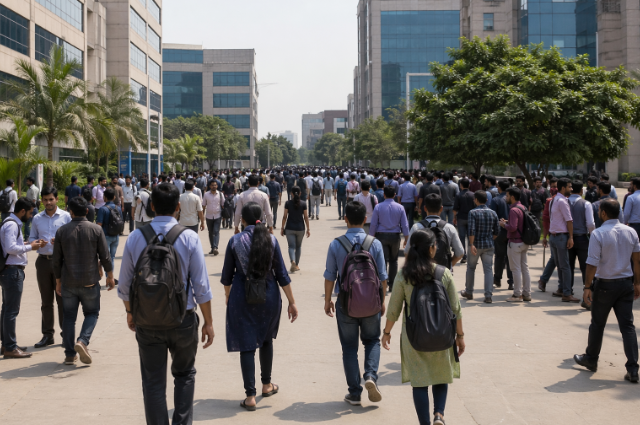
On an ordinary April morning in Noida, factory gates that usually opened to the noise of machines and rushing shifts instead became gathering points for anger. Workers from garment and export units stood outside in clusters, raising slogans and demanding something they believed had long been denied to them: fair wages. At first, it looked like another routine labour protest, the kind industrial towns witness from time to time. But as the day progressed, roads were blocked, police forces arrived, stones were thrown, vehicles were set ablaze, and parts of one of India’s busiest manufacturing hubs slipped into chaos. What happened in Noida in April 2026 was not only about one city. It was the story of how invisible state borders are creating visible unrest across North India.
The workers had a simple argument. Just across the border in Haryana, the state government had recently raised the minimum monthly wage from around ₹14,000 to nearly ₹19,000. In neighbouring Uttar Pradesh, many workers in industrial zones such as Noida continued to earn close to ₹13,000. For years, this difference may have existed quietly on paper. But in 2026, with inflation squeezing households and workers becoming more aware of opportunities nearby, the gap no longer felt administrative. It felt personal.
Two men leave for work before sunrise. One boards a shared auto toward a factory in Noida, while the other heads to an industrial unit in Gurugram. Their days look almost identical: long hours on the shop floor, repetitive production targets, short meal breaks, and tired journeys back to cramped rented rooms. They perform similar labour, face the same pressures, and carry the same responsibilities at home. Yet when the month ends, one receives several thousand rupees more than the other, not because he works harder or longer, but because his factory stands across a state border. In the interconnected economy of the National Capital Region, such differences no longer stay hidden. Workers compare salaries through friends, relatives, contractors, and social media, turning private frustration into public resentment.
Noida itself is built on labour. Behind its glass towers, expressways, and growing skyline lies an industrial ecosystem powered by migrants from Uttar Pradesh, Bihar, Uttarakhand, Rajasthan, and beyond. Many live in modest rented rooms where rent consumes a large share of income. Food costs have risen. Transport is expensive. School fees, medicine, electricity, and fuel already stretch thin budgets. For a worker earning ₹13,000, every hundred rupees matters. A wage difference of ₹5,000 or ₹6,000 with Haryana is not a statistic. It can mean better food for children, timely rent, or money sent home to ageing parents.
This is why the protest spread quickly. What started as a demand for higher pay soon widened into larger complaints that had been building for years. Workers spoke of long duty hours, uncertain overtime payments, delayed salaries, and poor grievance systems. These issues often remain invisible until one trigger brings them to the surface. In Noida, the Haryana wage revision became the trigger. It turned silent frustration into collective action.
Authorities initially treated the unrest as a public order challenge. Police were deployed, tear gas was used, and arrests followed after clashes intensified. Yet the government soon realised the problem could not be solved through force alone. Relief measures were announced: mandatory weekly offs, double wages for overtime and holiday work, timely salary payments by the tenth of every month, annual bonuses, and formal complaint systems, including committees for harassment cases. A high-level inquiry committee was also formed to study the root causes. These steps revealed an important truth. Even the state understood that behind the street violence lay deeper labour distress.
Across North India, government officials often sit in conference rooms discussing how to attract the next factory, warehouse, or export unit. Promises are made of cheaper land, quicker approvals, tax benefits, and smoother regulations. Hidden beneath these incentives is another unspoken advantage: access to low-cost labour. For a while, the formula appears successful. Companies arrive, production begins, and numbers look strong on paper. But outside those offices, workers continue to count every rupee, stretch every meal, and endure long shifts for wages that barely cover survival. Sooner or later, that pressure spills over. What looked like economic efficiency begins to unravel through strikes, absenteeism, constant worker turnover, falling productivity, and growing uncertainty for investors. Money saved through suppressed wages is often lost through unrest.
North India feels these tensions more sharply than most regions because its industrial cities are tied together like one large economic corridor. A truck leaving Noida may deliver goods through Ghaziabad before reaching Gurugram. Workers move between Faridabad, Sonipat, Manesar, and nearby districts depending on jobs, rent, and wages. Families often have members employed across multiple states, comparing incomes at dinner tables and over phone calls. In such a connected landscape, no wage decision remains local for long. When Haryana increases wages, workers in Uttar Pradesh immediately ask why they are left behind. If Uttar Pradesh responds, employers elsewhere begin recalculating costs. The factories may stand in different states, but the labour market functions as one region. Policy, however, still stops at the border, and that mismatch is where conflict begins.
If India wants to become a global manufacturing powerhouse, it cannot rely only on highways, incentives, and industrial parks. It must also build a stable labour environment where workers feel respected and fairly compensated. Investors seek predictability, and nothing is less predictable than a workforce pushed to breaking point. Fair wages are not merely welfare measures. They are part of an economic strategy.
The smoke that rose from burning vehicles in Noida was more than a sign of unrest. It was a warning signal. It showed that when neighbouring states move at different speeds on wages and worker welfare, the pressure does not remain confined to spreadsheets or government notifications. It reaches factory floors, city roads, and public order.
The border between Uttar Pradesh and Haryana may separate governments, but it does not separate expectations. In Noida this April, workers made sure the country noticed.
References
- Reuters, Police fire tear gas as workers' protest in India's Noida turns violent (13 April 2026) https://www.reuters.com
- Reuters, India's Uttar Pradesh state raises workers' wages amid protests over pay (14 April 2026) https://www.reuters.com
- The Hindu, Workers' protest over wage hike leads to unrest, violent scenes in Noida (13 April 2026) https://www.thehindu.com
- The Hindu, What led to the Noida workers' protest? (April 2026) https://www.thehindu.com
- NDTV, Noida Factory Workers Protest Live Updates (April 2026) https://www.ndtv.com
- The Times of India, Uttar Pradesh govt hikes minimum wages across categories after Noida protests (April 2026) https://timesofindia.indiatimes.com
- Economic Times, Uttar Pradesh government hikes interim minimum wages by up to 21% from April 1, 2026, after Noida worker protests (April 2026) https://m.economictimes.com