
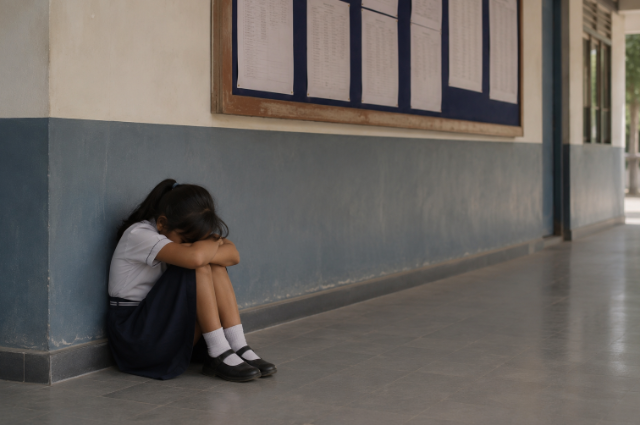
In what kind of society does a child’s report card become a death sentence? The horrifying murder of nine-year-old Anamika Chavan in a village near Pune has forced India to confront a painful reality. In a country where marks are often treated as a measure of worth, countless children grow up carrying pressures they are far too young to understand. For Anamika, that pressure allegedly ended in unimaginable cruelty.
On a quiet Sunday afternoon in Hanuman Wasti, Deulgaon Raje village in Pune district’s Daund tehsil, what should have been an ordinary family day turned into a nightmare. According to police investigations, 33-year-old Shantaram Chavan allegedly murdered his daughter after discovering that she had altered her school marksheet. Investigators say the child had changed her rank to first position while moving her brother to second. What may have been the fearful act of a child desperate for approval allegedly provoked a violent rage that cost her life. Police claim the father attacked Anamika using a tree-cutting machine before wrapping her body in a saree and attempting to burn it to destroy evidence. The accused reportedly tried to present the incident as an accidental house fire, claiming that the girl had been trapped inside. However, suspicions arose after police received information suggesting foul play, leading to the recovery of the partially burnt body. Both the father and the stepmother were arrested as investigations continued.
The country has been shaken not only by the brutality of the crime but also by how small the trigger seemed. A marksheet, something meant only to record academic performance, somehow became the centre of a murder investigation. Beneath the horror lies a reality many Indian families recognise too well. Academic success in India is often treated as the foundation of dignity, stability, and family respect rather than just one part of childhood. Children are praised for ranks, compared with siblings, and taught from an early age that failure brings shame. In such an environment, fear slowly replaces learning.
Psychologists and child welfare experts have repeatedly warned that extreme academic pressure can deeply damage a child’s mental health. According to data from the National Crime Records Bureau, thousands of students in India die by suicide every year, many linked to examination stress, parental expectations, or fear of failure. In 2022 alone, more than 13,000 student suicides were recorded across the country. These figures show that academic anxiety is not isolated but part of a much larger social crisis. While most situations never become physically violent, the emotional damage is visible everywhere — in exhausted teenagers, anxious school children, and homes where affection becomes tied to performance.
The tragedy of Anamika’s death also reveals something deeply unsettling about childhood fear. Children often lie not because they are manipulative but because they are terrified. A nine-year-old changing her marksheet does not reflect criminal thinking. It reflects fear of punishment, humiliation, disappointment, or comparison. Developmental psychologists explain that children at that age are still emotionally dependent on parental approval. They cannot fully understand the consequences the way adults do. When homes and schools become harsh instead of supportive, children often hide marks, forge signatures, or lie about results simply to escape emotional or physical punishment.
India has witnessed several disturbing examples of how academic obsession can distort family relationships. In Kota, Rajasthan, often called the coaching capital of India, intense pressure surrounding competitive examinations has repeatedly made headlines after waves of student suicides. In another widely discussed case from Telangana in 2023, a teenage girl reportedly died by suicide after scoring lower than expected despite performing well academically overall. These incidents differ from Anamika’s murder, yet they emerge from the same culture where marks are treated not as feedback but as judgments on a child’s worth.
Sociologists often describe Indian parenting as deeply achievement-focused, especially in lower and middle-income households where education is seen as the primary path to financial security. Parents sacrifice heavily for their children’s schooling and naturally hope for success. But that hope can become dangerous when love and approval depend entirely on performance. Fear of social embarrassment also plays a major role. In many communities, children’s achievements are seen as reflections of family prestige. Report cards are discussed openly among relatives and neighbours, creating an atmosphere of endless comparison and emotional exhaustion.
What makes this case even more disturbing is the alleged involvement of the stepmother, who police claim witnessed or enabled events surrounding the crime. It transforms the home, which should represent safety, into a place of terror. Child rights activists have long pointed out that violence against children in India often occurs within families themselves, hidden behind ideas of discipline, authority, or honour. According to the National Family Health Survey, a significant number of Indian children experience physical punishment at home despite growing awareness about child protection laws.
The outrage across Maharashtra comes not only from the brutality of the murder but from the frightening familiarity of the circumstances. Many Indians remember the fear of disappointing parents over marks. For most children, the consequences stop at scolding, punishment, or emotional trauma. For Anamika, the consequences allegedly became fatal.
This tragedy should force society to rethink what success means for children. Education was meant to encourage curiosity, confidence, and opportunity. Instead, in too many homes, it has become connected to fear. No child should feel compelled to change a marksheet to earn love or avoid punishment. No parent should treat academic setbacks as humiliation deserving rage. The value of a child can never be reduced to percentages or ranks printed on paper.
Anamika Chavan was only nine years old. She should have been worrying about cartoons, playground games, and unfinished homework. Instead, her final days were allegedly consumed by fear over a school result. Her death now stands as one of the darkest reminders of how dangerous unchecked academic pressure and domestic violence can become when compassion disappears from parenting. A marksheet can be corrected. A lost childhood cannot. A lost life never can.
References
- India Today Report on the Pune Marksheet Murder Case
- The Pioneer Coverage of the Daund Murder Case
- Free Press Journal Article on the Incident
- The Indian Express Report on the Case
- National Crime Records Bureau Official Website
- UNICEF India Mental Health Resources
- National Family Health Survey Reports
- World Health Organization Adolescent Mental Health Report