
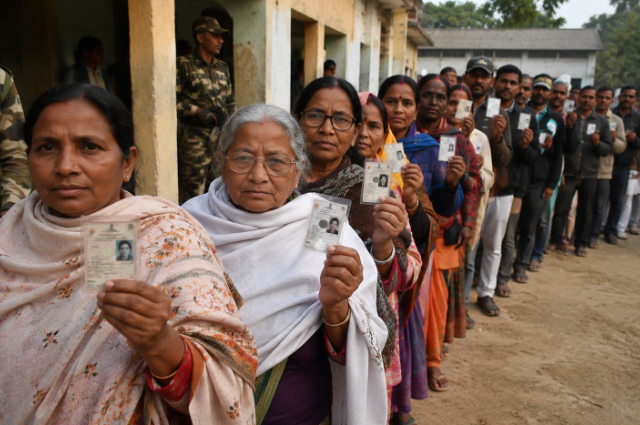
The streets of Bengal have always remembered politics like a wound. Elections in the state are never just about ballots and speeches. They are about identity, survival, memory, and power. In 2026, West Bengal witnessed one of the most controversial elections in its modern political history, not simply because the Bharatiya Janata Party stormed into power for the first time, but because the legitimacy of the electoral process itself became the centre of a national storm. The Election Commission and the BJP were accused by the Trinamool Congress of orchestrating what Mamata Banerjee subsequently referred to as "an institutional theft of democracy" before a single vote was cast. The Special Intensive Revision of electoral records, which eliminated about 90 lakh people from the state's voter list, was at the centre of this accusation. The magnitude was astounding. Beore voting had started, about 12% of Bengal's electorate vanished from the records.
This was not a standard administrative task for the TMC. Under the pretence of rectifying fraudulent entries, the party claimed that legitimate votes had been systematically eliminated, particularly from poor Muslim populations, migrant workers, border regions, and economically poorer neighbourhoods. Leaders of the BJP justified the change, saying it was required to get rid of unlawful immigrants and duplicate voters. However, the move's political ramifications turned the matter into one of the election's central disputes. Stories of citizens in districts like Murshidabad, North 24 Parganas, Malda, and portions of South Bengal learning that their names were no longer on voter lists despite having cast ballots in prior elections started to surface only days before polling.
After discovering his family's names had disappeared from the rolls, a sixty-year-old tailor in Basirhat allegedly walked almost three kilometres to a local election office with his old voter slips and Aadhaar certificates. Similar complaints about entire houses being categorised as "absentee" despite having lived in border districts for decades emerged. While BJP cadres accused the ruling party of attempting to shield fraudulent voting networks that had supposedly flourished during years of TMC control, TMC political activists set up camps to assist locals in confirming their registration status. Although the Election Commission insisted that the deletions were in accordance with protocol, the controversy developed to the point where the case continued to be investigated by the courts throughout the campaign.
The scale of the issue was amplified because Bengal entered the election already deeply polarised. Long before the first round of voting, the Citizenship Amendment Act, discussions about illegal immigration, religious identity politics, and opposition to incumbents had made the environment unstable. Narratives of border infiltration and demographic shift were central to the BJP's campaign, especially in regions close to Bangladesh. As the face of the BJP's Bengal campaign, Suvendu Adhikari frequently described the election as a struggle for "the protection of Hindus in Bengal." He was accused by TMC leaders of using overtly communal discourse and trying to split the electorate along religious lines. During the campaign, discourse frequently veered into perilous terrain. Adhikari's comments regarding the removal of Muslim TMC MLAs from the Assembly caused a great deal of indignation and heightened concerns among minority groups who were already worried about voter removals.
The timing of the voter roll controversy was particularly incendiary. The deletions took place during an election that ultimately saw the greatest turnout in Bengal's history—92.93 per cent. Ironically, researchers then speculated that a record number of eligible citizens may have cast ballots out of fear of losing their right to vote. In both urban and rural areas, long lines began to gather outside polling places early in the morning. Elderly voters in Kolkata showed up with numerous pieces of identification because they were afraid they would be rejected otherwise. Local political activists allegedly spent nights going door-to-door in villages around Birbhum and Hooghly to make sure supporters had not vanished from the rolls.
The cloud of suspicion persisted despite the widespread engagement. Soon after, there were claims of electronic voting machine tampering. Several booths complained that buttons had been blocked with tape, ink, and even bubble gum, making it impossible to cast votes correctly. Eventually, the Election Commission ordered repolls in fifteen booths, which only made opposition parties more suspicious. When the counting day finally came, Bengal looked more like a state preparing for conflict than jubilation.
The results shocked even seasoned political observers. BJP crossed the majority mark comfortably, winning more than two hundred seats and ending decades of dominance by either the Left Front or the TMC. Mamata Banerjee lost her own constituency battle against Suvendu Adhikari, marking a symbolic collapse of the party’s political stronghold. Yet instead of conceding defeat quietly, Banerjee refused to resign immediately and declared that the mandate had been manipulated. She accused the Election Commission of acting as “the main villain” of the election and alleged that more than one hundred seats had effectively been stolen.
Even seasoned political analysts were taken aback by the results. With over 200 seats won, the BJP easily surpassed the majority threshold and ended decades of control by either the Left Front or the TMC. The party's political base symbolically collapsed when Mamata Banerjee lost her home constituency match against Suvendu Adhikari. However, Banerjee refused to step down right away and claimed that the mandate had been altered rather than peacefully accepting loss. She claimed that over one hundred seats had been essentially stolen and accused the Election Commission of being "the main villain" of the election.
However, the BJP denied these accusations and claimed that the public's resentment following fifteen years of TMC rule was the reason behind its triumph in Bengal. Mamata Banerjee's previously powerful reputation had been damaged by rising unemployment, accusations of corruption, worries about women's safety, and charges of political favouritism.
The TMC, according to BJP leaders, was simply blaming voter roll changes because it was unable to recognise a real anti-incumbency tsunami. For many voters, particularly in Bengal's urban and semi-urban areas, the election was more about tiredness with long-standing political power than it was about philosophy.
In the end, the reality might fall halfway between political exploitation and administrative correction. Revisions to the electoral roll are common in Indian elections, but the sheer number of deletions in Bengal turned a technical exercise into a contentious issue for democracy. Perhaps the largest victim of 2026 was trust in the election process itself, in a place where politics has historically spilt into the streets through protests, bloodshed, and ideological warfare. The Bengal election was no longer only a struggle between the TMC and the BJP. Millions of people started to wonder if they could lose their right to vote before election day ever came around, making it a test of democracy's viability.
References
- Modi’s poll gains point to push on India's civil law reform, infrastructure | Reuters
- https://www.theguardian.com
- https://www.aljazeera.com
- https://www.aljazeera.com
- https://www.aljazeera.com
- https://www.aljazeera.com
- https://www.reutersconnect.com
- https://timesofindia.indiatimes.com
- https://timesofindia.indiatimes.com
- https://en.wikipedia.org