
Walk into a modern supermarket, airport, hotel, or fast food chain today, and the future seems to have already arrived. Self-checkout counters replace cashiers, kiosks take orders, chatbots answer complaints, and robots deliver room service. Global brands present these technologies as progress: faster service, lower costs, fewer errors, and a smoother customer experience. Yet behind this polished image lies a growing workplace problem that receives far less attention. As machines take over visible tasks, human workers are increasingly left to manage emotions. They are expected to smile, stay calm, and appear cheerful while dealing with the frustration these same technologies often create. In many workplaces, robots have not replaced emotional labour. They have intensified it.
The fake smile has become one of the quiet uniforms of the modern workplace. It is the smile a cashier wears while a customer argues with a frozen self-checkout screen. It is the expression a hotel receptionist holds while apologising for a kiosk that refuses to print a room key. It is the calm face of a flight attendant trying to settle passengers during a system delay, even while carrying their own stress and fatigue. From the outside, it looks like courtesy. Behind it, however, is effort. Sociologist Arlie Hochschild described this decades ago as emotional labour, the paid management of feelings. In today’s automated workplaces, her idea feels more relevant than ever. Employees are no longer only helping customers. More and more, they are asked to repair the strained relationship between people and the machines that were meant to serve them.
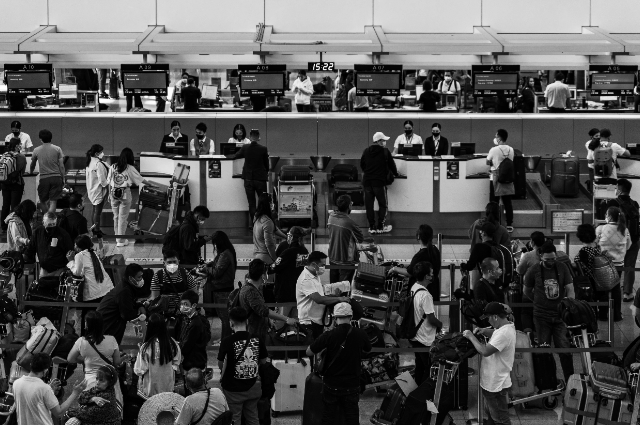
In India, airports offer one of the most visible examples of this new kind of workplace strain. At busy terminals like Indira Gandhi International Airport, Kempegowda International Airport, and Chhatrapati Shivaji Maharaj International Airport, passengers wheel their bags toward glowing kiosks meant to make travel quicker and easier. A few taps are supposed to replace the old check-in desk. Sometimes they do. Sometimes the screen freezes. Sometimes the passport will not scan. Sometimes the machine accepts every detail and then refuses to print the boarding pass. Within minutes, a small queue forms. Then come the sighs, the impatient glances at departure boards, and the fear of missing a flight. That is when the human worker arrives. Usually with a practised smile, they restart the machine, type in details by hand, answer the same anxious questions, and calm passengers already irritated by the delay. The airport may present the kiosk as modern efficiency, but when it stops working, it is not the machine that carries the pressure. It is the staff member who becomes technician, guide, troubleshooter, and emotional shield all at once.
Fast food chains provide another example. Global brands such as McDonald's, KFC, and Burger King have increasingly deployed digital ordering kiosks. These kiosks reduce direct conversation between staff and customers, but they do not eliminate customer frustration. When orders disappear from screens, customisations fail, or payment does not process, customers often turn to nearby workers. Employees must then fix the issue while maintaining the brand’s image of speed and friendliness. The machine may be the source of the problem, but the human worker absorbs the emotional consequences. A smiling face becomes part of the company’s damage control strategy.
Hotels have also experimented with service robots and AI-driven reception systems. Henn na Hotel became globally famous for using robot receptionists and automated services. However, media reports and later operational changes showed that many robots created new inconveniences rather than removing work. Voice systems misheard guests, robots failed to answer practical questions, and human staff had to intervene. Guests still expected empathy, understanding, and quick resolution, qualities machines struggled to provide consistently. Once again, workers had to step in politely and professionally, often after customers had already become annoyed.
Call centres reveal perhaps the most advanced version of this trend. Many multinational brands now use AI chatbots as the first layer of customer support. These bots handle routine questions but often fail when problems become complex or emotional. By the time a human worker receives the call, the customer may already be angry after navigating menus and automated replies. The employee must then calm the situation, solve the issue, and often meet strict time targets. Research from customer service industries has repeatedly linked this type of emotional strain to burnout, anxiety, and declining job satisfaction. Workers are not simply handling tasks. They are cleaning up the emotional mess left behind by poorly designed automation.
There is another layer to this story, one that workers feel, even when no customer is standing in front of them. In many automated workplaces, the smile is no longer simply expected; it is tracked. A customer taps a rating on a screen, leaves a review on an app, or answers a satisfaction survey after a short interaction. Somewhere in the background, dashboards update, scores shift, and managers review numbers that claim to measure friendliness. In some service jobs, these ratings can shape work schedules, bonuses, or future promotions. The result is a workplace where emotions are turned into data. A worker may be exhausted after a long shift, frustrated by faulty machines, or dealing with constant pressure, yet still feel compelled to appear cheerful because even
their expression now seems tied to performance. What once looked like a simple smile has, in many places, become another metric to be managed.
From a business perspective, the logic is easy to understand. Machines can lower wage costs, run for longer hours, and help create a futuristic brand image. Investors often reward companies that appear efficient and technologically advanced. But the hidden support behind this model is human emotional effort. When systems fail, people, not machines, carry the burden. They reassure confused customers, apologise for delays, and keep calm when situations turn tense. In many ways, workers become a shield protecting the brand from the weaknesses of its own technology.
This shift also raises difficult questions about the future of work. If automation is meant to increase productivity, should it not ease pressure on employees instead of adding to it? Should companies be allowed to reduce staff while expecting those who remain to handle technical problems and emotional stress at the same time? And if smiling under pressure becomes an unwritten rule, where does professionalism end and emotional exploitation begin?
Technology itself is not the problem. Well-designed systems can remove repetitive tasks and improve working conditions. The real issue begins when companies introduce automation mainly to cut costs while ignoring its human consequences. A self-checkout lane with enough staff support may work well. A self-checkout area watched by one exhausted worker trying to manage six faulty machines is something very different.
The workplace of the future may include more robots, kiosks, and AI assistants. But unless labour standards grow alongside technology, many workers may remain caught in a strange contradiction. They will stand among machines built to save effort, while being asked to work even harder emotionally than before. Behind every smooth brand experience, there may still be an employee wearing the most expensive unpaid accessory in modern business, a fake smile.
References
- Arlie Russell Hochschild, The Managed Heart: Commercialisation of Human Feeling https://www.ucpress.edu
- Study on self-checkout systems and labour restructuring https://arxiv.org
- World Economic Forum – Future of Jobs and Automation Trends https://www.weforum.org
- Harvard Business Review – Emotional Labour in Customer Service https://hbr.org
- Coverage of Henn na Hotel robot hotel operations https://www.bbc.com