
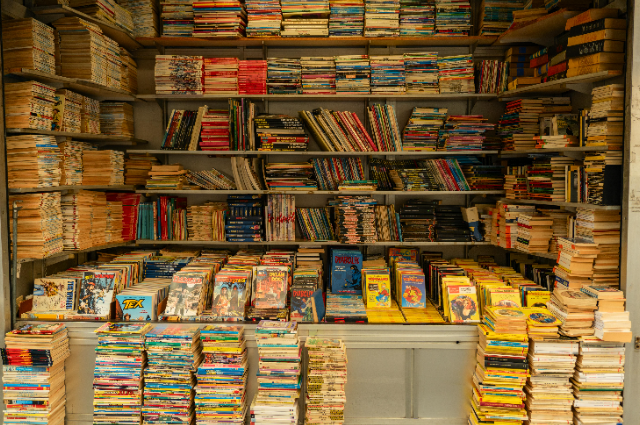
Have you ever been to a vintage bookstore or a handmade jewellery shop run by a single artisan? I think yes , some of us have visited, and some of us must have thought of working there or opening something similar, maybe a bookstore, a café, or a flower shop. But what stopped us? Obviously, our working hours, assignments or responsibilities. Yet, we have always thought of going to these shops or stores whenever we feel heavy. But what is the core in us that makes us think about them and keeps bringing us back?
It is nostalgia. It makes us feel like we are back in the times of the ’90s, when we used to sit in bookstores and read, when we visited cafés just to see if our crush had come, or when we went to a flower shop to see what new flowers had arrived. But somewhere along the way, we changed that present into past tense and held onto those moments only as memories.
These shops or stores were not just places - they were identities, representing people through them. But today, they are either being replaced or disappearing because of new technology and apps that can do these things much faster and more easily. This is what we call - the death of niche.
In the ’90s era, when you woke up in the morning and went to a bookstore just to read, or when you craved a cup of coffee or hot chocolate and ran to a local café, things felt different. Today, if you look around, you can clearly see how much has shifted - almost 80% has already changed. Whenever a person feels like reading, they open online apps such as Kindle - the most common and popular app to read books online and spend 5 to 6 hours reading there. Whenever someone feels like having coffee or wants to try a matcha flavour suggested by a friend, they simply order it online from Zomato, Swiggy, or the café’s official website. This same process applies to almost everything at home.
A customer needs satisfaction and service because they are investing their time and money. These new apps and services provide that satisfaction, but they also reduce the need for people to step out, take time from their busy schedules, walk through streets, and reconnect with that nostalgia.
Physical stores were meant for people to visit, to look, and to feel every product they buy. But nowadays, these stores are struggling with foot traffic. Consumers scroll endlessly on online apps—from Shein to Nykaa, from Zomato to Blinkit. Everything you think of buying by going to a store now arrives at your doorstep within minutes. Isn’t it strange that earlier you used to tell your friends to visit a niche store or café to explore something special, and today you tell them to check a website instead?
Customer loyalty is rarely seen today, or sometimes not at all. And to an extent, that is understandable. Today’s consumer buys where they feel satisfied, where they get the best price. Earlier, customers bought out of interest; today, they buy to satisfy needs and wants. Loyalty was once the biggest strength of niche stores, but that has changed.
The death of niche may seem almost complete, but it is not truly the end. Unique stores are not disappearing because they lack value; they are disappearing because the world around them has changed faster than they could adapt. Despite these challenges, many niche stores still survive because they have adapted to their environment - especially by embracing the digital age.
For niche businesses to survive today, they must accept customers as they are and evolve accordingly. They must blend storytelling with strategy, creativity with technology, and uniqueness with accessibility.
Because at the end of the day, a customer does not just buy a product, they buy meaning. And meaning, if preserved right, can never truly go out of style.
References
- Medium - decline of stores and shops
- Esw – digital platforms have changed consumer behaviour
- Pwc India – how India shops online
- Statista – time spent on online apps for shopping