
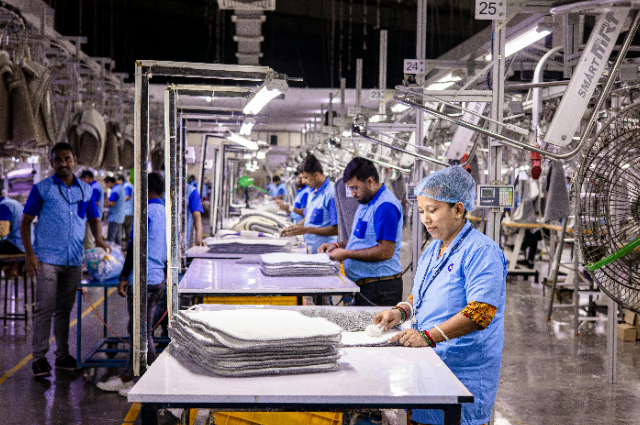
Beyond the barricades, Noida’s hosiery workers are battling a burden of low pay, insecure contracts and missing basic rights, even as the sector fuels a sizable share of India’s sock exports.
The Noida Hosiery Complex (Phase II) houses more than 150 registered units and employs roughly 2,500‑2,800 workers. According to the Ministry of Textiles, hosiery from the Delhi‑NCR region accounts for 12 % of India’s total sock exports, which are nearly about US$ 45 million in FY 2023‑24. Domestic demand for affordable, fast‑fashion hosiery rose 18 % in the following year, pushing production pressure onto these small‑scale units.
Employment patterns expose precarity.
A recent survey shows that only 42 % of respondents enjoy permanent employment. Twelve percent are classified as casual workers, while a substantial 46 % are engaged through contractors, 22 % on a piece‑rate basis and the remainder on a monthly contract. This shift toward casualisation and contractualisation leaves the majority without the stability that a permanent job would provide.
What the protests reveal
On Monday, 13 April 2026, police resorted to lathi charges as a protest erupted in Noida’s Phase 2 industrial area. Workers from the hosiery and garment sectors marched against a pay gap with neighbouring Haryana, where the state had announced a 35 % increase in minimum wages for unskilled, semi‑skilled and skilled workers effective 1 April 2026. The demonstration quickly turned violent: arson, stone‑pelting, and vandalism were reported, roads were blocked, and the unrest spread across Sectors 1, 60 and 84.
By the following day, authorities had filed seven FIRs and arrested more than 350 people, according to Commissioner Laxmi Singh of Gautam Buddh Nagar police. A separate police team is tracking social‑media accounts that were allegedly used to incite the unrest.
Wage revisions only partially address the gap
The Uttar Pradesh government responded with interim wage hikes, differentiating three categories:
- Gautam Buddh Nagar (Noida) Ghaziabad: unskilled ₹13,690, semi‑skilled ₹15,059, skilled ₹16,868.
- Cities with municipal corporations: unskilled ₹13,006, semi‑skilled ₹14,306, skilled ₹16,025.
- Other districts: unskilled ₹12,356, semi‑skilled ₹13,591, skilled ₹15,224.
These rates are slated to take effect from 1 April 2026, but they sit against a backdrop of much lower actual earnings. The average monthly wage for a skilled hosiery operative in Uttar Pradesh (2023‑24) is ₹13,200, roughly 30 % below the ₹18,000‑₹20,000 workers say they need to meet basic living costs.
Beyond wages: overtime work, holidays and social security
A survey by ‘The Print’ (April 2024) of 200 workers found that only 12 % receive the statutory double overtime rate after 9 pm; the rest get 1.5 × or no extra pay at all. Although a Labour Department circular (2 April 2024) mandates a weekly off and 12 paid holidays, informal reports suggest that 40 % of units still run six‑day weeks without audit verification.
Social‑security coverage is thin. An RTI filed in October 2023 shows that just 38 % of workers are enrolled in the Employees Provident Fund (EPF), and fewer than 25 % have Employee State Insurance (ESI) protection. When many factories closed temporarily in October 2024, only about 30 % of the original workforce was rehired, many at a reduced wage of ₹10,000 per month (Hindustan Times, 12 Nov 2024).
A personal glimpse of the daily grind
The human toll is illustrated by the story of Surana’s elder sister, who migrated from an ST Christian Oraon family in Hazaribagh to work in a Noida garment unit. She recounts standing all day to cut 200 pieces of thread within an hour; a “bahut fast kaam tha” that left her back aching. Even after two months, she was shifted to a checking line, still required to stand throughout her shift. Isolated on a floor shared with Malayali and Odia colleagues, she could not converse with anyone, and she ate lunch alone, missing the camaraderie of her peers. The lack of hostel accommodation forced her to share a cramped rented room with two other workers on opposite shifts.
The majority of the more than 2,500 workers do not have permanent positions; about half are employed by agencies on monthly or piece rate contracts, which leaves them without consistent pay or benefits. In 2026, the state of Haryana raised its minimum wages by 35%. This stark discrepancy led to a violent street uprising that resulted in police intervention and widespread arrests. Even the state-approved wage revisions that followed leave many workers earning well below the amount they need for basic living expenses, and the gruelling pace described by a migrant guard, standing all day, cutting hundreds of pieces in an hour, and suffering constant back pain, shows the price that was being paid by human lives.
Hosiery workers in Noida aren’t asking for much; just enough to live without constant instability. And that’s the uncomfortable part, because this is an industry that’s growing fast, exporting more, doing well on paper.
But the people behind it are still stuck.
A small wage increase here and there doesn’t fix the core issue. What’s missing is consistency, actual enforcement of labor laws, and jobs that feel stable instead of temporary.
If the industry can scale this quickly, it can treat its workers better. It just hasn’t had to.
Works Cited
- Jaiswal, Ragini. “Noida Factory Workers’ Protest Turns Violent after Stone-Pelting; Traffic Disrupted amid Route...” Moneycontrol, 13 Apr. 2026, www.moneycontrol.com
- Singh, Arun. “Noida Workers’ Protest Continues despite Revised Pay; 300+ Arrested. Here’s Why | Hindustan Times.” Hindustan Times, 14 Apr. 2026, www.hindustantimes.com
- Sipa USA. “India: Workers at the Hosiery Complex Stage Massive Protest in Noida Phase 2 Demanding an Increase in Compensation.” Reuters Connect, 10 Apr. 2026, www.reutersconnect.com
- “India: Workers Protest over Wage Hike Turns Violent in Noida.” Reuters Connect, 13 Apr. 2026, www.reutersconnect.com