
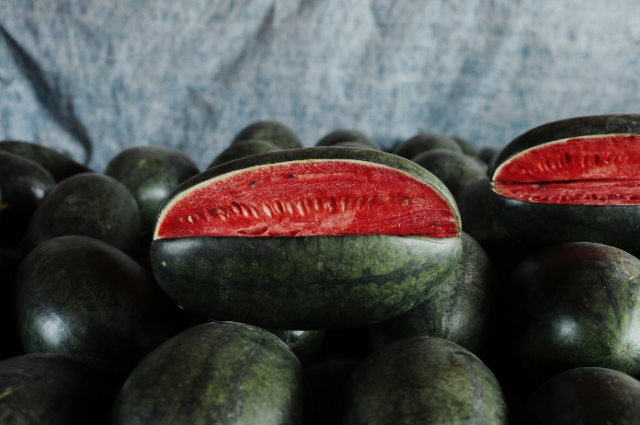
What happened: Abdullah Dokadia, a 45-year-old mobile accessories trader, his wife, Nasreen (35), and their daughters, Zainab (13) and Ayesha (16), hosted a dinner for five relatives on Saturday night. After the guests left, the family consumed watermelon at around 1 am. By 5 am, all four developed severe symptoms — vomiting and diarrhoea. They were rushed to Sir JJ Hospital but were declared dead despite intensive medical efforts.
Why were the relatives spared? The relatives who attended dinner consumed only the biryani and left before the watermelon was cut. None of them reported any illness, which narrowed suspicion toward the fruit consumed later that night.
The investigation twist — it may NOT be the watermelon: The autopsy report has largely ruled out the fruit as the direct cause, instead pointing toward poisoning. Key organs of the victims — including the brain, heart, and intestines — were found to have turned green. Doctors noted the symptoms and internal findings do not align with a routine case of food poisoning.
Forensic tests also found traces of morphine in Abdullah Dokadia's system, which has deepened suspicions.
Possible motive being explored: Investigators are probing whether Dokadia's role as a witness in an older criminal case involving a real estate developer could have created a motive. While no direct connection has been established, officials have kept this angle open.
What police say now: Police have dismissed some media claims about forensic findings, saying the team is still awaiting complete forensic analysis and that no confirmed findings have been officially shared so far. Tracing the source of the watermelon remains a key challenge — Abdullah reportedly mentioned he purchased it from a vendor in the Null Bazar area, but that vendor has not been found.
What initially appeared to be a tragic case of food poisoning from watermelon has evolved into a potential murder investigation, with authorities now exploring deliberate poisoning as a possibility. Conclusions are awaited pending toxicology and histopathology reports.
Beyond the Fruit Story: Unsettling about the Mumbai incident is less the string of fatalities and more how quickly officials pointed to one known cause—watermelon tainted somehow. This view seemed right since events lined up neatly. Also, family members present during the meal avoided that particular fruit entirely.
Still, strong feelings do not equal evidence. Stories that sound convincing tend to require deeper scrutiny more than others.
Clinical Mismatch Confirmed: What stands out is the mismatch between clinical signs and early conclusions. Forensic tests now confirm zinc phosphide—lethal rat poison—in all four victims and the watermelon. Following severe reactions leading to quick fatalities, deliberate poisoning fits better than digestive infections. Pathologists noted unusual green colouring in the brain, heart, and intestines—classic for this toxin. Lab results prove something beyond random contamination. Something acting fast, widespread across body functions, might be involved.
The Pivot Question: Now comes the central puzzle: should rodent toxin have caused their deaths, or what led to placing it inside the melon once visitors were gone?
Later that evening, timing took priority even though sequence held equal importance. Before most meals ended, dinner arrived; mutton pulao was served while the family stayed safe. Close to midnight, watermelon appeared. By five in the morning, discomfort reached each of them. Unexpected hours shaped what unfolded next. A short window of just four hours strongly indicates intentional administration rather than random occurrence. The scientific fact remains: when ingested, zinc phosphide produces lethal phosphine gas within the digestive tract — a mechanism well suited to covert transfer through food such as fruit.
Morphine Red Herring: Uncertainty peaks with morphine traces in Abdullah Dokadia's body only. Was it medical? Or a second poisoner's mistake? Without dose or source, it taunts investigators. But the green organs seal it: rat poison, not fruit, was the killer. Watermelon? Just the perfect carrier—juicy, trusted, post-dinner.
In that sense, fruit may be less important than the sequence around it. Who had access after the guests left? Was rodenticide slipped into the pulao preparation earlier? Did the family touch anything pre-watermelon?
Deeper Motive Emerges: Most troubling is Dokadia’s past role in property disputes. After visitors departed, adversaries acted without delay - targeting each individual. The produce carried intent - it served as a tool of harm. Could the source be a market seller? A person entering homes unnoticed? Perhaps one known well?
Why It Stays Open: What gets excluded shapes truth as much as evidence. Early "watermelon" talk delayed the poison angle. Currently, authorities trace those linked to acquiring or using the rat toxin. Accident? Or assassination? The green organs don't lie, but they don't name names.
This incident in Mumbai shows fewer theatrics, greater intent: a lethal substance hidden within food, taking four individuals silently. Advantage emerges where testimony disappears alongside kin.
Works Cited
- Bhardwaj, Puja, and Vaibhav Tiwari. “Rat Poison in Watermelon Killed Mumbai Family, Forensic Analysis Reveals.” Www.ndtv.com, NDTV, 7 May 2026, www.ndtv.com. Accessed 10 May 2026.
- ET Online. “Mumbai Watermelon Death Case Solved: Here’s What Killed the Family of Four.” The Economic Times, 7 May 2026, economictimes.indiatimes.com. Accessed 10 May 2026.
- Moneycontrol City Desk. “54 Tests Later, FSL Confirms Rat Poison in Watermelon Killed 4 Members of Mumbai Family.” Moneycontrol, 8 May 2026, www.moneycontrol.com. Accessed 10 May 2026.
- Tewari, Samridhi. “Mumbai Family Mystery Deaths Case: Rat Poison Found in Viscera, Watermelon Samples.” ThePrint, theprint, 7 May 2026, theprint. in. Accessed 10 May 2026.
- “Zinc Phosphide Technical Fact Sheet.” Orst.edu, 2018, npic.orst.edu