
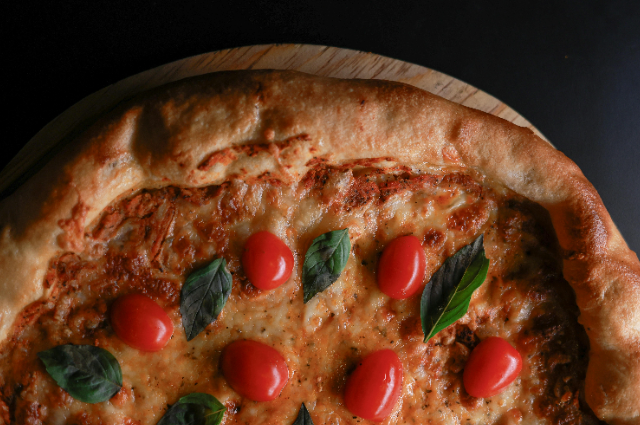
Why we love pizza
Ask ten people why they love pizza, and you'll hear ten answers. Some say it's the gooey cheese. Others say it's the warmth of the fresh crust. For many, it's the joy of sitting together pulling slices apart that creates a sense of togetherness.
Pizza Finds a Second Home in India
Think back. Where did you first taste pizza? Maybe it was at a mall, maybe at a birthday party, or maybe at a small café experimenting with something new. No matter where that first taste happened, it signalled the start of a new food journey. Today, pizza feels as normal as pakoras.
Every slice served has a past and a present. Follow its trail far enough, and suddenly you're in Naples, catching the smoky scent of dough crisping in a stone oven. And just like that, you begin to see how this dish made its way from Italian streets to Indian homes.
Be it Mumbai’s cheesy speciality or neighbourhood markets in Delhi, pizza quickly gained its label of Affordable, quick, and irresistibly favourite fast food, capturing worldwide attention.
What actually counts as pizza?
All of this leads to a more fundamental question: what actually counts as pizza? At its broadest, it could be described as a yeasted dough base baked at high heat and topped with a range of ingredients that vary by region and tradition. While similar flatbreads exist in the Middle East and East Asia, it is more accurate to treat them as distinct forms. What we recognise today as pizza has been shaped most significantly by working-class Italians and later by the Italian diaspora of the nineteenth and twentieth centuries. Even now, its technique, ingredients, and methods of preparation differ widely across regions and cities, though many of the standards associated with its modern form trace back to Naples.
The Rise of Pizza in India
Along with burgers and ice creams, pizzas have become one of the most loved foreign dishes in India. According to the Financial Express, the pizza market is worth INR 83 billion as of May 2024, driven in part by its adaptability, including its wide availability as a vegetarian option.
Since the opening of Pizza Corner in Chennai in 1996, the industry has grown to over 1,860 outlets, led by chains like Domino’s Pizza and Pizza Hut, with a significant share of sales now coming through delivery platforms such as Swiggy and Zomato.
This expansion traces back to the 1990s economic reforms that brought global fast-food chains into India. But as these brands scaled, they also adapted—raising a key question: is this “local” pizza a natural evolution, or a carefully shaped response to the market?
Adapting to the Indian Plate: Always Pizza, Never the Same
Menu variations further highlight this localisation. Options like a buffalo-style veg pizza, a barbecue chicken variant, or a chicken tikka version show how global formats are adapted to reflect regional tastes and familiar flavour profiles.
In the meantime, pizza also evolved in Italy. Whereas not long ago, pizza had to be cheap, nowadays more and more places focus on quality and invention. Not always successful but surely interesting.
That's the magic of the pizza in different countries-it's always pizza, but never identical.
The Strategy Behind “Local Flavour”
Food companies rarely leave taste to chance. Large chains study regional preferences in detail—spice levels, vegetarian demand, familiar ingredients—and then build menus that reflect those expectations.
A paneer topping or tandoori sauce may seem like a natural blend, yet it is also a tactical choice to give a global product a local touch. The names, images, and descriptions are crafted to evoke a sense of familiarity and comfort even before the first bite is consumed.
The concept of "local flavour" often appears personal and somewhat cultural, yet it is commonly influenced by market research, branding techniques, and consumer behaviour.
A Slice Between Culture and Commerce
What looks like authenticity may, in many cases, be a calculated response to what people are most likely to buy.
This doesn't mean the experience isn't real. Local adaptations do reflect real tastes and cultural habits. The paradox is in the balance: what we think of as authentic is often a mix of preference and planned positioning.
Pizza, thus, goes beyond simple food. It becomes a product shaped by cultural and commercial elements, where authenticity is not only preserved but continually reinterpreted.
References
- Admin. (2025, January 8). How did Pizzas Gain Acceptance Worldwide?
- The Chocolate Room India Blog: Exploring Global Food Stories.
- https://www.thechocolateroomindia.com