

Today’s article begins with the usual story that one hears every day, to the point that it's rather shocking that one feels rather… numb. One wakes up and scrolls through news on their phone while waiting for chai to boil. “19-year-old assaulted on the way home from tuition, accused of absconding.” The person holding the phone reading feels their stomach dropping. The kettle whistled, leaving the individual jump.
By evening, such stories, as it should be, would spread everywhere. In the colony park, an Uncle Mishra of their society shook his head: “What was she doing out at * PM? Parents don't watch their girls.” At the tea stall, the person would glance upon two boys, smirking and saying that it must be the usual case “love affair gone wrong” while simultaneously the person’s cousin would text “it's one of those 90% fake cases, and now the boy’s career will be ruined”. However, what would intrigue the initial person who was waiting for their chai to boil was their amma, who was silent and looked at the individual’s 14-year-old sister and double-locked the main door. In short, nobody would ask how the girl was; in fact, nobody questioned the name of the accused at all.
In 12 hours, this news, alongside every similar news, would now stop being about the suffering of the victim. Rather, the conversation would include what the victim wore, where the victim walked, who to blame and who to doubt. In short, the ending makes the victim disappear from their own story, and instead, the protagonist who took her place now are the excuses.
Consent and Rape
In layman’s terms, consent means to agree to something or allow something to happen. It refers to a general agreement, permission, or compliance for something to happen or to do something. It manifests in several different ways across different situations.
The first one to understand is to express consent. It is the type of consent that is given directly, clearly, and unmistakably. It is further divided into either verbal (saying “yes” or “I agree”) or written (signing a form, like in legal contracts or medical procedures).
The other one that is known and inferred from actions, conduct, or the facts of the situation, rather than spoken words, is termed implied consent. The third type is called informed consent, where a person gives the said consent only after fully understanding all the facts, implications, and risks of the situation - the cornerstone of medical procedures and clinical trials. The last one, unanimous consent, refers to a structural or organisational term where every single party involved agrees to a decision without a single dissenting voice. In personal interactions, it emphasises that if multiple people are involved in an activity, everyone must actively agree.
“Consent refers to the voluntary agreement, permission or approval for something to happen/ to be done, often involving a conscious decision to comply with another’s proposal" -
To make the legal and ethical complexities of personal consent easy to remember and practice, educators and legal experts often compress them into The Four Cs:
| The “C” | What Does it Mean? |
| Clear | Rather than being passive, consent must be active. In short, it must be an unambiguous and identifiable agreement, and silence should not be considered a “yes.” |
| Continuous | Consent should be known as a dynamic concept and hence can be revoked at any point. If a person changes their mind, the consent instantly vanishes, and the activity must stop immediately. |
| Conscious | A person must be fully aware and capable of making a rational decision. A “yes” during sleep, unconsciousness, or intoxication with either drugs or alcohol should not be a part of said consent. |
| Coercion | Free Consent must be given freely. Any agreement that is reached through pressure, guilt-tripping, or manipulation via blackmail or fear of force is to be considered ethically as well as legally void. |
Therefore, rape is an act without consent. It refers to unlawful sexual intercourse that is actively carried out against the will of the person by force, threat, or intimidation. In the Indian legal view, under Section 63 of the Bharat Nyaya Samhita, which basically replaced Section 375 of the Indian Penal Code, “rape is defined strictly as specific sexual acts (including penetration by the penis, manipulation, or insertion of objects/body parts into a woman's body) committed under specific circumstances.” These basically include “acts done against her will, without her consent, or when consent is obtained through coercion, fear of death, intoxication, or deception (such as a false promise of marriage).” Furthermore, the absolute age of consent has been set to 18 years old after the POCSO Act of 2012, making any sexual act below this age, even with apparent consent, still considered rape legally.
The most widely recognised framework, developed by criminologists A. Nicholas Groth and Jean Birnbaum, categorises sexual assault based on the psychological motivations driving the offender:
- Power Rapists: Here, the motivation lies in seeking power reassurance by asserting dominance, control and authority (using verbal manipulation such as “she asked for it”) over the victim (viewing them as an object to be tamed or conquered).
- Anger Rapists: In anger-driven assault, sex is used to execute venting and contempt as a displaced reaction to perceived injustices in the offender’s life (be it women, employers or society in general). The assault is characterised by brutal physical violence, rough handling, and verbal abuse. The primary goal is not sexual gratification, but the physical degradation and humiliation of the victim.
- Sadistic Rapists: The most dangerous and psychopathic category, sexual excitement and pleasure for the rapist are directly linked to inflicting physical and psychological pain, terror, and torment on the victim. The aggression here is calculated, prolonged, and ritualistic, with most of the time being planned with the aid of instruments of bondage, torture, or severe physical mutilation.
The Curious Case of Baba Ram Rahim
Gurmeet Ram Rahim Singh, the Dera Sacha Sauda chief and self-styled godman. His story starts way back in 2002 (that extended till July 2007), when the CBI registered an FIR following sexual exploitation allegations and filed a chargesheet. The tale re-emerges in August 2017, when a special CBI court convicted him of rape, causing widespread riots, and sentenced him to 20 years in prison. From 2019 to 2021, the intensity electrified when he received life sentences for the murders of journalist Ram Chander Chhatrapati and manager Ranjit Singh. Later, in 2024 was acquitted of the Ranjit Singh murder case alongside the same for the Chhatrapati murder case in 2026, reversing the earlier life sentences. The trajectory of his case highlights deep-seated flaws in both the societal fabric and legal administration of justice in India.
The first layer of issues one can peel from this onion-like situation is how structural power allows the powerful to suppress victims for decades. The anonymous letter exposing the rapes was written in 2002, but a conviction was only achieved 15 years later in 2017. The flaw was simple - victims who accuse the powerful, politically connected, or generally wealthy face institutional resistance, character assassination, and severe threats to their lives, effectively chilling the speeches of survivors.
The second layer is what I believe was the most obvious of problems - a society that values absolute blind devotion to a cult leader/ patriarch over the trauma of a victim. Cult-like reverence creates a protective social shield around abusers, where the community chooses to victimise the survivors, rather than making the perpetrators accountable.
The last layer, or should I say the most glaring legal loopholes, lies with the fact that political expediency frequently undermines the legal spirit of incarceration. This is due to the humongous amount of vote banks that sect leaders possess. This, in return, makes state machinery use local prison guidelines instead (like the Haryana Good Conduct Prisoners Act) to grant frequent reliefs. This routine dilution of jail terms dilutes the retributive and deterrent nature of the law, severely re-traumatising survivors who must watch their abuser step out of prison regularly.
Rape Culture in India in general
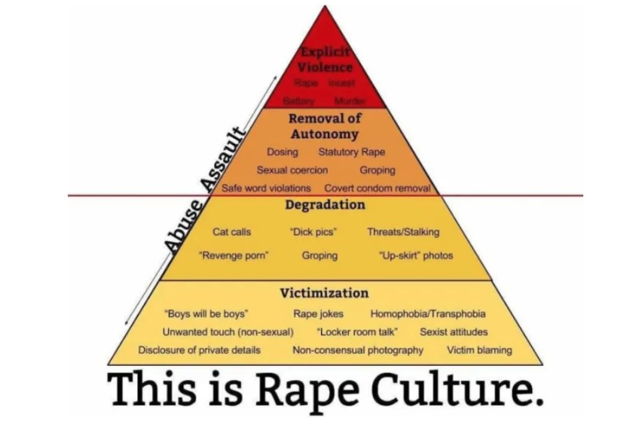
In India, rape culture is deeply entrenched in systemic patriarchy, institutional loopholes, and social stratification. Analysing this pyramid through the lens of the Gurmeet Ram Rahim Singh case reveals exactly how these theoretical layers manifest in real-world atrocities.
Starting from the base of victimisation, with sexist attitudes, "boys will be boys" mindsets, rape jokes, and intense victim-blaming, is something one would label as the first reason why India still lags in gender equality overall, as India is still a nation where women are routinely socialised to prioritise family "honour" (izzat) over their own bodily autonomy. If an assault occurs, society immediately questions the victim's clothing, the time she was outside, or her character. In the Ram Rahim Singh Case, the Dera Sacha Sauda was set as a cult that established a culture of absolute obedience. This, in turn, conditioned the women to view the leader as the divine patriarch, creating systemic silence and making challenging the leader a spiritual sin, making the social environment highly hostile to any form of dissent or disclosure.
The base layer is escalated to active degradation, including cat-calling, stalking, non-consensual photography, and threats. The quintessential example of this is stalking, and street harassment (often normalised euphemistically as "Eve-teasing") are frequent occurrences. According to data from the National Crime Records Bureau (NCRB), crimes against women have seen persistent structural highs, with over 360,000 cases registered annually in recent years, a massive portion of which involve assault with intent to outrage a woman's modesty. In the Ram Rahim case, the anonymous letter sent by a female disciple in 2002 explicitly detailed a pervasive environment of intimidation. Sadhvis (female disciples) who did not conform or who attempted to speak out were subjected to intense surveillance, psychological stalking, and threats of isolation or violence from the cult’s core enforcers.
Now, above the line of overt abuse sits the removal of autonomy: sexual coercion, grooming, and leveraging power dynamics to force compliance. In India, these power dynamics are commonly expressed through caste hierarchies, workplace seniority, or religious authority to routinely strip women of choice, making the threat of social ruin or economic starvation a tool to force compliance. The Ram Rahim case here serves as the textbook example of institutional grooming and spiritual coercion. The leader leveraged his absolute religious authority to isolate female disciples from their families. Consent was entirely manufactured through a severe power asymmetry; when a victim is taught that the perpetrator holds the keys to her spiritual salvation and worldly safety, free and informed consent cannot exist.
And finally, at the top of the pyramid lies the direct result of the bottom layers remaining unchecked. Because society excuses the base, perpetrators feel insulated enough to commit explicit violence. The NCRB reports an average of nearly 80 to 90 registered rape cases every single day across the country. Shockingly, the data consistently shows that in nearly 89% to 94% of these cases, the accused is someone known to the victim (family, neighbours, or institutional superiors), debunking the myth of the "stranger in a dark alley." Safe behind his fortress, protected by millions of loyal followers and political alliances, Ram Rahim systematically raped multiple disciples. When a rational journalist, Ram Chander Chhatrapati, attempted to expose the crimes by publishing the victim's letter, he was murdered. The apex of the pyramid was maintained through lethal force.
Every time Ram Rahim Singh walks out on parole, it is not just a man leaving prison. It is a message, rather, to every survivor who spent years in court reliving their trauma, to every family that was threatened for speaking up, in fact, to every woman who wonders if reporting is worth it; that message is nothing but a slap. But the prison gates don't open by themselves.
But the prison gates don't open by themselves. We opened them. We are the ones who forward the bhajans, who fill the satsangs even after the conviction, who’d argue that he did social work while clicking viral videos of him cutting cakes and making music albums with furlough. We simply joke, “Baba is back”, and scroll past. It is we who teach our sons to be strong, not to be safe from others, while teaching our daughters not to go out late. The evil can be understood with one simple phrase - stop asking what the victim wore during their most traumatic night.
A parole is not granted in isolation. It lives in a culture that still values a godman’s followers against a survivor’s tears, finding the followers heavier. Stop saying that justice is denied in the courtroom if you cannot grapple with the reality that it starts from our WhatsApp forwards, excuses and silence.
So yes, every parole is a slap to a survivor, but the hand that delivers it isn't just the system; it’s ours as well. Until we keep clapping for the man and still blame the victims that range from infants to lizards, the slap will keep on landing.
Citations:
- What Are The 4 Pillars of Sexual Consent? | Pouya Zoghipour
- Consent 101: Respect, Boundaries, and Building Trust - RAINN
- RAPE-UNDER-SECTION-63-OF-BHARATIYA-NYAYA-SANHITA - the law with layers
- S.63. The offence of Rape under BNS: A Critical Review
- Punishment for Rape under the Bharatiya Nyaya Sanhita, 2023 - Legal Articles - Free Law
- Gurmeet Ram Rahim Singh - Wikipedia
- Gurmeet Ram Rahim Singh convicted in 2002 rape case | Crime News | Al Jazeera
- Timeline of cases against Dera Sacha Sauda sect chief
- youtube.com
. . .