
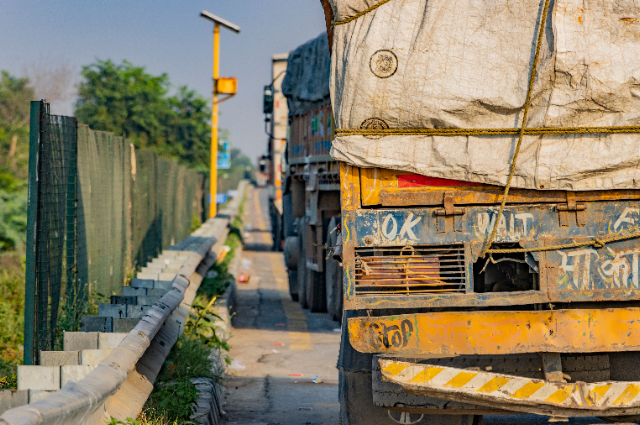
To begin my article, I would like you, the reader, to imagine yourself as a driver from Delhi with a Tata 407 in your name. You have been driving this automobile for the past 8 years now, from Delhi to Nagpur, thus making 8 years of chai stops at 3 AM alongside the same years dedicated to navigating yourself through the potholes on your journey that could swallow a goat. However, one inescapable moment that you’ll stumble upon is the same three words painted on the back of every truck ahead of you - HORN OK PLEASE.
The mystery never ends, ever since you stumbled upon it as a fully conscious adult with a fresh driver’s license in your hand. The ustad will tell you that it means “blow horn before overtaking, that's what it means.” But you’ll notice that trucks from Punjab will have flowers around them, while the ones from Tamil Nadu have them in English and Tamil. While some will add “Use Dipper at Night”, others will just write an “OK” in giant letters, as if the horn part was optional.
The worst part is that nobody - not the old drivers at the dhaba, not the RTO babu, not even Google at times - would give you a straight answer. You’ll wonder, does the OK refer to the okay part of the Kerosene? Or is it just there because… it has always been there? Driving on and on, you’ll wonder: Are you following a rule, a request or just an almost 7-decade-old enigma that is painted in yellow? In short, today’s story, in conclusion, is about this very sign that one cannot stop seeing.
The “Horn OK Please” Story
To begin with, one has to understand what the phrase “Horn OK Please” consists of. Well, at its basic, functional root, the phrase was a traffic instruction that gained its popularity as highways in India historically were single-laned or narrow, and to add fuel to the fire, early commercial trucks did not have a rear-view mirror. Because truck drivers sat up high inside a noisy cabin with a massive blind spot directly behind them, they were unable to see the vehicles trailing behind them. The phrase explicitly requested trailing drivers to honk their horn before attempting to overtake, giving the truck driver a heads-up to either shift left or maintain their lane.
However, in that case, the “Horn Please” sign would have made sense. What makes it intriguing is the insertion of the “OK” right in the middle. It has baffled people for generations, leading to several debates in our personal lives about the origin, from which three compelling theories have arisen that explain how it got there:
Theory A: WWII “On Kerosene” Warning
During World War II, there was a severe civilian shortage of diesel across British India. Truckers were forced to mix diesel with highly unstable, volatile kerosene to keep their vehicles moving. Because kerosene is incredibly flammable, an accident could cause an immediate explosion. To warn trailing drivers to keep a safe distance, trucks had "On Kerosene" painted on the back, which was later abbreviated to "O.K." Over time, the phrase merged with "Horn Please."
Theory B: The Tata “OK” Soap Advertisement
In the mid-20th century, the TATA Group's corporate wing (Tata Oil Mills Co., or TOMCO) launched a budget washing soap brand named "OK" to compete with popular daily-use soaps. Since Tata manufactured the vast majority of commercial trucks running on Indian roads, they used the tailgates of their own newly manufactured trucks as mobile billboards. They painted "OK" right in the centre, often framed by a lotus symbol. Long after the soap brand went defunct, local painters simply kept writing it out of habit.
Theory C: The Overtake Light and Separation
In the early days of multi-panelled wooden truck tailgates, the words were originally painted across separate panels: HORN on the left, PLEASE on the right, and OK in the centre.
- The Distance Test: The lettering was spaced so that if a trailing driver could clearly read the word "OK," they were safely within the braking distance.
- The Manual Signal: Some trucks featured a small physical light bulb right above or inside the "OK" lettering. When a trailing vehicle honked, the truck driver would check if the road ahead was clear and manually flip a switch to light up the "OK" sign, signalling that it was safe to overtake.
While the sign is ubiquitous indeed, the truck art changes drastically as you cross state borders, as it is the reflection of languages, regional aesthetics, and socio-economic priorities.
| Region | Aesthetic Profile | Common Typography & Elements |
| North (Punjab, Haryana, UP) | Extravagant, hyper-colourful, heavily stylised. Built on heavy metal bodies | Bold Gothic or Bollywood-billboard style typography. Flanked by fierce eagles, structural geometric patterns, and protective elements like Nazar Battu (evil-eye wards). |
| South (TN, Kerala, Karnataka) | Cleaner, highly geometric, deeply spiritual, and structurally distinct | Less emphasis on chaotic colours. Often says "Sound Horn" or "Blow Horn" instead of "Horn OK Please." Heavy focus on hand-painted imagery of local deities, temple architecture, and serene landscapes. |
| West (Maharashtra, Gujarat) | Highly decorative, heavily utilising brass work, tassels, and plastic radiums. | The font is clean and highly readable. Maharashtra officially attempted to ban the sign in 2015 to combat noise pollution, leading to an increase in reflective tape safety designs. |
| East & Central (Bengal, Odisha, MP) | Highly artistic, prioritising expressive murals over heavy geometric patterning. | Elaborate floral motifs, cultural figures (like Rabindranath Tagore in Bengal), and classical text scripts mixed with the English slogan. |
| Northeast | Minimalist, rugged, built for treacherous mountain terrain. | Smaller trucks with a heavy focus on protective religious symbols (like the Tibetan prayer flags or the Holy Cross) rather than sprawling textual signs. |
The 2015 Ban
On April 30, 2015, the Maharashtra State Transport Department, led by then-Transport Commissioner Mahesh Zagade, issued a sweeping circular that shook the Indian trucking community: the phrase "Horn OK Please" was officially banned on the rear of all commercial vehicles across the state. While the policy was introduced with progressive intentions, its real-world legal and social outcomes highlighted the massive gap between administrative mandates and deep-seated driving behaviours in India.
Legally, the ban was executed under Section 134 (1) of the Maharashtra Motor Vehicle Rules, which strictly regulates the type of signage, advertisements and writing permitted on the rear side of commercial vehicles. It was to supplement the rationale of the state government that "Horn OK Please" wasn’t just a safety message but a direct exhortation to honk. The circular stated that the phrase gave motorists a psychological "license" to blow their horns unnecessarily, heavily contributing to noise pollution. Regional Transport Officers (RTOs) were directed to launch enforcement drives. Violating trucks faced strict penalties, including fines up to ₹500 (a significant amount for a driver at the time) or the suspension of their vehicle permits.
The announcement earned polarised responses across different segments of Indian Society. While some corporate transport bodies, like the All India Motor Transport Congress, initially welcomed the decision as they argued that the sign was a relic of a bygone era when roads were single-lane and narrow and now since we have the modern, multi-lane highways, drivers should now evolve by using indicators and dipper lights to pass, rather than sound; The drivers and artists on the other hand exclaimed that the ban attacked their professional identity alongside fears on RTO harassment.
The reason behind the negative responses was highlighted by anti-noise pollution activists (such as Mumbai's Awaaz Foundation) who pointed out that targeting a slogan on a truck was an ineffective, roundabout way to tackle a behavioural problem. The ban failed to reduce noise pollution for several structural reasons.
The first reason was the fact that, in reality, noise pollution occurs in dense city centres like Mumbai and Pune due to bumper-to-bumper traffic, weaving auto-rickshaws, and impatient drivers at traffic signals. The trucks that are largely banned from entering these city limits during peak daytime hours meant that the "Horn OK Please" trucks were never the primary source of urban noise.
Not only that, in India, honking is deeply embedded in driving habits. Drivers do not look at a truck tailgate and decide to honk; they honk instinctively to claim right-of-way, warn pedestrians, or express frustration.
Lastly, on Indian highways, heavy vehicles still routinely hog the fast lane due to a lack of strict lane discipline enforcement. Because of this, passenger cars are frequently forced to pass from the left or squeeze through tight gaps. For safety, a quick tap of the horn remains a vital way to tell a blind-sided truck driver, "I am right next to you, please do not drift."
Ultimately, in 2015, the ban succeeded in erasing a linguistic icon from Maharashtra’s roads that forced the trucks to use generic, sterile safety elements like bright yellow and red reflective radium tape. However, because it targeted the visual symptom rather than the systemic issues—such as aftermarket loud air horns, poor driving-school education, and a complete lack of lane discipline—the relentless soundtrack of the Indian highway remained exactly as loud as before.
The Economics Behind the Paint
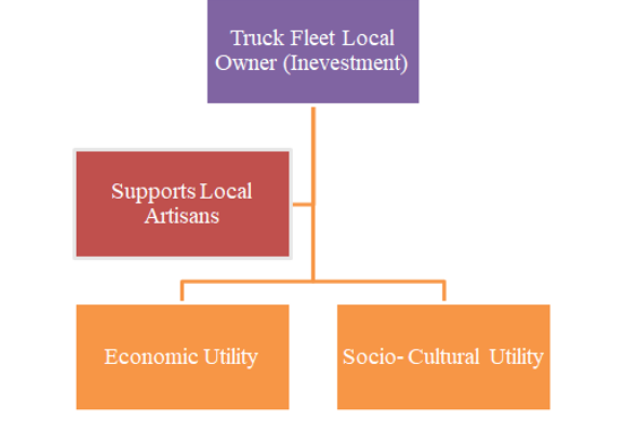
The survival of the “Horn OK Please” is deeply intertwined with the economics of the mural and local paint industry. First of all, it supports the local artisans, as every major highway has its own designated hubs where generations of hand painters make their entire livelihood by decorating these trucks. A full custom job can cost between 15,000 INR and 60,000 INR ($200-$600 USD).
Second of all, to a truck driver, their vehicle is their primary asset and a literal home on wheels for months at a time. Hence, a well-striking, painted truck commands respect on the highway, deters police harassment (as it looks well-maintained and professional), and significantly holds its resale value in the commercial vehicle market in comparison to a rusted, plain chassis.
Highway Folklore and Urban Legends
Driving through pitch-black, poorly lit national highways for 18 hours straight takes a psychological toll. Decades of exhaustion have birthed a distinct subculture of paranormal highway lore surrounding the "Horn OK Please" trucks.
The Hitchhiking Woman in White (Chudail)
It is the most famous highway legend of India. It involves a woman who is dressed in a pristine white saree standing by desolate stretches of road, such as around the NH8 or lonely forest routes in Central India, past midnight. The legend basically says that if a lone truck driver passes her without looking, violating the psychological "Horn Please" rule of alerting the spirits of the road, she will then appear sitting in the empty passenger seat next to them, or clinging directly to the tailgate over the painted "OK" sign, causing the vehicle's engine to overheat or steering to lock up entirely.
Ghost Truck of Naneghat
There is a deeply widespread story among long-haul drivers in Western India, whispered in hushed tones when interacting with each other during lunch hours. It involves an old, rusted supply truck allegedly belonging to the World War II era that reportedly drives the mountain passes without any headlights. In this legend, basically, drivers claim that if you approach this phantom vehicle from behind, its "Horn OK Please" sign glows with a green, eerie supernatural light despite having no physical bulb. Drivers who aggressively honk in order to overtake often find themselves driving straight off the cliffside—the phantom truck vanishes into thin air, leaving behind only a faint scent of burning kerosene.
Citations
- How Horn OK Please Became Deeply Iconic in India’s Road Culture
- What is the meaning of the famous slogan "Horn OK Please" written behind Indian trucks? Mystery unveiled | - Times of India
- Horn OK Please: A History
- https://www.motorbeam.com
- Horn OK Please - Wikipedia
- 'Horn OK Please' Banned for Trucks in Maharashtra
- No more ‘Horn Ok Please’ on trucks, tempos: State | Mumbai News - The Indian Express